15 Bathroom Staples That Vanished Quietly After 1970
The American bathroom of 1970 had a specific inventory, and if you grew up in one, you could find everything in it blindfolded.
Not because it was well-organized. Because it never changed. The same pink cake of soap sat in the same soap dish for years. The same bottle of Listerine -- the original brown kind, the kind that tasted like it was trying to punish you -- stood in the same corner of the same shelf. The bathroom was a room of habits, and the habits were durable. You knew where everything was because it had always been there and always would be.
Most of it is gone now. Here are fifteen things that used to live in every American bathroom and quietly stopped.
1. The Pink or Blue Tile That Went Floor to Ceiling
Not an accent wall. Not a tasteful border. Floor to ceiling, corner to corner, in colors chosen sometime around 1955 and then lived with for the next forty years. Bubble-gum pink was the most common. Seafoam green ran a close second. Powder blue showed up often enough to count as its own category.
The tile itself was solid. It did not crack, it did not fade, and it sealed the walls against moisture better than the drywall that replaced it. The problem was the color. Nobody in 1985 wanted a pink bathroom. Nobody in 1995 wanted one either. The tile came out by the boxful, often before the house changed hands, hauled to the curb and replaced with something neutral and beige and forgettable.
The honest note: the pink tile was not better. It was just indestructible, which is a different thing.
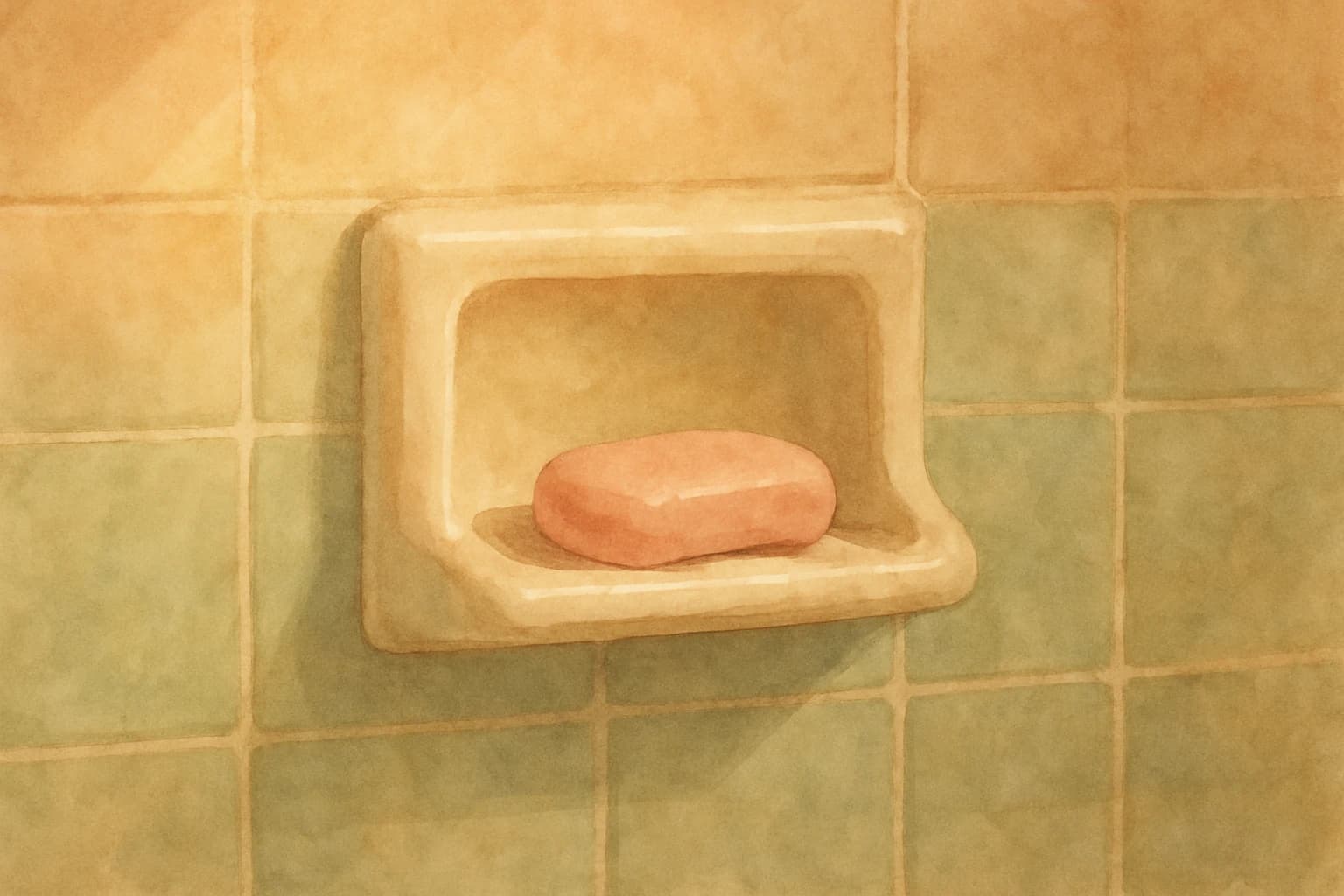
2. The Soap Dish With the Cake of Soap
A fixed soap dish, set into the wall above the sink or the tub, holding a bar of Ivory or Dial or Camay. The bar got used down to a sliver, and then somebody pressed the sliver against the new bar until they fused together. Every household had a method for this. Every method was slightly different, and everyone believed their method was correct.
3. The Medicine Cabinet With the Blade Slot
Standard medicine cabinets of the era came with a narrow slot at the bottom, labeled for the disposal of used razor blades. The idea was that the blade would fall into the wall cavity and disappear. If you've ever renovated a house built before 1970, you know where those blades actually went: they piled up inside the wall for decades, and when the wall came down, there they were. Some contractors have pulled out hundreds of blades from a single bathroom wall.
The slot was a design idea that made sense on paper and created a genuinely strange archaeological record inside the walls of half the houses in America.
4. The Water Glass in a Holder
A single glass, mounted to the wall beside the sink, used by everyone in the household for rinsing after brushing. Sometimes it was a real glass glass. Sometimes it was the little waxed paper cups in a dispenser. But the permanent glass in the permanent holder was the more common setup in the early part of the decade.
At some point, dentists started pointing out that a shared glass used daily by multiple people and rarely washed was roughly as sanitary as everyone sharing a toothbrush. The wall-mounted glass disappeared fairly quickly after that.
5. The Rubber Bathmat With the Suction Cups
Stuck to the bottom of the tub, usually in white or pale yellow, with a grid of suction cups underneath that theoretically kept it in place. In practice, the suction cups lost their grip on the porcelain over time, and the mat would shift underfoot. You peeled it up occasionally to find a colony of mildew that had been developing since the Eisenhower administration.
It was still there in most bathrooms because the alternative was falling. The mat stayed until it disintegrated or until someone threw it out in disgust and replaced it with an identical one from Kmart.
6. Listerine in the Original Brown Bottle
Amber-colored, almost medicinal in its presentation, and it tasted like exactly what it was: something antiseptic. The formula was developed in the 1870s as a surgical antiseptic, and the flavor had never really moved on from that origin. You used it because the bathroom had always had it. The idea that mouthwash could be mint-flavored or orange-flavored or in any way pleasant had not yet arrived in mass-market form.
7. The Scale With the Dial
A bathroom scale with an analog dial, the needle swinging to your weight when you stepped on it. The dial had a red line you could set to your goal weight. Many people set it and then looked away from it for years.
These scales were inaccurate in a relaxed sort of way. They gave you a general neighborhood rather than a precise number. Whether this was a flaw or a feature depended on your relationship with the number.
8. Avon Bottles on the Back of the Toilet
The decorative kind, shaped like cars or animals or historical figures, filled with perfume or cologne. Your grandmother had them. Your mother had a few. They appeared in bathrooms across the country through the 1960s and 1970s, accumulating on the back of the toilet tank or on a shelf above it.
The Avon representative who had sold them to your mother or aunt was a real figure in the neighborhood. The bottles were purchased as much to support her as for the product inside. Once the perfume was used or evaporated, the bottle stayed as decoration, because it was pretty and because throwing away something you paid for felt wrong. By 1980 most bathrooms had a collection of empty decorative Avon bottles that nobody knew what to do with.
9. The Electric Razor on the Sink
Plugged in, sitting in the cradle that came with it, taking up the corner of the vanity nearest the outlet. The cord was just long enough to reach the face of a man standing at the sink. Norelco was the dominant brand for much of the decade.
10. Brylcreem or Vitalis on the Shelf
Hair products marketed specifically to men, in actual containers that sat in plain sight. Not hidden. Not kept under the sink. On the shelf above the sink or on the back of the toilet, next to the Aqua Net that belonged to his wife. The bathroom shelf was the medicine cabinet's overflow section, and it held everything that didn't fit inside the cabinet, which was most things.
11. The Towel Rack With the Embroidered Guest Towels
Decorative towels, hung over a rack, never to be used. The same logic as the formal living room applied here: there were good towels and there were everyday towels, and the good ones were for guests who never came, or who came and were too polite to use them. In some houses the guest towels had embroidered edges or little cross-stitched flowers. They stayed on the rack for years in perfect condition, while the everyday towels got thin and soft in the actual linen closet.
12. A Heating Vent in the Ceiling That Doubled as a Fan
The exhaust fan and the heat vent were sometimes the same unit, a combined fixture in the ceiling that ran on two separate switches. One switch turned on a heater that blasted hot air downward. The other ran the exhaust fan. The heater function worked well for the first two minutes you were in the bathroom, which was generally not enough time for most purposes.
13. A Box of Bandages in the Medicine Cabinet
Not a first-aid kit. A box. Standard-size Band-Aids in the cardboard box they came in, not the resealable plastic tins that came later. The box was usually damp around the edges from the bathroom humidity. The adhesive on the older ones at the bottom of the box had sometimes given up entirely.
14. Mercurochrome or Merthiolate for Cuts
Orange-red and brighter than blood, applied with the little glass wand applicator built into the cap. It stained skin for days. It stained clothes permanently. It hurt considerably less than iodine, which was the main thing in its favor, and that was enough to make it the first-line treatment for childhood scrapes throughout the 1960s and into the 1970s.
Both were quietly removed from American store shelves in the 1990s after the FDA raised concerns about mercury content. They did not go out in a blaze of attention. They were simply there one decade and gone the next, replaced by hydrogen peroxide and Neosporin, which are better in every measurable way but which lack the particular ceremony of the orange-red wand.
15. A Wall Calendar From the Insurance Agent or the Hardware Store
Often it was the pharmacy's name at the top, or the fuel oil company, or the local John Deere dealer. It hung on the back of the door or on the wall beside the mirror, given away free at the start of the year as a piece of advertising, and kept because a calendar is useful. Appointments were written on it in pencil. A family's year was partly recorded there, in the margins of a calendar printed by someone selling something else.
A note on what isn't worth missing: the shared water glass, the mildewed rubber mat, the mercury in the medicine cabinet. The bathroom has genuinely improved as a room. The materials are better, the hygiene practices are better, and the color palette has recovered from the pink-tile years. None of this is wrong.
What went with the old inventory was a kind of settled permanence -- the sense that the bathroom held the same things it had always held, and would hold them indefinitely. The Listerine was there because it had always been there. The guest towels would outlast the house. The Avon bottles would stay until someone decided what to do with them, which meant they would stay forever.
The contemporary bathroom is more curated, more intentional, and easier to clean. It just doesn't feel like it's been there since before you were born. That steadiness is what the pink tile was really holding onto, and the pink tile is long gone.
Did your parents' bathroom have any of these? What's the one thing you remember most clearly from the medicine cabinet? Let us know in the comments -- we read them all.
Get a new story every Sunday morning.
One email a week. No spam. Unsubscribe anytime.
If this brought back a memory, you might also like
The Condensation Ring Left by the Aluminum Cup
Tap water and ice made the outside cold enough to leave a ring on the table, changing the taste before the liquid ever touched your lips.