10 Sounds the American Kitchen Made Before the Sun Came Up
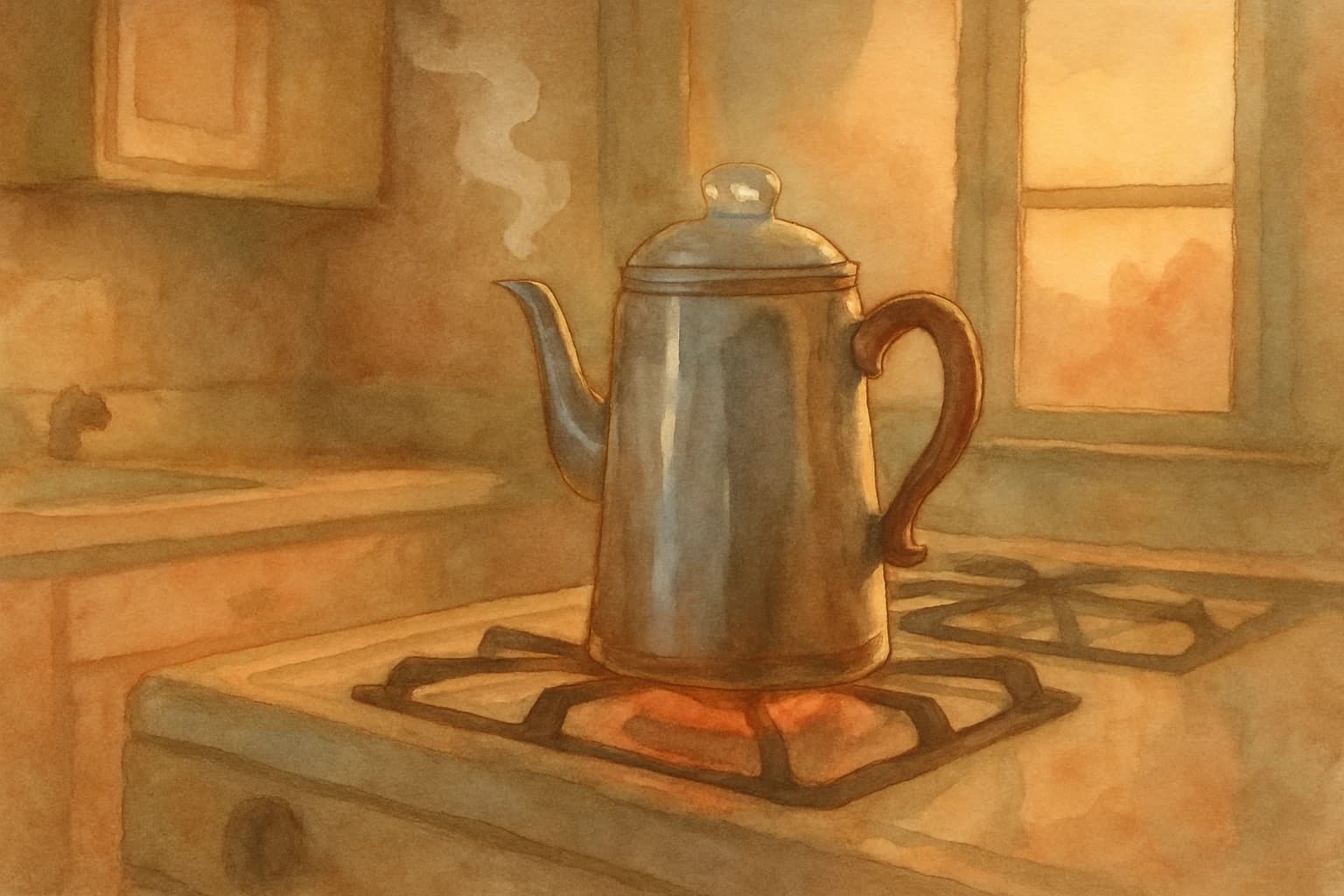
The percolator chugged its eight-minute climb while the house slept. You heard the old fridge's heavy suction through the wall before anyone else woke.
Stories from a slower time
The percolator chugged its eight-minute climb while the house slept. You heard the old fridge's heavy suction through the wall before anyone else woke.
Inside the blue Royal Dansk tin, the cookies were gone by Christmas week, replaced by loose buttons and a spool of thread that stayed for decades.
You watched the wildlife documentary, the bowling tournament, and the 1948 film, because changing the channel meant walking across the room to turn the dial.
You heard the diesel cough rattling down the block and the sharp hiss of air brakes before the bus was even visible, marking the time left before standing at the driveway.
The trays lived in a narrow gap behind the closet door, waiting for the four distinct clicks that turned the living room into a restaurant for one night.
A worn brass key that might open a lake house sold in 1988 and a half-used roll of tape that once held a screen door hinge for six years.
Kids walked around with orange-tinted elbows from Mercurochrome, while a glass thermometer required three minutes of silence under the tongue.
The manager who was already tired at twenty-three never explained why arriving at nine meant you were late, or that they judged you on how you folded towels in the empty hours.
In a house with windows that didn't quite seal, the cold was a guest that walked into the kitchen if you let it, forced back only by closing the door in under three seconds.
You ran hot water over the frozen bottom or risked spraying the counter, knowing a butter knife would scratch the tray and your mother's warning about slipping blades.
A rubber tray caught the March mud while a row of mismatched boots waited for owners who had long since grown, and a Folgers can held nails nobody remembered using.
The cheese never reached the corners of the square pizza, and the gravy turned the Salisbury steak into wet cardboard, yet no one ever asked what part of the cow it was.
A coffee can with a foil lid sat on the stove's edge, collecting hot fat that would later spoon into cast iron to fry eggs and bake cornbread.
The album smelled of old paper and curing adhesive, holding blurry photos of a 1977 bad haircut and a mother's straw hat from a South Carolina gas station.
A low, rhythmic jiggling like a coin in a cup meant dinner was underway in a serious way, locking the family in for at least forty-five minutes of steam.
Concrete floors worn thin by decades of mopping and wringer rollers that could take a finger off defined a space built for work, not comfort.
The damp sponge in a margarine lid sat beside the book as you licked each stamp, pressing them into squares to count the slow arithmetic of a full page.
From the original brown Listerine that tasted like punishment to bubble-gum pink tiles running floor to ceiling, these familiar fixtures have quietly left the American home.
Tap water and ice made the outside cold enough to leave a ring on the table, changing the taste before the liquid ever touched your lips.
The soap bottle drained upside-down over a fresh one to save every drop, leaving a permanent ring on the four-inch ledge where the household's unsung history gathered.
The sharp industrial smell of chlorine announced the summer before you saw the water, while the concrete deck radiated heat through the thin rubber of your sandals.
Handwritten signs with arrows pointed toward driveways by seven-thirty, marking a quiet economy built on bread makers, ice skates, and fondue sets used twice.
He knew you took sliced rye, not round, and that buying motor oil meant your husband had sent you to get it right.
Creases ran in four directions, erasing small county roads into white space where you guessed or found another way before the engine even turned over.
The air was cooler and smelled of long-stored soil when you opened the heavy door to find the bare bulb swinging over jars of August tomatoes and bins of turnips.
You knew she kept a handkerchief in her apron to wipe her hands before touching good blouses long before you ever sat in her kitchen.
The skeleton of the Ferris wheel rose in sections by the highway, and a rubber mallet struck steel to ring a bell that rarely sounded.
By noon the jelly had soaked through to the soft side, and if it was a warm September the bag had even sweated, yet the bologna with yellow mustard still tasted like home.
You stood in the coat while she held your face to the window light, checking for pale skin before you were ever allowed to sit down.
Everything inside was slightly too warm from the sun and grayish with road dust, waiting for a flat tire or a nosebleed.
A rusting Maxwell House can held every screw removed since the Eisenhower administration, requiring a four-minute dig to find the exact 5/16 bolt you needed.
Whatever vegetables had gone soft and whatever broth hid in the back of the cabinet went into the pot, simmering alongside sandwiches pressed in an iron skillet.
Your mother knew a child was rushing without looking up, hearing the spring bounce twice as it hit the frame.
A brown ring where vanilla or coffee once pooled, and a firm 'NO' written beside a step that still carries the conviction of forty years ago.
You could walk down the middle of the still-wet sidewalk without explaining yourself, or sit on a porch step that was almost dry for fifteen minutes.
Inside twenty-four hours of the new arrival, the old book moved to the toilet rack to be cut into paper furniture and standing toys for the children.
The peanut butter sandwich arrived warm by ten, and the loose banana was already bruised by the time you reached the driveway where Schwinn wheels were circling.
Inside a hard-sided olive green suitcase sits a folded tourist map of a city the traveler may never see again, a paper bag from a restaurant long gone.
A half-finished coloring book records the boredom of long trips, while a single dime waits under the floor mat, lost and found by turns.
The air held the dry, white scent of chalk dust that settled into the eraser felt and the heat of a radiator that had run through the night.
The sharp chemical note of fresh erasers and the flat wood smell of unsharpened pencils told you summer was over before you even reached the checkout.
The spine was cracked from use, and pencil marks in the thin, onion-skin pages left a trace of every word looked up by hand.
Your grandmother set a folded dish towel in her lap like a prop, closed her eyes 'for a minute,' and breathed through her nose for twenty-five minutes.
Before a word was spoken, the dented tin pail on the workbench told a story through its shape and the calluses of the man who carried it.
The cardboard flaps were tight, the wrappers unpeeled, and the tips sharp in a way that exists only before the first stroke touches paper.
The music came from three blocks away, giving you just two minutes to find your mother, negotiate, and reach the curb before the truck drove past.
You had to know the math worked out before you reached the counter, where amber Root Beer barrels sat next to jars with no signs at all.
Past the melted plastic worms and tangled hooks lies the stratum of a cracked bobber and loose lead shot that nobody ever threw away.
A concrete floor held a cast-iron wringer washer that never moved, while a single pull-chain bulb cast light on the deep, ugly utility sink.
A late-morning creak meant father returned from mowing, while the repeated dusk slams signaled the neighborhood rearranging itself for dinner.
It held a card table leaning against the wall and National Geographics from the Kennedy administration, kept because discarding them felt like a sin.
You negotiated for one and a half sheets of yellow tickets in the parking lot, knowing your father would hold the rest until you needed more.
A torn notebook page sits under a magnet or beside the fruit bowl, telling you to defrost dinner if you get home after six.
Before the catalog, a farm wife in Nebraska knew only two shades of housedress; the catalog showed her twelve colors and a ratchet set of forty-six pieces for less than a quarter of the town price.
His coffee went cold on the side table while the newspaper stayed folded, as he sat in the corner doing nothing but resting his mind on nothing in particular.
A pencil note asking for free beer was written in the margin and then erased, a quiet exchange that summed up how the whole office operated.
You ate when she ate and sat in a chair on Tuesday mornings while she went to the beauty parlor, never complaining as you lived inside her daily rhythm.
He adjusted the carburetor with a screwdriver and filed worn distributor points for a dollar fifty before noon.
You knew what Tuesday smelled like: cast-iron salmon patties frying with crumbled crackers and an egg.
You can still walk through the doors, but the third-floor lunch counter where a grilled cheese and a Coke cost less than $1.50 is gone.
He left at sixty-two with a gold watch and a pension check that arrived on the first of every month until he died, a fixed promise for decades of steady work.
The line-end bell was a real brass ring that carried through the house, warning you that the margin was nearly gone before you even looked down.
She brought a casserole in her own dish, marked with masking tape on the bottom, knocked once, handed it over, and left without staying for a visit.
They didn't post their anniversaries online; they just kept separate drawers in the dresser and sat down at the table most nights while the day stopped being separate.
A tall can of pink salmon sat in every pantry in 1965, turned into twenty-minute patties for sixty cents, then quietly disappeared when the weeknight rotation changed.
A heavy plastic key fob designed to be mailed back and an AC unit that was either off or loud defined the roadside motel before it vanished.
Standing in your own driveway, you hear yourself say something and realize it wasn't yours first, but a habit inherited from a generation that knew how to make do.
A brittle newspaper clipping and a neighbor's handwriting from 1954 are tucked behind the divider, waiting in a system only the family understood.
He spoke while sharpening a blade or riding a truck that smelled of dog and diesel, offering wisdom that wasn't framed as advice but as the next thing that needed to be said.
The oven hummed at nine for a one o'clock meal, while the half-onion lay flat to caramelize in a pan that let the meat breathe.
A brown bottle of ammonia with a warning label everyone ignored, and a simple spray of vinegar that leaves no film on the glass.
On a slow Tuesday with only five kids, you called ground-rule doubles for right field and argued the fair ball call until a compromise was reached.
She kept the wooden spoon in the second drawer on the left since 1958, and a single pound of baking soda handled everything from grease fires to bee stings.
The paper arrived between three and four, creased into thirds and tucked tight, ready for a toss that kept it from opening mid-air onto a wet lawn.
From the hard hits of full-contact tag to the collective tackling of British Bulldog, these unstructured playground rituals would land a child in the principal's office before lunch.
Glass bottles sat on the porch step cold from the night air, left by a man you never saw but who arrived before you woke up.
The smell of sawdust on hardwood floors and cheap candles near the front followed you through aisles of fresh rubber erasers and candy weighed by the piece.
A doctor in a suit sat on your bed with a glass thermometer, and you could board a plane with just your name and no security checkpoint.
While 'understand' feels clinical, 'dig' implies earned comprehension, and 'bread' tethers money to rent and groceries rather than stock portfolios.
You knocked on the back door, not the front, holding out a dented saucepan for chicken broth or two eggs in a transaction that required no written agreement.
He went around to the front to lift the hood, checked the oil with a rag from his back pocket, and wiped the windshield in two methodical strokes.
The dish came out of the oven in the same pan it had been built in, set on a trivet with the serving spoon already resting inside, requiring zero ceremony.
From a coffee can of hand-straightened nails to plywood wedged against the fence, kids constructed leaning, collapsing structures without a single instruction manual.
A folded, used paper towel tucked away because it still had something left, and a stubby pencil with an eraser worn down to a hard, useless nub.
A counterman squeezed maraschino syrup into a glass of carbonated water, serving a drink that tasted nothing like the canned kind on the marble counter.
A third-grader served as the unofficial commissioner of Four Square, while Marcus ran full speed at a chain of locked hands to break through or join the other team.
The faintly medicinal scent of canning supplies and sweet sugar dusted on paper bags greeted you before you even opened the pantry door.
You had to duck under a Duran Duran poster to knock, and recorded radio songs by pressing play and record while hoping the DJ stayed silent.
Two fingers lifted briefly from the steering wheel, tilted upward then down, lasting only half a second to buy a piece of local goodwill on a gravel road.
Layered chocolate wafer cookies sat overnight in an icebox, absorbing cream until they sliced like cake, a technique lost when the wafers vanished from shelves.
You carried a laminated card in a wallet next to nothing else important, crossing four blocks by yourself with a canvas bag to return an hour later with six books.
You watched the glass knob on the percolator turn dark to know the coffee was done, while a ring mold for gelatin salads hung on a nail near the stove.
A dollar in 1975 bought a lot more than people remember. Not just more stuff. More of a life. A gallon of gas with change back. A movie ticket. A McDonald's meal.
Listen to your house right now. You'll hear a hum. The fridge, the HVAC, the charger, the router. In 1968, a quiet house was actually quiet. The clock ticked. The radiator clicked. That was it.
Your father had fewer phrases than your mother, and they hit harder. He didn't repeat himself, because he didn't need to. Once was enough.
We had a room nobody was allowed to sit in. The good furniture, the plastic on the couch, the lamps you weren't allowed to touch. You walked through it to get somewhere else.
The housecoat hung on the back of the bathroom door. She put it on before the coffee and took it off before company came. It was the uniform of a life lived mostly at home.
It hit the porch with a thump every October. Four pounds of everyone in town, listed alphabetically, with their home address and phone number. You could find anyone.
There was a stack on the coffee table that never moved. Reader's Digest on top, National Geographic underneath with the yellow spines facing out, TV Guide somewhere in the middle.
Saturday morning was the lawn. Every man on the block knew it. The mower started by nine. The edging was done by ten. The conversation over the fence about fertilizer lasted until eleven.
The DJ said the words and every married couple over forty stood up at the same time. They didn't need to be asked twice. They already knew the song.
He came up the walk on foot every weekday around two in the afternoon. He waved. You waved back. His name was Walter, or Gene, or Frank. You knew it because he'd been coming for fifteen years.
The parade started at ten in the morning and ran six blocks down Main Street. Most of the town was there. The rest of the town was in the parade.
Hundreds of you wrote back with the phrase your own grandmother used. We read all of them. We cried at some. Here are ten more.
It came in a cardboard sleeve and it burned the roof of your mouth. McDonald's just brought back the fried apple pie for the first time in 34 years.
The car was packed the night before. You woke up at four in the morning. This is how American families took a vacation, and it is mostly gone now.
Your father did not announce his work. He just did it. By the time you noticed, it was done. You grew up assuming the things had taken care of themselves.
Your grandmother's freezer was not for ice cream. It was for emergencies, unexpected company, and grandchildren who showed up hungry.
Sound traveled differently when the windows were open. The whole neighborhood was a single shared acoustic space, and you lived inside it.
Summer used to have a soundtrack. Not a playlist, not a song. A real ambient track that ran from June to September. You only noticed it was gone after years.
The thump came around six in the morning. The Sunday paper occupied a whole morning for tens of millions of families. It has thinned to almost nothing.
If the 1970s would get you arrested, the 1980s would get you sued. The decade was a victory lap for American carelessness, and the lawyers hadn't gotten busy yet.
A card table on the front lawn. A pitcher of Country Time. A handwritten sign in crayon. Twenty-five cents a cup. They are mostly gone now.
Smell bypasses everything and goes straight to where childhood is kept. One whiff and you're eight years old again, and she is alive.
He came home at 5:45. He didn't say much about his own day. A lot of American fathers were like this. What was inside them died with them.
Open the second drawer down in any American grandmother's kitchen between 1955 and 1990, and you would find roughly the same collection of objects.
The garage was your father's room. Every American garage in 1975 had roughly the same ten objects in it. Some of you can still smell the room.
He loaded his pockets every morning the same way for sixty years. A pocketknife, a handkerchief, a few coins. You could reconstruct most of who he was from what he carried.
The yard was a room. The whole neighborhood spent the hottest hours of the day in the open air, because the alternative was an oven.
The roast went in before church. By the time you came home, the whole house smelled like Sunday. For most of the twentieth century, this weekly ritual was the single fixed point holding families together.
The wood paneling wasn't actually wood. It fooled no one and was beloved anyway. Eighteen feet long, a V8 that drank gas like it was free, and a third-row seat facing backwards.
The prize was the reason you wanted the cereal. The cereal was just a vehicle for the small plastic object buried somewhere inside the box.
The rack stood by the register, a wire carousel six feet tall. You were on vacation. The postcards were ten for a dollar. You picked out six.
He came before dawn. You heard the clink of glass bottles on the porch, the milk truck starting again half a block away. Then he was gone, and there was milk on your step.
They've been married fifty-six years. He pours her coffee without being asked. She pushes the cream toward him without looking up. Here's what the long-married generation knew about staying together.
The phone rang at six on Sunday evening. Everyone knew who it was. She called every Sunday at six, because the rates dropped after six on weekends.
You came home when the streetlights came on, because that was the deal the whole neighborhood had agreed to. That deal is gone now. There may never be another generation like ours.
She snapped the sheet once, threw it over the line, and pinned it with two clothespins from her apron pocket. There was a rhythm to it that most of us have never learned.
The folding tables came out at nine. By eleven they were full. Tuna casseroles, fried chicken, Jell-O salad with mandarin oranges. The food was the excuse. The community was the point.
Made from what was in the pantry, what was on sale, and what was left over from Sunday. These Depression-era recipes cost almost nothing, fed the whole family, and tasted better than half of what we eat now.
The industry buried vinyl twice. The kids were never supposed to go back. Then vinyl revenue surpassed $1 billion in 2025, the first time since the 1980s, driven largely by Gen Z buyers.
Saturday had a shape. You knew, without checking anything, roughly what the day held, because Saturday in 1975 followed a pattern most families understood.
The creak of a wooden swing, the slap of a screen door, neighbors talking in the evening air. The American front porch has been disappearing for fifty years, and most of us didn't notice.
Main Street is half boarded up, the population sign is weathered, and the grocery store closed in 2014. But somebody is fighting very hard to make sure these towns don't disappear entirely.
The bell over the door, the waitress who knew your name, the booth with duct-taped vinyl. There used to be a diner within ten minutes of everywhere. Now there's barely one within an hour of anywhere.
Your grandmother had a stationery drawer and wrote thank-you notes within three days of receiving anything. We hated it as kids. We were also being handed one of the most powerful small skills in adult life.
For fifteen years, a generation of children grew up unable to read their own grandmothers' letters. Now nearly half of U.S. states have passed laws to bring cursive back to schools.
We rode bikes without helmets, drank from garden hoses, and rode in the beds of pickup trucks. Here are 23 perfectly normal things from the '70s that would land you in serious trouble today.
The town gathered at the cemetery at ten in the morning. That start has mostly fallen away. The cookouts and the mattress sales remain.
Your grandfather could fix almost anything with what was already in the garage. No YouTube, no service calls, just a workbench, good tools, and patience. Here are 12 skills worth reclaiming.
There's a moment, somewhere around age thirty-five, when you say something to your kid and stop, slightly horrified, because you just heard your mother's voice.
We rolled our eyes at Grandma's sayings when we were young. Now we're starting to understand the quiet wisdom hiding inside phrases like 'this too shall pass.'