The Last Icebox Cake
Dessert used to be a statement.
Not a fancy one. Nothing that required a pastry degree or a kitchen scale or ingredients you had to order online. But a statement nonetheless -- that the meal was worth finishing, that the table was worth sitting at a little longer, that whoever made the thing had thought about you when they put it together. The desserts on this list didn't come in boxes with glossy photographs on the front. Most of them required time and a certain confidence, the kind that builds up over years of making the same thing until it comes out right.
They're mostly gone now. Here's what they were.
1. Icebox Cake
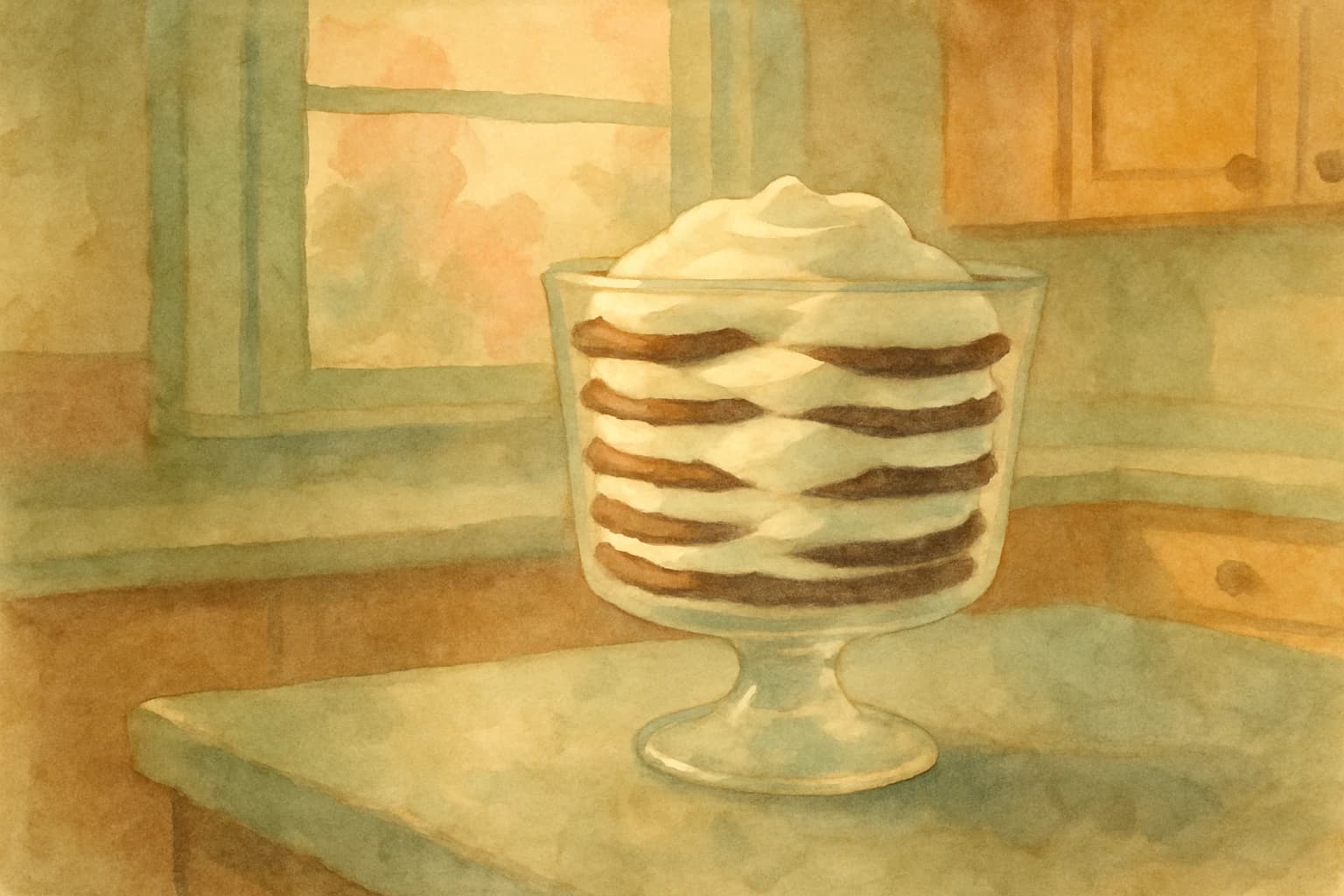
The name is the first thing to understand. This cake did not go in the oven. It went in the icebox, which is what your grandmother called the refrigerator even in 1975, because that's what it had been called for the first forty years of her life. You layered chocolate wafer cookies with whipped cream, stacked them into a log or a round, and let the whole thing sit overnight until the cookies absorbed the cream and softened into something that sliced like cake. No baking. No frosting. The technique was the recipe.
Nabisco made the chocolate wafers for decades, and the recipe was printed right on the box. When Nabisco discontinued the wafers around 2023, the icebox cake became effectively impossible to make in its original form. People have tried substitutes. None of them are quite right. The cookie was doing particular structural work, and the cookie is gone.
2. Charlotte Russe
A Charlotte Russe was a cold dessert built inside a ring of ladyfinger cookies standing upright around the edge of a mold, with Bavarian cream or whipped gelatin poured in the center to set. When you unmolded it onto a plate, you had something that looked like it required skills nobody in the family had claimed to have.
It was popular from roughly the 1890s through the 1950s, showed up in women's magazines and community cookbooks, and then faded as the desserts it competed with -- Jell-O molds, then elaborate layer cakes, then store-bought pie -- became easier. Making a Charlotte Russe required advance planning, a mold, and ladyfinger cookies, which were not always easy to find depending on where you lived. The degree of difficulty won out eventually. Desserts that require advance planning and specialty equipment lose the weeknight war.
3. Prune Whip
One paragraph, because the name says everything that needs to be said about why this one disappeared. Prune whip was stewed prunes folded into meringue or whipped egg whites and chilled. It appeared in American cookbooks from the 1900s through the 1950s. It was genuinely popular. People made it without embarrassment because prunes were a normal, unloaded ingredient in an era before the word "prune" became a punchline. The thing disappeared not because the recipe stopped working but because the ingredient became culturally impossible. You could call it "dried plum whip" now and get a different reception, but nobody has.
4. Stack Cake
This is an Appalachian dessert, and if you grew up in Appalachian communities you may know it as something still made at church gatherings or family reunions. Outside that region, most Americans have never seen one.
The stack cake was built from thin, dry gingerbread layers -- sometimes five, sometimes eight -- stacked with a spiced dried apple filling between each one. The whole thing sat for a day or two before serving, the filling softening the layers into something that sliced clean and tasted nothing like gingerbread alone or apple butter alone. It was traditionally made for weddings, with neighbors each bringing a layer, the final height of the cake signaling how many people had come together to make it.
The recipe is not hard. The technique is not obscure. It disappeared because Appalachian foodways lost their audiences as communities thinned and moved, and because the dessert requires the particular step of waiting -- no shortcuts, no microwave, no way to rush the layers.
5. Syllabub
Colonial American tables knew syllabub, and for a long time so did the tables that came after them. You whipped cream with sugar and wine or cider until it was thick and frothy, then served it in small glasses. Sometimes you layered the cream on top of the wine and let the separation happen slowly. It was a dessert, a drink, and a centerpiece simultaneously, and it required nothing but the ingredients and an arm willing to whip.
It faded with the temperance movement, which made wine on the dinner table complicated in certain households, and then again with Prohibition, and it never fully came back. The electric mixer arrived just as syllabub was leaving, which is a small irony -- the tool that could have made it easier arrived at the moment the cultural context for it was gone.
6. Lane Cake
Lane cake is a Southern layer cake filled with a boiled mixture of egg yolks, sugar, butter, raisins, pecans, and bourbon. It shows up in To Kill a Mockingbird. In the novel, it's significant enough to cause neighborhood gossip over its liquor content. That tells you something about what the cake meant in its place and time.
It's an involved cake. The filling has to be cooked to the right temperature. The layers have to be handled carefully. The bourbon has to be present but not overwhelming. Done right, it is one of the genuinely great American cakes -- dense, complex, not too sweet, with a filling that holds its flavor over several days.
It's mostly gone because it's hard, and because the regional culture that passed the recipe from one generation to the next thinned out the way regional food cultures tend to when people move and marry outside the tradition and nobody writes the recipe down in a form the next person can follow. The Lane cake is documented enough that you can find good recipes. Making one is worth the afternoon.
7. Lemon Snow Pudding
Lemon juice, gelatin, and beaten egg whites produced a dessert that was exactly what the name says: cold, white, light, and tart in a gentle way. A custard sauce poured alongside. A clear glass dish to serve it in so the color showed.
It was summer food for households that didn't have air conditioning, because it was cold and it was light and it took no oven time. The refrigerator did the work. When air conditioning arrived in American homes through the 1960s and 1970s, the logic of the no-bake summer dessert weakened slightly. You could bake a cake in July now without making the house impossible. The lemon snow survived into the 1970s in old ladies' recipe boxes, then started disappearing with the old ladies.
8. Apple Brown Betty
A Brown Betty is not a crisp and not a cobbler. It's layers of buttered bread crumbs and sweetened fruit, baked until the crumbs absorb the fruit juices and the top gets dark and almost caramelized. The bread crumbs are the point -- they give it a density a crisp doesn't have, and a different kind of chew.
The Apple Brown Betty appeared in American cookbooks starting in the 1860s and stayed through the mid-20th century, then lost ground to the apple crisp, which is similar in concept but swaps oats and butter for the bread crumbs and feels slightly more modern. The Betty is better, in honest terms. The crisp is more forgiving and requires fewer decisions about bread and crumb size, so the crisp won.
9. Floating Island
Poached meringue floating on a pool of vanilla custard. The meringue goes in the poaching liquid -- milk or water -- until it sets, then lifts out and sits in the custard, which was made from the same milk it cooked in. The whole thing is made from eggs, milk, and sugar. The technique is the whole recipe.
French in origin, common in American households through the first half of the twentieth century, occasionally served in good restaurants through the 1970s. The Culinary Institute of America still teaches the technique. American home kitchens stopped making it somewhere around the time the fear of undercooked eggs took hold in public health messaging through the 1980s and 1990s. The poached meringue involves hot liquid but no prolonged high heat, and safety concerns -- whether or not fully warranted -- gave home cooks a reason to step back from the learning curve.
10. Boiled Custard
This is the one most people's grandmothers made at Christmas, in the South especially. A thin, pourable custard of eggs, sugar, and milk, flavored with vanilla and sometimes a splash of something stronger. Served cold in a cup or a glass, not in a bowl. Drunk more than eaten.
The difference between boiled custard and eggnog is mostly a regional vocabulary disagreement and a question of thickness. Southern households called it boiled custard. Northern households called the same concept eggnog or something close to it. The commercial eggnog in the carton is a distant relative of boiled custard in approximately the same way that aerosol cheese is a distant relative of a good aged cheddar.
The homemade version required watching a pot, which is work people stopped doing when the carton became available in every grocery store in November. The carton tastes fine. The homemade version tastes like the holiday was made for you, because it was.
A few of these probably deserve to stay gone. Prune whip is not a battle worth fighting. The syllabub is genuinely better as a curiosity than as an expectation. Certain gelatin-based desserts of the era not listed here were held together by novelty and the sheer force of postwar enthusiasm for convenience ingredients, and they deserved to retire.
But the Lane cake and the boiled custard and the stack cake are a different matter. Those are desserts that disappeared not because anyone decided they weren't good but because the people who knew how to make them didn't have a way to hand the knowledge down before they were gone. That's a different kind of loss, and it's worth naming.
Did your family make any of these? Is there a dessert from your childhood that nobody makes anymore? Share your story in the comments -- we're listening.
Get a new story every Sunday morning.
One email a week. No spam. Unsubscribe anytime.