10 Things Every American Family Did on a Saturday in 1975
Saturday had a shape.
You woke up to it. You knew, without checking anything, roughly what the day held, because Saturday in 1975 followed a pattern most American families understood without ever discussing it. The day was not scheduled, exactly, but it had a rhythm, and the rhythm was the same in your house and your friend's house and your cousin's house in another state.
Here are ten things that happened on a Saturday in almost every American household in 1975, in roughly this order.
1. Cartoons in the morning
The kids were up first. Six-thirty, sometimes earlier. Bowls of cereal in front of the television in the living room. Bugs Bunny, Scooby-Doo, Super Friends, Land of the Lost, The Flintstones reruns. The lineup ran from seven until noon on the major networks.
Your parents stayed in bed until the smell of coffee gave them no choice. Sometimes your father came out in a bathrobe, looked at the television, said something about how much sugar was in the cereal, and went back to bed. Saturday morning belonged to the kids, and the parents tacitly agreed to stay out of the way.
2. Dad mowing the lawn
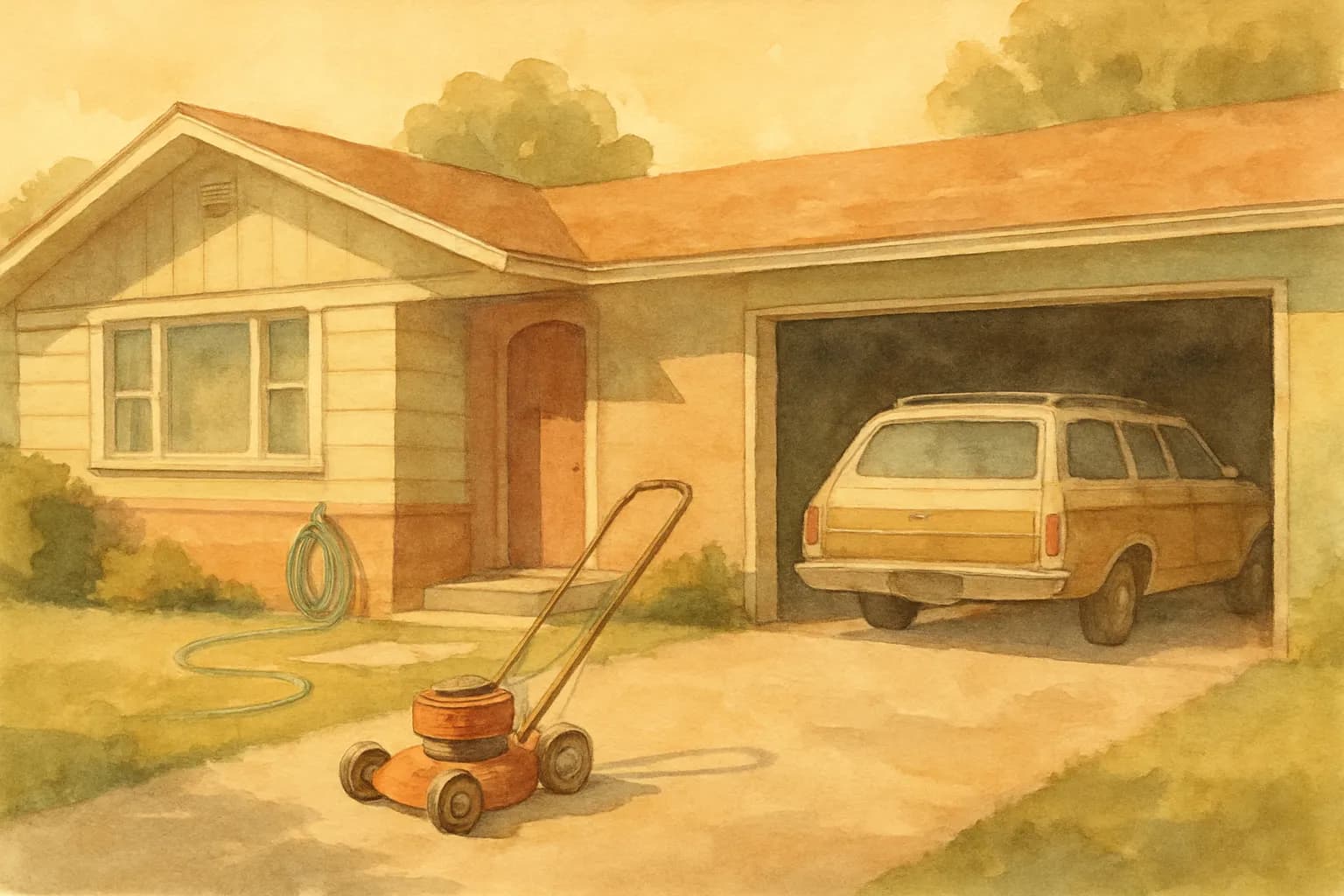
The first thing you heard from outside was the lawn mower starting up. Usually around nine, sometimes earlier if it was going to be hot. The smell of cut grass and exhaust came in through the window, and the cartoons were briefly drowned out every time he passed by.
He took a beer break at the halfway point. He raked or bagged afterward, depending on the year and the mower. The lawn took ninety minutes. By the time he came in for lunch, the whole street smelled like fresh-cut grass, because your neighbor had been mowing too, and so had the guy two doors down.
3. Mom doing the laundry
The washer and dryer ran all day. Saturday was laundry day in most households, because the working week didn't permit it. By breakfast there was a load going. By noon, there were two more.
The laundry was sorted on the floor of the hallway, sometimes the bedroom. Whites in one pile, colors in another, darks in a third, towels in a fourth, sheets in a fifth. Your mother knew the order without thinking. The dryer ran from morning until early evening, and the smell of dryer sheets and warm cotton filled the back half of the house all day.
4. The run to the dump
After lunch, your father took the kids and the trash to the dump.
The dump was an actual destination. You backed the station wagon up to the edge of the pit, your father threw the bags over, and you watched them land on the mountain of trash below. There were seagulls. There was a smell. There were sometimes interesting items thrown away by other people, which your father usually wouldn't let you take, but he would notice them with you and shake his head.
The dump was a small adventure. It was also one of the small ways your father included you in his Saturday, which was the actual point.
5. The trip to the bank or the hardware store
On the way home from the dump, you stopped at the bank, which was open on Saturday mornings until noon, and you stopped at the hardware store, which was open until five.
The bank teller knew your father's name. He cashed a check or made a deposit. The hardware store had a smell of metal and paint and oiled wood that you have not really encountered since the small ones closed. He bought a few specific things he had been thinking about all week: a new washer for the leaking faucet, a particular size of nail, a quart of paint for a project he hadn't told your mother about yet.
You were allowed to walk down the aisles. You touched things you weren't supposed to. The hardware store man called you by your first name and asked how school was.
6. The Saturday afternoon ballgame
The TV was on by one in the afternoon. Game of the Week on NBC, in the years before cable made every game available. You watched the game in the living room with your father, who explained the rules to you, again, even though you'd known them for two years.
He fell asleep in the recliner around the fourth inning. The game played on. You watched it because he had been watching it, and now it was somehow your job to watch it too. Your mother brought him a glass of iced tea that sat on the side table getting warmer because he was asleep.
7. The kids playing outside until dinner
Around three, you went outside. Your friends were already there. You and four other kids organized a game of something — kickball, freeze tag, capture the flag — that went on until somebody's mother yelled for them to come home for dinner.
There was no plan. There was no parent in the yard supervising. There was no schedule. You came home when the streetlights came on, or sooner if you got hungry or hurt. Saturday afternoon was the high point of a child's week, and most American kids in 1975 spent it outdoors, with other kids, doing whatever the group decided to do.
8. The Saturday night bath
Before church on Sunday, the kids got the Saturday bath. It was the long bath of the week, the thorough one, the one where your hair actually got washed and your fingernails got cleaned and the dirt of the entire week came off you.
You went in clean. You came out cleaner. Your mother laid out your church clothes on the foot of the bed. The TV in the living room was on, your parents were watching something, and you went to bed early because tomorrow was Sunday and Sunday started early.
9. The Saturday night dinner that was slightly nicer than weekday dinner
Saturday dinner wasn't Sunday dinner. Sunday dinner was the big one. But Saturday dinner was a step up from the weekday meals. Steak sometimes, if the budget allowed. Spaghetti and meatballs. A roast chicken. A meatloaf with mashed potatoes that took an hour to make.
The family ate together at the kitchen table, not in front of the television. Your mother had been working on dinner for the better part of an hour. Your father had washed his hands at the kitchen sink and was sitting in his usual chair. Everyone was there. The phone was on the wall, and it didn't ring during dinner because nobody called during dinner.
10. The Saturday night variety show or movie
After the kids were in bed, your parents watched television together. The Carol Burnett Show on CBS. Sometimes a movie on one of the other channels. Sometimes the news, if anything was happening.
They sat on the couch with a bowl of popcorn or a couple of beers. They laughed at the same jokes. They talked through the commercials. They went to bed by eleven, because tomorrow was Sunday and Sunday started early.
You didn't know, at the time, that the day had a shape. You just lived inside it. The shape was the same in every house on the block, and in most of the houses in your town, and in most of the American towns of a certain size, on the same Saturday, all over the country.
Saturday in 2026 has no shape. Some people work. Some people don't. Some are running errands at ten p.m., some are awake at four in the morning, some never leave their house, some leave for the weekend on Friday and don't come back until Sunday night. The day no longer has the same structure, in your house or your friend's house or your cousin's house in another state.
Most of us miss it without knowing we miss it. The shape was something we had together. It used to make Saturday feel like a thing we were all doing at the same time.
The shape is mostly gone now. But if you close your eyes on a Saturday morning and smell fresh-cut grass through an open window, you can feel the outline of it, still there, like a path worn into a lawn that nobody walks anymore but that the ground still remembers.
Get a new story every Sunday morning.
One email a week. No spam. Unsubscribe anytime.
If this brought back a memory, you might also like
The Quiet Disappearance of the Front Porch -- and What We Lost With It
The creak of a wooden swing, the slap of a screen door, neighbors talking in the evening air. The American front porch has been disappearing for fifty years, and most of us didn't notice.