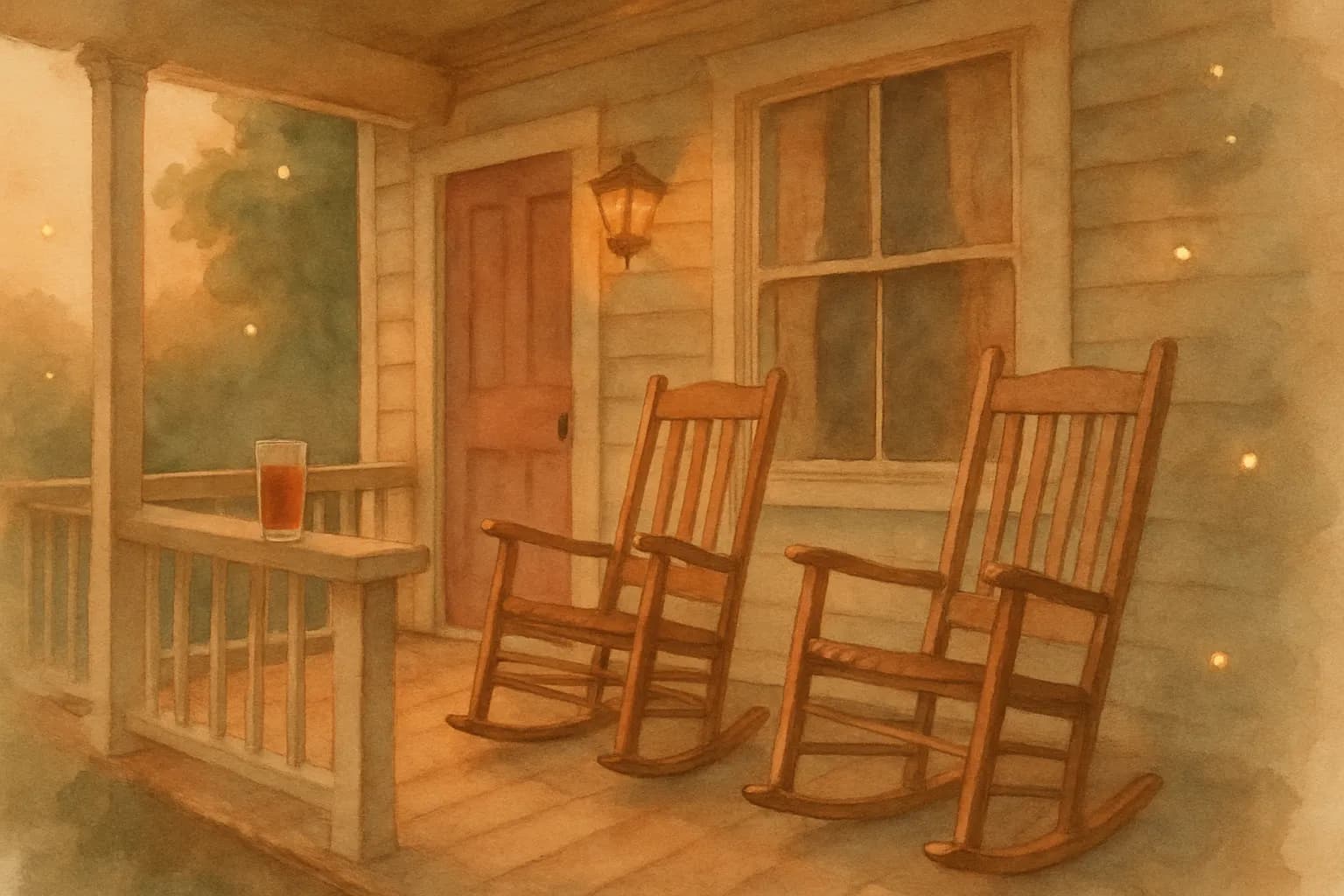
The Quiet Disappearance of the Front Porch -- and What We Lost With It
There was a sound that summer evenings used to make. The creak of a wooden swing on chains. The slap of a screen door. The clink of ice in a sweating glass of tea. Somewhere down the street, a man calling his dog home. And underneath all of it, the low, steady murmur of neighbors talking on their porches.
If you grew up before 1980 or so, you remember it. And if you've driven through a new subdivision lately, you've noticed what's missing.
The American front porch is disappearing -- has been for fifty years -- and most of us didn't notice it happen.
The porch was once the most important room in the house
In the decades before air conditioning, the front porch wasn't a decoration. It was infrastructure. On a hot August night, the inside of a house was an oven. The porch -- shaded, open to the breeze, raised off the hot ground -- was where the family actually lived from dinner until bedtime.
You ate there. You read the paper there. Children did homework on the steps while the adults talked. Couples courted on porch swings, with the door propped open so Mother could hear what was being said. Babies napped in bassinets on the floorboards. When the lightning bugs came out, you stayed put and watched them.
The porch wasn't just shelter. It was a stage, and the whole neighborhood was the audience.
It made neighbors out of strangers
When you sat on the porch, you saw everyone who walked by -- and they saw you. A wave became a hello. A hello became a conversation. A conversation became, over the course of a summer, a friendship.
Kids playing in the street did so under the eyes of half a dozen adults, none of them their parents, all of them in charge. If the Henderson boy was up to no good, three porches' worth of mothers saw it and reported back. If old Mrs. Kowalski hadn't come out for her usual evening sit, someone walked over to check on her.
We didn't have a word for it then because we didn't have to. Sociologists now call it "passive surveillance" or "third places" or "informal social capital." Back then, it was just where you lived.
Then we went inside, and we never really came back out
Three things killed the front porch, and they all arrived together.
The first was air conditioning. By the late 1960s, central air had moved from luxury to standard in new construction. The inside of the house was suddenly cooler than the porch. There was no longer a reason to sit outside in the heat.
The second was television. The family that had once gathered on the porch after dinner now gathered around a screen in the living room. The conversation went inside with them. Once it left the porch, it never came back.
The third was suburban design. New subdivisions in the 1970s and '80s stopped putting porches on houses. Instead they put two-car garages on the front -- so the first thing you saw from the street was a closed door. Family life moved to the back: the back deck, the back patio, the privacy-fenced yard. Where you used to face your neighbors, you now faced away from them.
A house with a back deck and no front porch sends a clear message to the street: we are here, but we are not available.
What we lost was small, and enormous
Nobody died because the front porch went away. No one is going to write a policy paper demanding their return. The losses were quieter than that.
We lost the easy, unscheduled contact with neighbors that used to be the texture of daily life. We lost the casual oversight of children by a whole street of adults. We lost the habit of sitting still in the evening with nothing to do but watch the world go by. We lost a certain kind of slowness that air-conditioned, screen-lit indoor life doesn't allow.
We also lost a way of being alone-together -- present to one another without having to perform or plan. The porch let you sit beside someone for an hour and say almost nothing, and that was the whole point.
A small comeback
There is, here and there, a small revival. Some new-urbanist neighborhoods -- Seaside in Florida, Kentlands in Maryland, dozens of smaller developments -- require porches by design code. Older homeowners are restoring porches their grandparents would have recognized. On certain quiet streets, on certain summer evenings, you can still see it: a couple in rocking chairs, a glass of something cold, a wave at every passing car.
It isn't much. But it's worth noticing.
Because the front porch was never really about the architecture. It was about the choice -- made every evening, by a whole neighborhood at once -- to be out where the world could find you. To sit down where your neighbors could see you sitting. To make yourself, for a few hours after dinner, available to the life of the street.
That choice is still ours to make. It just takes a chair, an evening, and the willingness to be seen.
Pull one out tonight. You might be surprised who waves back.
Get a new story every Sunday morning.
One email a week. No spam. Unsubscribe anytime.
If this brought back a memory, you might also like
Small Towns That Time Forgot -- and the People Fighting to Keep Them Alive
Main Street is half boarded up, the population sign is weathered, and the grocery store closed in 2014. But somebody is fighting very hard to make sure these towns don't disappear entirely.