Small Towns That Time Forgot -- and the People Fighting to Keep Them Alive
You drive in on the state highway, the one that used to be the only way through before the interstate went in twenty miles north. There's a sign at the edge of town with the population on it, weathered, the number lower than it was when the sign went up. The speed limit drops. You pass a shuttered gas station, a feed store with the lights still on, and a Dairy Queen that closes at seven.
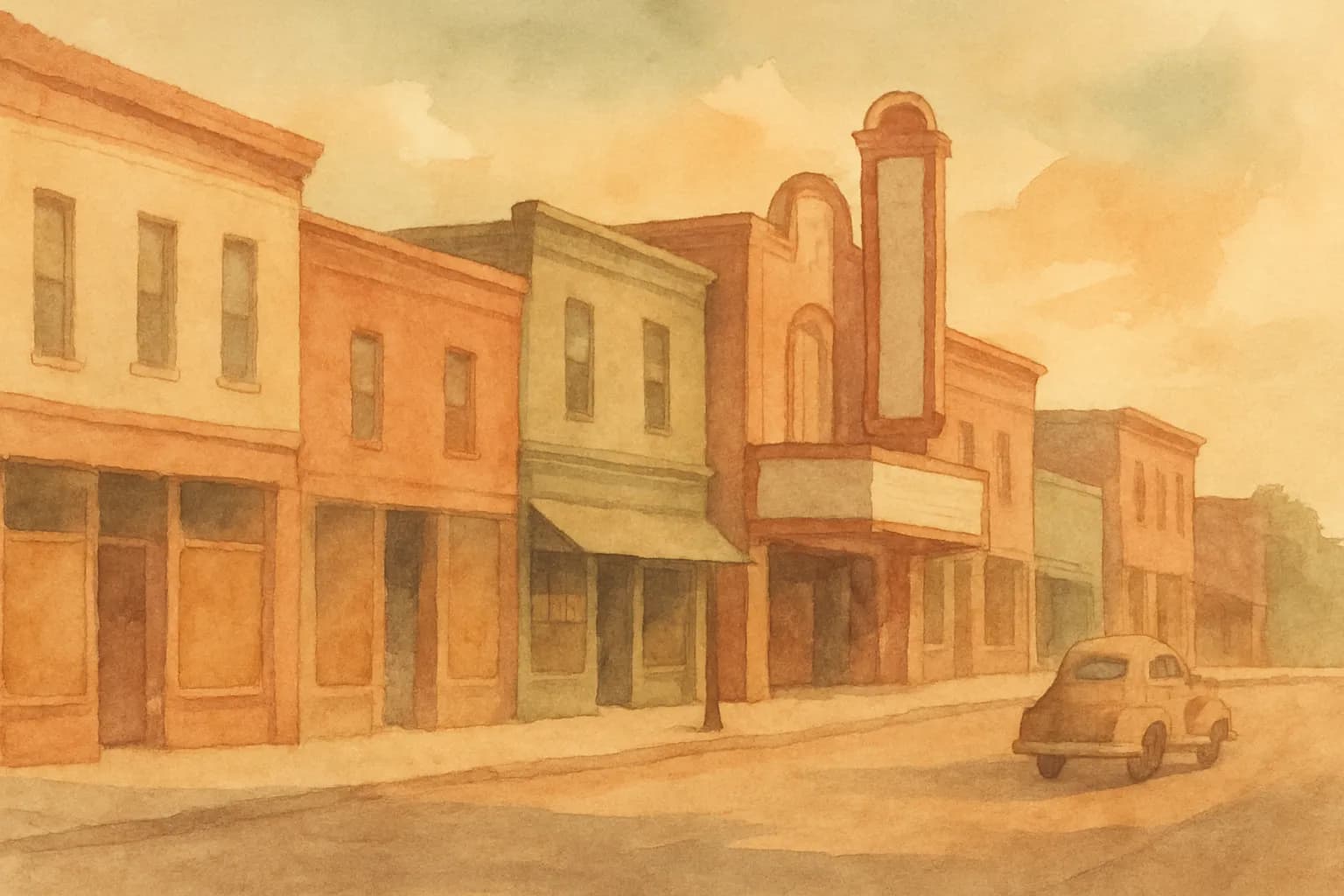
Main Street is six blocks long. About half of it is boarded up. The hardware store is gone. The five-and-dime is gone. The movie theater is gone, but somebody saved the marquee and it still says HAPPY 50TH ANNIVERSARY, MARGE & DON from a Saturday night in the spring. The grocery store has been closed since 2014. The post office is still open, three days a week.
This town used to have three thousand people. It has eleven hundred now. And somebody is fighting, very hard, to make sure it doesn't drop to nine.
There are towns like this all over America. We barely notice them anymore.
What small towns once were
For most of American history, the small town was the basic unit of the country. Not the city, and not the suburb. The small town.
It was the economic center of a circle of farms that stretched ten miles in every direction. The farmers came in on Saturday to sell what they had and buy what they needed. The town had a grain elevator, a feed store, a hardware store, a dry goods store, a doctor, a dentist, a lawyer, a banker, a barber, a couple of churches, a school, a diner, a bar, and a newspaper. Everything you needed for a complete human life was contained in those six blocks.
The town was small enough that everyone knew everyone. That meant you couldn't get away with much. It also meant you couldn't be invisible. The lonely old widower had three people checking on him. The kid in trouble had four adults paying attention. The family going through a hard year had food on the porch they hadn't asked for. The web was tight, and the web caught people.
There are reasons people left small towns, and not all of them were good ones. The web that caught you could also smother you. The privacy that cities offered was a real freedom. But for the millions of Americans who stayed, the small town was a complete world.
What happened to them
The unraveling took most of a century, and three forces did most of the damage.
The first was the consolidation of agriculture. Family farms got bigger, fewer, and more mechanized. A region that used to support two hundred farming families now supports twenty. The other one hundred eighty families packed up and went to cities for work. The Saturday shopping trip to town stopped happening because the people who used to take it had moved away.
The second was the highway. The interstate system, built between the 1950s and the 1970s, routed traffic around towns instead of through them. Towns that had thrived on the old US highways watched their lifeblood divert twenty miles north or south. The motels closed. The diners closed. The gas stations closed. A whole class of small American towns was strangled by the very efficiency of the new road system.
The third was the big box store. When the Walmart went in at the county seat, the dry goods store in every smaller town within forty miles closed within five years. The hardware store followed. The grocery store followed. The pharmacy followed. The downtown became, over the course of a decade, a row of empty windows.
Each of these forces was rational. Each of them happened for reasons. And each of them, added together, killed the small American town as it used to exist.
The people who didn't leave
In every town like this, there are still people. Some of them never left. Some of them came back. Some of them, increasingly, moved in from somewhere bigger, looking for something cheaper and slower.
These are the people fighting for the town now. They are the ones who buy the closed grocery store and reopen it as a co-op. They are the ones who turn the old movie theater into a community arts space. They are the ones who start the farmers' market on Saturday morning, who restore the courthouse square, who write the grant applications, who badger the state for one more round of funding.
You can see them at the diner on Tuesday morning, talking through what the town is going to do next. They are usually in their fifties or sixties. They are usually tired. They are also, in their quiet stubborn way, some of the most impressive Americans alive.
They don't get written about much. The story of small-town America that gets told is usually the decline story, and there are reasons for that. But the other story -- the one about people who refuse to let a place die, who show up at the council meeting every other Thursday, who put their own money into a building they will never get rich on -- that story is also true, and it deserves to be told more often.
Towns that figured something out
A few small towns have, against the odds, started to grow again. The ones that do tend to figure out one of a few playbooks.
Some lean into tourism, restoring their historic downtowns and marketing themselves to weekenders from the nearest city. The model towns are well-known -- Galena, Illinois; Marfa, Texas; Hood River, Oregon; dozens of New England villages -- but the playbook has been quietly copied in hundreds of smaller places that you won't have heard of and don't need to.
Some position themselves near outdoor recreation. Towns on a lake, near a national forest, at the trailhead of something. They sell access to nature to people who have the money for nature but not the time to live near it full-time.
Some have become artist colonies, intentionally or accidentally, after a critical mass of painters and writers and potters discovered they could afford a house there. The arts crowd brings galleries, brings coffee shops, eventually brings tourists, and a town that was dying slowly starts breathing again.
And some, in the last few years, have been quietly resurrected by remote workers. The pandemic taught a whole class of professionals that they didn't need to live in San Francisco or New York to do their jobs, and a small but real wave of them have moved to places where a four-bedroom Victorian costs less than a one-bedroom condo back home. They bring their salaries with them. The town's tax base grows for the first time in forty years.
None of these are silver bullets. Most small towns won't manage any of them. But the model exists, and the towns that find it are showing what's possible.
Why it matters
You could argue that the decline of the small town is just the market working -- that people moved to where the jobs were, and that the towns they left behind don't owe anyone anything. There's truth in that.
But there's something else worth saying. The small town held a particular kind of American life, and that kind of life is hard to reconstruct anywhere else. The casual web of mutual care. The kid raised by a whole town. The old man at the diner counter who knows the name of every person who walks in. The funeral where the whole town shows up. The Friday night football game that the entire county watches. The slow steady knowledge of a place that comes from staying in it for fifty years.
That kind of life can still happen, here and there, in the towns that have figured out how to survive. It is rarer than it used to be. It is more precious for that.
If there's a small town within an hour of you, drive there this weekend. Walk the main street. Eat at the diner. Buy something from the store. Tip well. Talk to whoever's behind the counter. Notice who's keeping the place alive -- and consider, even for an afternoon, what it would mean to spend your money where someone is fighting to keep a community going.
It isn't much. But it's something. And the towns that are still here have stayed here because enough people did something, instead of nothing.
The towns that are still here stayed because somebody decided they were worth the trouble. Most things worth keeping do.
Get a new story every Sunday morning.
One email a week. No spam. Unsubscribe anytime.
If this brought back a memory, you might also like
What Happened to the Neighborhood Diner? A Love Letter to Vinyl Booths and Bottomless Coffee
The bell over the door, the waitress who knew your name, the booth with duct-taped vinyl. There used to be a diner within ten minutes of everywhere. Now there's barely one within an hour of anywhere.