The Lost Sound of a Quiet House
Listen to your house right now.
You can probably hear at least three things. The HVAC system cycling. The refrigerator humming. A device somewhere -- a phone, a TV on standby, a smart speaker waiting for a wake word -- making the low electric whisper that modern electronics make even when they aren't doing anything. There's probably also outside noise getting in: a passing car, a leaf blower across the street, the neighbor's air conditioner.
None of this is loud. But the cumulative result is that your house is never actually silent. There's a constant background hum of small mechanical sounds, and you've stopped hearing it because it never stops.
A house in 1968 was not like this. A house in 1968, much of the day, was actually quiet. And the difference matters in ways that are hard to articulate until you sit with it.
What a quiet house sounded like
A 1968 house, at three in the afternoon on a Tuesday, with your mother in the kitchen and you reading in the living room, sounded like this:
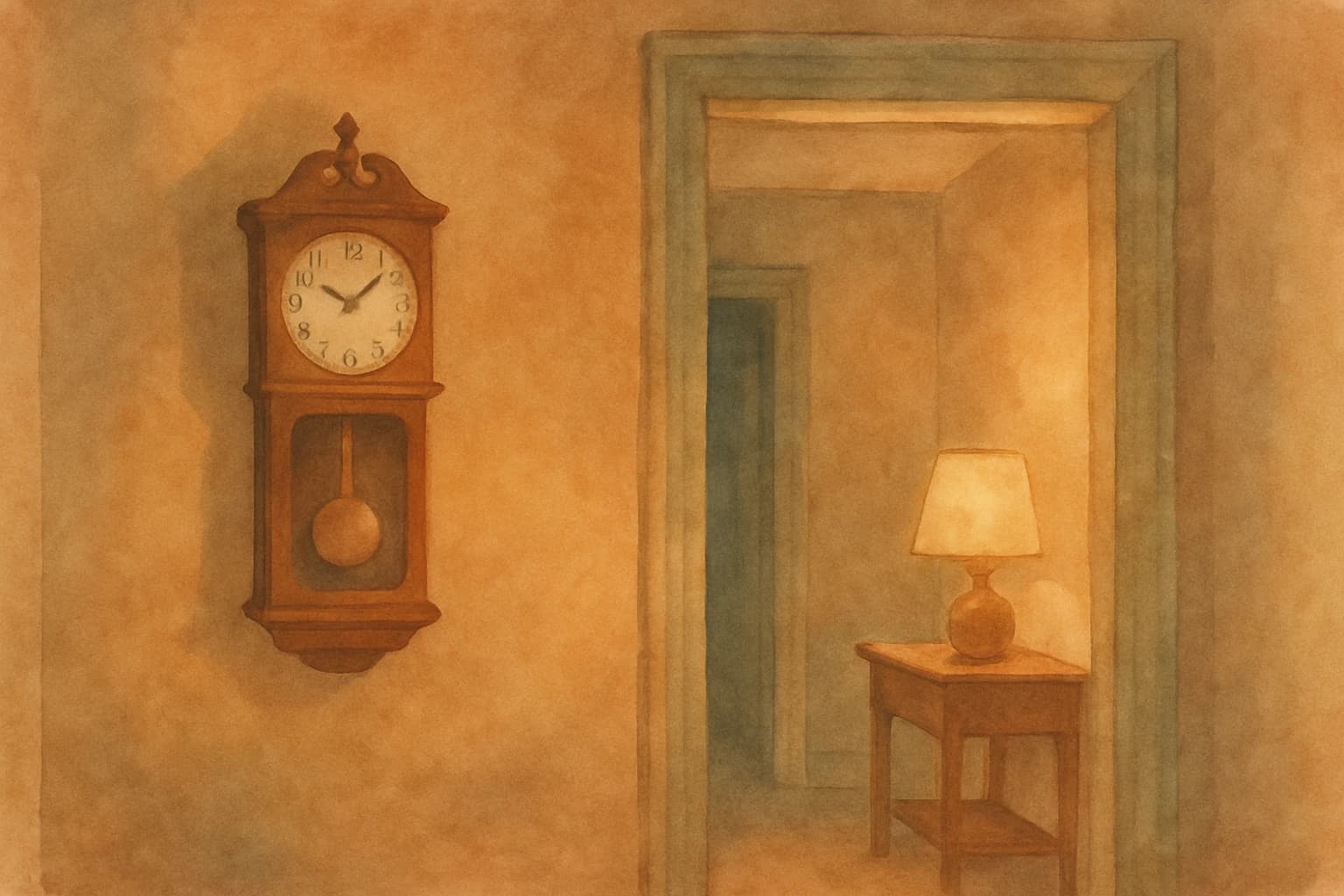
The clock in the hallway. A big wooden one, sometimes a grandfather clock, sometimes a wall clock with a pendulum, ticking at exactly its mechanical rate. You could hear the tick from any room in the house.
The refrigerator, occasionally. Older refrigerators cycled on and off with audible compressor noise, but they ran less constantly than modern ones, and there were long stretches where the kitchen was silent except for the clock.
The radiator, in winter, with its small clicks and water sounds as the heat moved through the pipes.
Birds outside. The breeze in the trees. A car going by on the street, every few minutes, audible because the windows might have been open and because the rest of the soundscape was quiet enough to let it through.
Your mother's footsteps in the kitchen. The small clink of a teaspoon against a cup. The sound of her turning a page of the newspaper.
That was the soundtrack. Most of the time, the house was quiet enough that any sound at all was noticeable. The clock was the loudest thing, and the clock was not very loud.
What changed
The change happened gradually, in waves of household technology that each added a little background sound.
The first wave was central air conditioning, arriving in volume in the late 1960s and accelerating through the 1970s. The system ran for long stretches in summer, producing a constant low hum from the vents and the outdoor unit. The hum became part of the house, and people stopped hearing it consciously, even though it was always there during the cooling season.
The second wave was the modern refrigerator. The compressor cycles got longer and the sound profile shifted, but the bigger change was that refrigerators got larger and more numerous -- many households added a second one in the basement or garage -- and the cumulative refrigeration sound increased.
The third wave was the television, in two stages. First, the television itself, which when on filled the house with sound and which, in many households after about 1975, was on for many hours of the day. Second, the standby state of modern televisions, which produce a low electric whisper even when they appear to be off, because they are not actually off, they are waiting for the remote.
The fourth wave was the proliferation of small electronics. Phones charging. Computers in standby. Wireless routers humming in the corner. The cable box. The DVR. The microwave with the clock on it that emits a tiny electric sound. Smart speakers. The cumulative background noise from a 2026 household's small electronics is real, even though no single device is loud enough to notice.
The fifth wave is just more of everything. More appliances. More devices. More fans, more pumps, more compressors. The modern house has been quietly accumulating mechanical sound sources for sixty years, and the cumulative effect is that the quiet baseline of 1968 is essentially unreachable in a modern home.
Why this matters
A house that's actually quiet is a different cognitive environment from a house with a constant background hum. The difference is small but real.
Reading is different. A 1968 child reading a book on a Tuesday afternoon was reading in a soundscape with almost nothing in it. The book had the room's full acoustic attention. A modern child reading in the same chair has the HVAC, the fridge, the standby electronics, and probably a phone notification or two competing for ambient attention. The reading still happens. It happens against a different background.
Thinking is different. Quiet houses produce a kind of mental space that hummy houses don't. Your mother, sitting at the kitchen table with a cup of coffee at two in the afternoon, in a house where the only sound was the clock, was in a cognitive environment that essentially doesn't exist for the contemporary equivalent person. She was alone with her own thoughts in a way the modern version isn't, because the modern version is never quite alone -- there's always the background hum, and now also the phone in the pocket, which provides additional non-quiet.
The quality of solitude is different. The 1968 housewife alone in her quiet kitchen and the 2026 work-from-home professional alone in her hummy home office are both technically alone, but the texture of the aloneness is different. The 1968 version had silence to fill. The 2026 version has ambient sound to push against. These produce different mental states.
Sleep is different. The 1968 bedroom was, by default, much quieter than the 2026 bedroom, because there were fewer devices in it. The HVAC ran less. The phone was a wall phone in the hallway, not a glowing object on the nightstand. The clock was a wind-up clock, not a digital one with a display. Sleep quality research now points to the cumulative ambient sound of a modern bedroom as a real factor in sleep disruption, and the 1968 bedroom by accident produced a better sleep environment than most modern intentionally-designed ones.
What we know it cost us
The cost is hard to measure precisely, because nobody was measuring household ambient sound levels in 1968 and comparing them to now. But the trend lines we can see -- attention span declines, sleep quality declines, reported difficulty with solitude -- are consistent with an environment that has lost its baseline of quiet.
We didn't lose the quiet on purpose. We added small useful things, one at a time, and each one was a reasonable addition. Air conditioning. A better refrigerator. A television in the family room. A computer. A wireless network. A smart speaker. None of these is the villain. The villain is the accumulation, and the accumulation snuck up.
What you can do
You cannot reproduce 1968 in a 2026 house. The infrastructure is different. But you can have a quiet hour, sometimes, on purpose.
Turn off the HVAC for an hour on a temperate day. Unplug the things you can unplug. Sit in the kitchen with a cup of coffee and notice what's left. The clock, if you have one. The refrigerator cycling. The trees outside if the window is open. Maybe a bird. Maybe nothing for several minutes at a stretch.
The first ten minutes will feel slightly off. You're not used to that level of acoustic emptiness, and your brain will reach for something -- a podcast, music, the news. Don't reach. Sit. Let the quiet be there for a while.
After about twenty minutes, something will happen in your head that's hard to describe and that you probably haven't felt in a long time. The thinking will get slower. The drift will be more associative. The ambient noise of your own mental life -- which is also constant, and which you also stop noticing -- will partially settle.
This was the default state of an afternoon in 1968. It is now an effortful practice. Whether to recover it is up to you. But it's worth knowing that the quiet your grandmother sat inside, on a Tuesday afternoon in her kitchen, is a real cognitive environment that produced something specific, and that the modern hum is not free, even if you've stopped noticing the bill.
Do you remember the sound of a quiet house? Where do you go now when you want one? Tell us in the comments -- we'd love to hear.
Get a new story every Sunday morning.
One email a week. No spam. Unsubscribe anytime.
If this brought back a memory, you might also like
10 Things Every American Father Said at the Dinner Table
Your father had fewer phrases than your mother, and they hit harder. He didn't repeat himself, because he didn't need to. Once was enough.