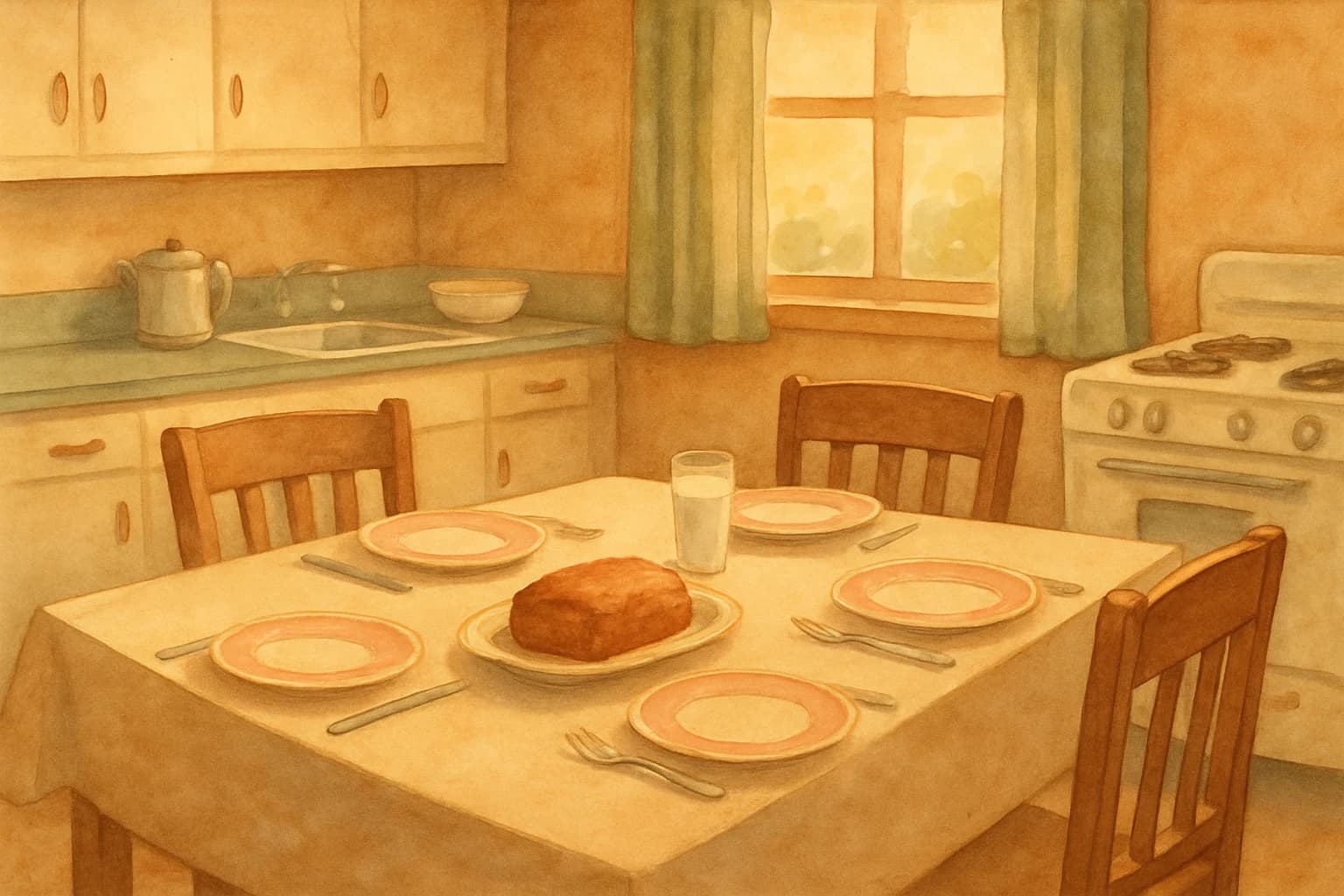
10 Things Every American Father Said at the Dinner Table
Your father had fewer phrases than your mother, and they hit harder.
He didn't run a constant verbal current the way she did. He came home, washed his hands, sat down, ate, and listened. But every so often a sentence came out of him -- short, declarative, often funny without trying to be -- and the sentence landed in a way that you remembered for the rest of your life. He didn't repeat himself the way she did, because he didn't need to. Once was enough.
Here are ten of his sentences. You'll know most of them, because the same ten ran in every American household for about forty years.
1. "Eat what's in front of you."
The response to any complaint about what was on the plate. You said you didn't like green beans. He said, eat what's in front of you. You said you didn't want the casserole. He said, eat what's in front of you.
It wasn't said unkindly. It was said the way you'd say the sky is blue. The proposition was that food was on the table and you were a person at the table, and the rest of the equation was obvious. He had grown up in a household where you ate what was on the plate because there might not be more, and even though that wasn't his children's situation, the rule had survived the change in circumstances.
2. "I'm not made of money."
The response to any request for spending. You wanted the new bike. You wanted to go to the movies. You wanted the sneakers everyone else at school had. He said, I'm not made of money.
It was true. He wasn't. He was made of one income and a mortgage and four people who needed shoes, and the request was being entered into a budget that he was the only one tracking. The phrase was both a refusal and an explanation, and it transmitted, by repetition, the actual economic situation of the household to children who otherwise wouldn't have noticed.
3. "When I was your age..."
The setup for any number of stories that you would have heard before and would hear again. When I was your age, I walked to school in the snow. When I was your age, I worked at the gas station after school. When I was your age, my father would have taken his belt off for what you just did.
You rolled your eyes at the time. You repeated the same construction to your own children in your forties, with a kind of helpless recognition that he had been telling you something real and you had not been listening. The phrase was a generational marker, passed from father to child to grandchild, in the same words, with the same delivery.
4. "Because I'm your father, that's why."
His version of your mother's "because I said so," with a slight modification. The invocation of fatherhood specifically was a small structural claim -- he wasn't just an adult who outranked you in this conversation; he was your father, and the office itself carried weight.
You knew, when this phrase came out, that the conversation was over. He did not deploy it often, which was part of why it worked. The phrase was held in reserve for moments when his authority needed to be invoked directly, and the rarity of its use made it more effective when it came out.
5. "We'll see."
The most studied phrase in the catalog. We'll see was the response to almost any future-oriented question. Can we get a dog? We'll see. Can we go to Disney World next summer? We'll see. Can I get my ears pierced when I'm twelve? We'll see.
The phrase was not a refusal. It was also not a yes. It was a deferral, designed to end the immediate conversation without committing to anything, and to be revisited at his convenience. Your mother said no more directly. Your father said we'll see, and you learned, over years, that we'll see usually meant no, but occasionally meant yes, and never meant yes, definitely, today.
6. "Ask your mother."
The pass-off. Any question you brought to him in the kitchen, while he was reading the paper, that did not require his specific input, got rerouted to your mother. Dad, can I sleep over at Lisa's? Ask your mother. Dad, can I have a snack? Ask your mother. Dad, where are my soccer shoes? Ask your mother.
It was a clean division of labor. Domestic logistics were her department. He didn't pretend to know the schedule. He sent you to the person who did. The phrase was efficient and respectful of her domain, even when it sounded dismissive of yours.
7. "Turn off the lights."
Said every evening, often multiple times. He went through the house in the hour before bed turning off lights that you'd left on, and the children of any household with a thrifty father grew up associated with the soft click of light switches and the quiet exasperation of the man who saw the electric bill every month.
The phrase had economic weight. The lights cost money. The cost was not large, but the principle was the principle, and the principle was that you used what you needed and not more. A great many older Americans still cannot leave a room without turning off the light. Their fathers trained them.
8. "Did you check the tire pressure?"
The thing he said before any car trip, especially before you, as a teenager, took the car somewhere. Did you check the tire pressure. Did you check the oil. Did you fill up before you left so you wouldn't run out on the highway.
The questions were not really questions. They were a checklist of things he was making sure you knew to do. He had absorbed, over thirty years of maintaining a car, a body of knowledge that he was trying to transmit to you in the form of these small repeated questions, and over time the questions became the knowledge. You now check your tire pressure before a road trip because he asked, and your kids check theirs because you ask.
9. "That's enough."
The shutdown. A fight between you and your sibling at the table that had gone on long enough. A complaint that had been registered three times. A whining tone that had crossed a line. He said, that's enough, and it ended. He didn't have to repeat it. The voice was different from his other voices, slightly lower, slightly more clipped, and the room understood.
The phrase did not lead to a punishment unless ignored. Ignoring it was the punishable act. He had given the warning. The warning was sufficient. He expected to be heard the first time, and in most households, he was.
10. "I love you too."
Said in response, not initiated. Your father, of his generation, mostly didn't open with I love you. It wasn't in his vocabulary as a starter. But when you said it to him -- usually at bedtime when you were small, or on the phone when you'd gone off to college -- he said I love you too.
The words were small and they came out a little stiff, sometimes, because they were not what he had been raised to say. But he said them. Every time. He had decided, somewhere along the way, that his children would hear those words from him, even if his own father had never said them to him, and so he taught himself the response and offered it whenever it was given to him.
It was not a long sentence. It was the one that mattered most.
Your father may have had other phrases too. Most fathers did. These are the ten that came up across most American households, in some version, between roughly 1955 and 1985, with regional variations and personal additions.
He didn't write any of them down. They were oral, passed from father to son to grandson by daily repetition. He's mostly gone now, or mostly older now, and the chain depends on whether you remember to say the same things to your own kids.
What did your father say at the dinner table? What's the one phrase of his you catch yourself using? Tell us in the comments -- we'd love to hear.
Get a new story every Sunday morning.
One email a week. No spam. Unsubscribe anytime.