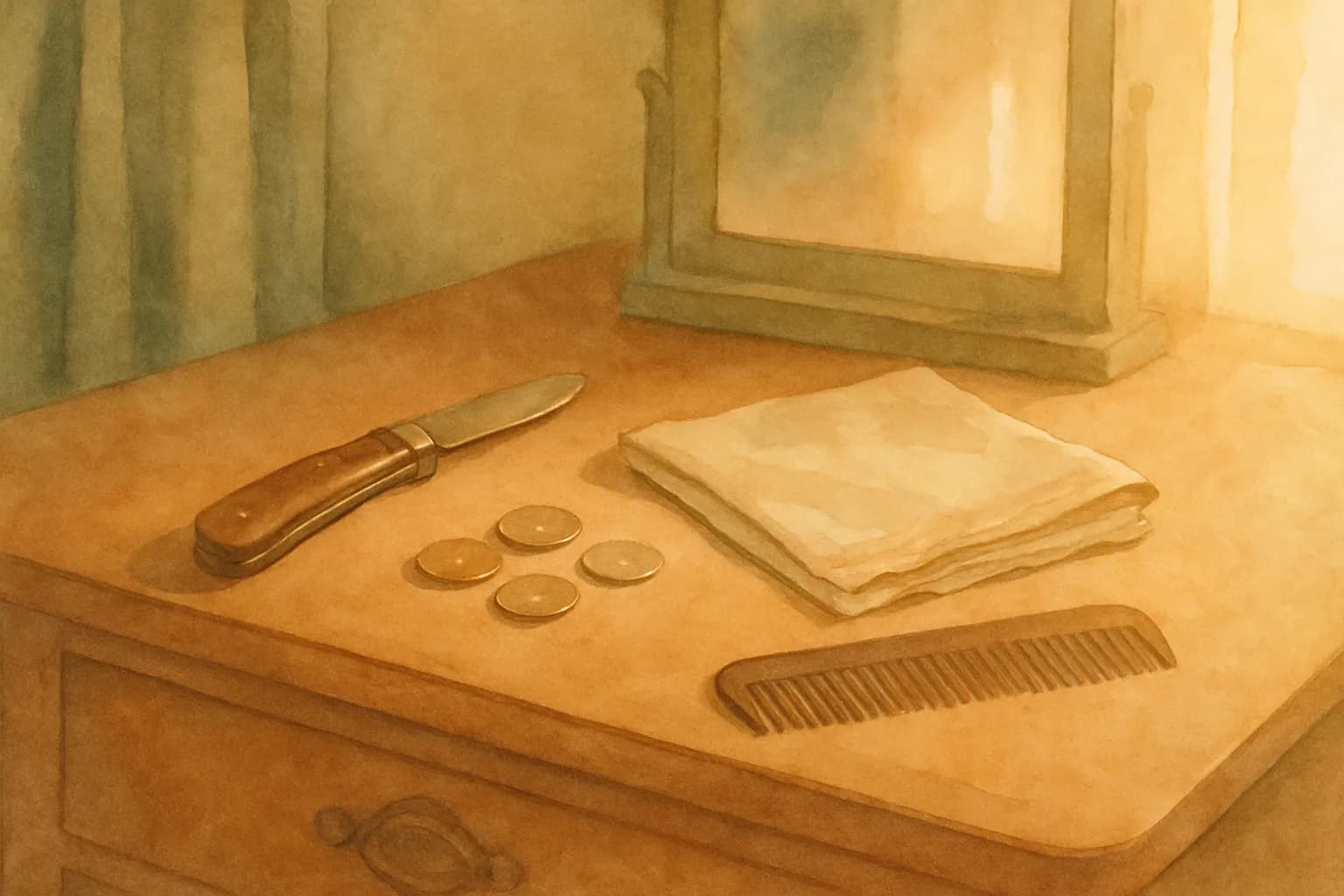
10 Things Your Grandfather Carried in His Pocket Every Day
Your grandfather got dressed in the morning, and as part of getting dressed, he loaded his pockets.
It wasn't a routine he thought about. He'd been doing it since he was twelve. The pockets of a man's pants held the small tools of his life -- the same things, in the same arrangement, every day, for sixty years. You could empty his pockets at the end of the day and reconstruct most of what he was.
Here are 10 things he carried. Most of them have been replaced by a phone, which is not the same thing.
1. A handkerchief
Always cotton. Always white or pale blue. Folded into quarters, ironed by his wife on Sunday afternoons, stacked in the top drawer with the others.
He used it to blow his nose, to dab his brow on a hot day, to clean his glasses, to wrap a small cut, to wipe a child's face. It went in the wash, came out clean, got folded again. He had ten of them and they lasted thirty years.
The shift to disposable tissues was, in retrospect, a small civilizational decline. He would never have understood why we use a piece of paper once and throw it away.
2. A pocket knife
Single blade, maybe two. Bone or wood handle, polished smooth by sixty years in a pocket. Sharp enough to cut a piece of twine, to open a box, to peel an apple, to whittle a stick for a grandchild, to clean under a fingernail.
He'd carried the same knife since his father gave it to him at fourteen. He'd sharpened it a thousand times. When he died, one of the grandchildren got it, and now it's in a drawer somewhere, getting cleaned out maybe once a year. It's still sharp.
3. A money clip, or sometimes a coin purse
He didn't carry a fat wallet. His wallet had his driver's license and a few cards. The cash went in a money clip, in his front pocket, folded once, biggest bills on the outside.
Coins went in a small leather coin purse with a clasp. He paid cash for nearly everything. He knew exactly how much money he had at any given moment, because he could feel it.
4. A comb
Black plastic, six inches long, slipped into the back pocket. He used it three or four times a day. After lunch. Before going into a meeting. Before getting out of the car at church. He'd take it out, run it through his hair in two passes, put it back.
A man who didn't carry a comb was a man who hadn't been raised right. That was the underlying belief, and you could not have argued him out of it.
5. A wallet with photos of the grandchildren
The wallet itself was leather, brown, worn smooth on the corners. Inside: his license, a few business cards, a Social Security card he wasn't supposed to carry but did anyway, and the photos.
The photos were small -- school portraits, in cellophane sleeves, sometimes ten or fifteen of them, in chronological order. He'd flip through them at the coffee shop and at the church social. Here's Bobby in second grade. Here's Susie last summer. The cashier had seen them before. She looked anyway.
6. Reading glasses
He started carrying them around 1968. He pretended he didn't need them for about eight years. By 1976 he had three pairs -- one in his pocket, one on the kitchen table, one by his reading chair.
The case was a hard plastic clamshell. The lenses were always smudged. He cleaned them with the handkerchief. He took them off when anyone took a picture.
7. A notebook and a pencil stub
Small spiral notebook, about the size of a deck of cards, slipped into the shirt pocket. The pencil was always a stub -- sharpened down to two inches, with the eraser worn flat -- because he wrote things down all day and pencils got short.
In the notebook: phone numbers. Things to pick up at the hardware store. The dimensions of a window he was going to replace. A name a friend had mentioned. The grocery list his wife had given him over the phone. A note to himself about a payment due.
He didn't trust his memory for small things. The notebook was the memory. He referred to it three or four times a day. When it was full, he transferred the still-useful pages and started a new one.
8. Cigarettes and a Zippo (or, later, breath mints)
For most of his adult life, a soft pack of Pall Malls or Lucky Strikes lived in the breast pocket of his shirt. The Zippo was in the pants pocket, balanced against the change.
When he quit -- and most of them quit eventually, in 1978 or 1982 or whenever the doctor finally got serious -- the same pocket carried a roll of Life Savers or a tin of Sen-Sen mints. The hand reached for the same place. The habit didn't fully die. Only the cigarettes did.
9. Keys on a single ring
Three or four keys, on a brass ring with no decorations. House key. Car key. Office or shop key. Maybe a key to his father's old house, which he didn't visit anymore but kept anyway.
No carabiner. No keychain trinkets. No bottle openers, no flashlights, no fobs. The whole apparatus weighed two ounces and lived in the right front pocket, balanced against the loose change.
The car had a separate ignition key and trunk key, by the way. He carried both. He never lost them. He never locked himself out. The keys were not a problem he had to think about, the way modern keys are.
10. A small folded card
In the wallet, sometimes in the pocket. A prayer card from his mother's funeral. A holy card from a wedding. A wallet-sized photo of a brother who died in the war. A printed verse cut out of a hymnal. A list of phone numbers in his daughter's handwriting.
Something quiet, sentimental, and small. He never showed it to anyone. He pulled it out sometimes when no one was looking. It had been there for thirty years, and it was the thing he would have replaced first if he'd lost his wallet.
The phone has replaced most of this now. Notes, calendar, calculator, photos, payment, identification, communication, entertainment -- all in one device, in one pocket, with no real personality.
But there was something to the older system that's worth noticing. Your grandfather's pockets were curated. Every item earned its place. Every item had a story. The things he carried said something about who he was -- what he valued, what he expected of a day, what he wanted close.
A phone says you have a phone. His pockets said the rest.
The pockets are empty now. But somewhere in a drawer, if you're lucky, the knife is still sharp.
Get a new story every Sunday morning.
One email a week. No spam. Unsubscribe anytime.
If this brought back a memory, you might also like
The American Summer Before Air Conditioning Sent Us All Inside
The yard was a room. The whole neighborhood spent the hottest hours of the day in the open air, because the alternative was an oven.