The American Summer Before Air Conditioning Sent Us All Inside
The yard was a room.
On a hot summer afternoon in 1972, the inside of an American house was warmer than the outside, especially upstairs, especially in the bedrooms, especially after the sun had been on the roof all day. People did not stay inside. They went out into the yard, onto the porch, into the driveway, down to the corner. The whole neighborhood spent the hottest hours of the day in the open air, because the alternative was an oven, and the air outside, even if it was ninety degrees, at least moved.
This is the part of pre-air-conditioned American life that's hardest to explain to anyone who didn't live through it. The outdoors was where you lived in the summer. Not for an hour after dinner. All day.
The geography of a hot afternoon
The yard had zones, and you knew them.
The shade under the oak tree on the east side of the house was the coolest spot until about noon. After noon, the shade migrated to the west side, where the porch was, and that was where the adults moved. The kids moved with them, or they took the sprinkler out onto the lawn and ran through it until they were soaked.
The back patio, if you had one, was where the laundry hung on the line and where the picnic table sat. Lunch happened there in the summer, every day, often consisting of sandwiches made on the kitchen counter and carried out on plates. The kitchen was the hottest room in the house. Cooking inside on an August afternoon was something nobody did except in emergencies.
The basement, if you had one, was the place of last resort during a real heat wave. Concrete walls, no windows, slightly damp, ten degrees cooler than anywhere upstairs. You set up a card table down there. You read books in a folding chair. You slept on a cot in the rec room if the upstairs got intolerable.
The garage was the male equivalent of the basement. Concrete floor, open door, fan blowing. Your father retreated there when he had a project. Sometimes when he didn't. The garage was cool enough to work in, and your father preferred to be somewhere he could work.
The kids out until midnight
In the summer, the rules about when kids had to come home were different.
During the school year, you came home when the streetlights came on. In summer, the rule loosened. The streetlights came on around eight-thirty, which was clearly too early for a kid who had been waiting all year for summer freedom. So the rule shifted, in most houses, to something like come home when we call you or come home when it's actually dark or come home around ten, ish.
What this meant in practice was that the neighborhood was full of children running around at nine, ten, eleven at night. Capture the flag in the dark, with jars of lightning bugs as base markers. Sardines, which is hide-and-seek in reverse, played across four backyards. Long bike rides under the streetlights, with playing cards clothes-pinned to the spokes to make them sound like motorcycles.
The parents were on the porches and the lawns watching, sort of, but not really paying attention. They were talking to other parents. They could hear the kids. The kids knew not to leave the block. The system worked because everyone in it knew the rules without having been told.
A typical July night in an American suburb in 1973 had more children outside, awake, doing things together at ten p.m. than most American suburbs see in an entire summer now.
Sleeping with the windows open
Bedtime was a different kind of event.
You took the Saturday bath, more or less every night in the summer because you'd been outside all day. You put on light pajamas, sometimes just underwear if it was really hot. You went upstairs to a bedroom that was, despite the open windows and the box fan, still uncomfortably warm.
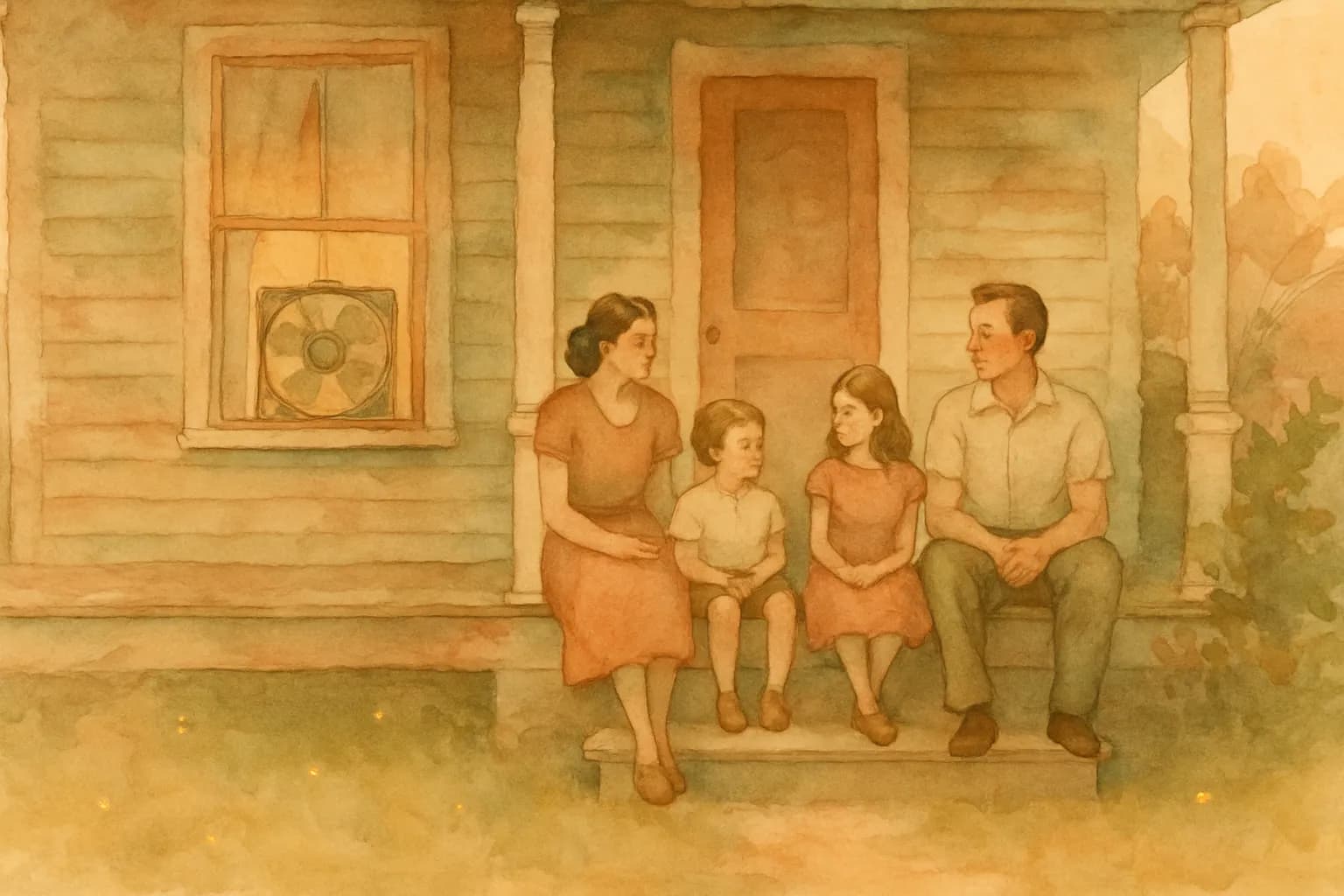
You lay on top of the sheet, not under it. You positioned yourself in the path of the fan. You listened to the neighborhood — the cicadas, the dog two yards over, the conversation drifting up from the porch below where your parents were still sitting with a glass of iced tea — and you fell asleep slowly, sweaty, with the air moving across your skin.
Sometimes you couldn't sleep upstairs at all. On the worst nights, you came back down and slept on the couch in the living room, which was cooler. Or you slept on the screened porch, on the daybed with the cushions that smelled like grass and laundry detergent. Or, if the house had one, you slept in the basement on a cot.
Children who grew up in air-conditioned bedrooms have never been hot enough at night to be forced to sleep somewhere else in the house. This is not nothing. The minor adversity of a hot bedroom was a small annual American experience that almost no kid today has.
The porches as evening gathering
After dinner, in the summer, the porches filled up.
Your parents went out around seven. So did the neighbors. So did the people across the street. The porch was where you sat after the kitchen had cooled down enough to be tolerable, with a glass of iced tea or a cold beer, watching the kids run around in the failing light.
The conversation moved between porches. Did you see what the Hendersons did to their lawn? She finally got him to take down that fence. I hear the school is hiring a new principal. The neighborhood news flowed across the front yards, casual, unhurried, with everyone half-listening from their own porch and contributing when they had something to add.
A summer evening of this kind was three to four hours long. The porches stayed full until ten or eleven, sometimes later. The mosquitoes came out around dusk and the citronella candles came out with them. The lightning bugs came out a little later. The children eventually came in, sticky and exhausted, and were sent upstairs to the hot bedrooms with the fans.
This was the entire evening's entertainment, and it was free, and it required nothing more than chairs and other people.
The public swimming pool
If your town had a pool, you spent the summer there.
The town pool was a concrete rectangle, sometimes Olympic-sized, sometimes smaller, with a chain-link fence around it and a lifeguard chair at each corner. Admission was a quarter for kids, more for adults. A summer pass was five dollars and covered the whole family.
You went every day, usually arriving around eleven in the morning and staying until four. You ate lunch from the snack bar — a hot dog, a bag of chips, a Popsicle. You swam, you cannonballed off the diving board, you played Marco Polo, you got told to walk by a lifeguard who knew your name. You came home sunburned, with the chlorine still in your hair, exhausted.
The pool was the cheap, public, civic alternative to air conditioning. Towns built them in the postwar years for exactly this reason. They were enormously popular and enormously democratic. The doctor's kids and the mechanic's kids splashed each other in the same water, and the social hierarchy outside the fence was suspended for the duration of the swim.
Many of these pools are still operating, often run by parks departments, often underfunded but still open. Most American children don't go to them anymore. The backyard pool, where wealthier families have their own, and the air-conditioned house, where everyone else stays, have largely replaced the public pool as the summer destination.
What we got, and what we paid for it
Air conditioning was a real gain. Heat kills, especially older people, especially during the increasingly long and severe summer heat waves the country has been getting. The case for AC in 2026 is overwhelming, and nobody who lived through pre-air-conditioned summers actually wants to go back to a hundred-degree bedroom in August.
What we got in exchange for the indoor cool was an indoor life.
The kids stopped playing outside until dark, because indoor air was more comfortable. The parents stopped sitting on the porches at night, because the porch was hotter than the living room. The neighbors stopped seeing each other casually, because the casual contact required everyone to be out at the same time, and once anyone could choose to stay in, most people chose to stay in.
The yard stopped being a room. The porch stopped being a gathering place. The block stopped being a community. The summer, which used to be a season lived outdoors with other people, became a season lived indoors alone, with the air running and the windows closed and the television on.
The trade was probably worth it for adults, on balance. It is less clear that the trade was worth it for children, who lost a kind of summer that no replacement has matched.
What you can still do
You cannot turn off the air conditioning for your whole neighborhood. You cannot summon the porches back to being full at nine o'clock at night. The cultural shift is too big to reverse with personal effort.
What you can do, occasionally, is open the windows. Pick a cool evening. Turn off the AC for a few hours. Sit on the porch with a glass of something cold. Listen to the neighborhood, which is still out there, just quieter. Notice the cicadas, which are still doing their work. Watch the kids who do happen to be outside.
You may even, on a good night, see another set of neighbors do the same thing on their own porch. Wave. They will wave back.
This is not the summer of 1973. The summer of 1973 is gone. But pieces of it are still recoverable, and the recovery is mostly a matter of opening a window and sitting still for an hour.
The summer of 1973 is gone. But on a cool night with the windows open, you can still hear the faintest edge of it, drifting in from somewhere down the block.
Get a new story every Sunday morning.
One email a week. No spam. Unsubscribe anytime.
If this brought back a memory, you might also like
Why Sunday Dinner Mattered More Than We Realized
The roast went in before church. By the time you came home, the whole house smelled like Sunday. For most of the twentieth century, this weekly ritual was the single fixed point holding families together.