What Happened to the American Lemonade Stand?
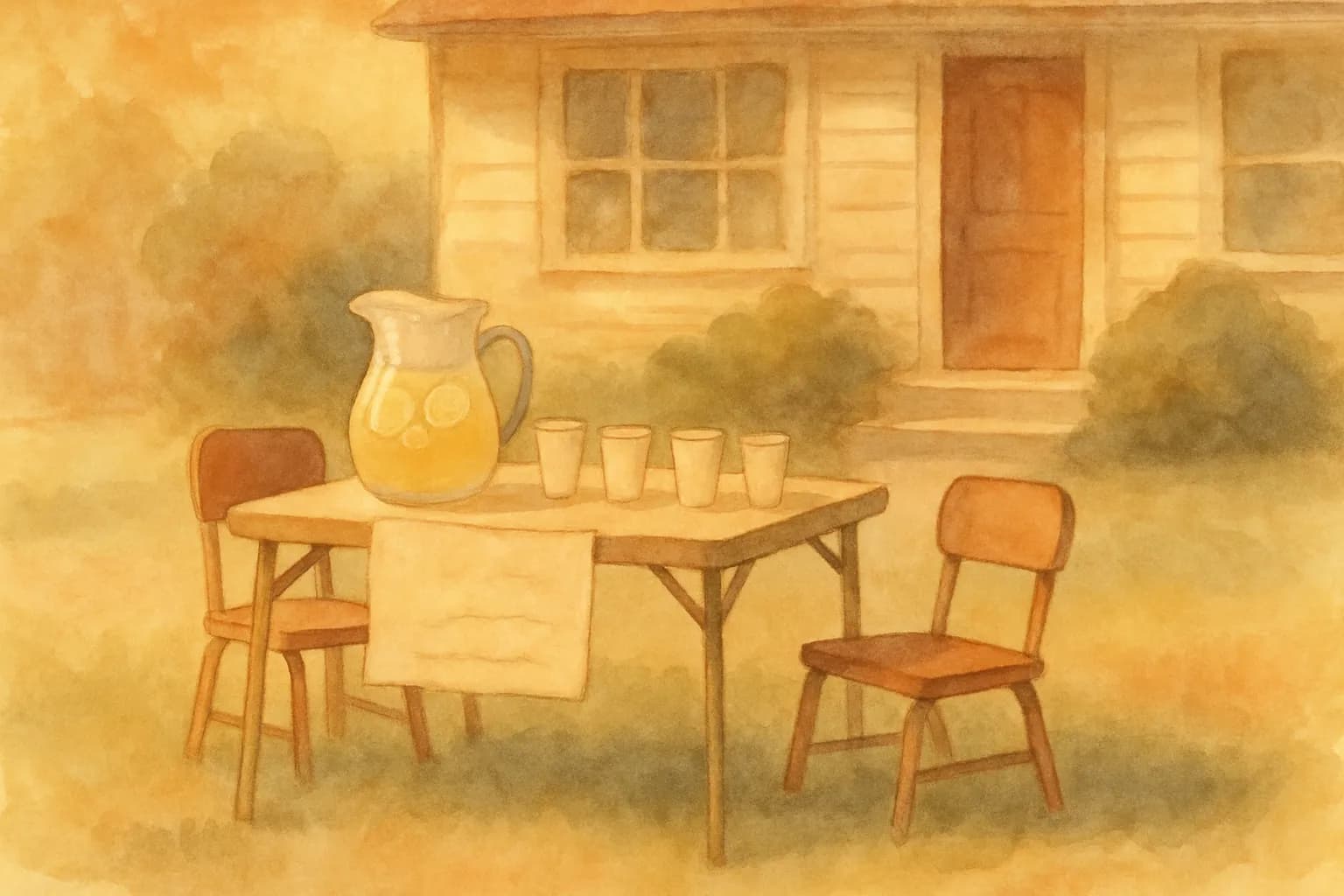
A card table on the front lawn. A pitcher of Country Time. A handwritten sign with the word LEMONADE in crayon, slightly crooked, with the price corrected once where the eight had been written backwards. Two kids in lawn chairs, swinging their feet, watching the street.
Twenty-five cents a cup. Or fifty, if it was a hot day and they were feeling ambitious.
This was a small American business. There were millions of them, every summer, on every block, run by children between roughly the ages of six and eleven, and they were one of the standard sights of suburban America for about fifty years. They are mostly gone now, and the reasons they're gone tell you something about how childhood has changed.
The economics of a lemonade stand
The stand cost almost nothing to set up. The Country Time was in the pantry already, or your mother bought it on the next grocery run and considered it a worthwhile investment. The pitcher was from the kitchen. The cups were the Dixie cups from the bathroom, or sometimes the better cups your mother let you have once she understood what you were doing.
The card table came from the basement. The sign was made with poster board left over from a school project, with markers from the kitchen drawer, with corrections taped over the worst spelling mistakes. Total cost of capital: somewhere around four dollars, mostly absorbed by your parents, who treated the whole enterprise as roughly equivalent to camp.
Revenue varied. On a slow day, you sold three cups and went home discouraged. On a good day — a Saturday, a hot one, with a lot of foot traffic — you could clear seven or eight dollars between the two of you, which was real money to a nine-year-old in 1979 and bought you a lot of candy from the drug store on the corner.
You weren't really in business to make money. You were in business because being in business was an experience. You were learning, without being taught, how to take an idea from concept to execution, how to face the public, how to handle a customer, how to make change.
The customers
The customers were neighbors, mostly. Mr. and Mrs. Henderson from across the street, who always bought a cup whether they wanted one or not. The mailman, who would sometimes accept a free cup in the heat. Your friend's mother walking back from somewhere with her own kids in tow. The teenage boy from down the block on his bicycle, who paid a quarter, drank the cup in two gulps, and complimented your sign.
Occasional strangers passed. A car would slow down, the window would roll down, a man in his fifties would hand you a dollar for a cup and tell you to keep the change. He had a granddaughter your age, probably, and he was thinking of her. You said thank you, the way you'd been taught, and he drove off feeling slightly better about the world than he had two minutes earlier.
This was the actual product the lemonade stand sold. The lemonade was just the excuse. What the customer was buying was a brief encounter with a small American childhood in progress, and the price of admission was a quarter.
What was happening in the experience
The kid running the stand was getting a kind of practical education that no school offered.
You were facing the public. A six-year-old behind a card table is making eye contact with adults and asking them, with words, if they would like to buy something. This is not easy. The first hour was always nervous. By the third hour you were comfortable. By the end of the day you had learned, in a small way, that strangers could be approached, that commerce was a thing humans did with each other, and that you were capable of participating in it.
You were learning to make change. The math was practical. Twenty-five cents a cup, customer hands you a dollar, you give back three quarters. By the end of the summer you could do this in your head faster than most adults can do it now with a calculator.
You were learning the difference between a good day and a bad day, and what made the difference. Foot traffic mattered. Weather mattered. Location on the block mattered. The presence of a cute sibling under five increased sales noticeably. The presence of a hand-lettered sign that included a smiley face also helped. You learned all of this without anyone teaching you, by running the experiment several Saturdays in a row.
You were learning to handle money. You ran a cash business. You made change. You counted at the end of the day. You and your sibling argued about whose half was whose, and you eventually settled it, and you took your share to the candy store. The whole loop, from labor to wage to spend, happened on a Saturday in your front yard.
Why it's gone
A few things came together over about thirty years.
First, the supervision changed. The lemonade stand worked because parents were okay with children running an unsupervised small operation in the front yard while they did other things inside. That assumption — that kids could be alone outside, dealing with strangers and money, for several hours at a time — has retreated significantly. The same parents who let their seven-year-old run a stand in 1985 now have grandchildren whose every hour is structured by a calendar of adult-supervised activities.
Second, the regulatory environment got weird. Starting in the late 2000s, there were a series of widely reported incidents in which local police or health inspectors shut down children's lemonade stands for operating without a business license or a food permit. The cases were always somewhere else, never your town, but the cumulative effect was a kind of low-grade national anxiety about whether the lemonade stand was actually legal anymore. Multiple states have since passed laws specifically protecting children's lemonade stands from this kind of enforcement, which tells you how widespread the worry had become.
Third, the front yard itself has emptied out. Most American children don't spend Saturday in the front yard anymore. They're inside, on screens. The front yard, which used to be a stage, is now a strip of grass that nobody looks at. The lemonade stand requires a front yard with kids in it, and that condition is less common than it was.
Fourth, foot traffic in suburban neighborhoods has dropped. The mailman is still on foot, but he's the only one. The neighbors are mostly in cars. There are fewer pedestrians, fewer strollers, fewer kids on bikes, fewer adults walking the block. The lemonade stand needs a sidewalk culture, and a lot of American sidewalk culture has thinned out.
A small comeback worth supporting
The lemonade stand is not extinct. You'll still see one if you drive around an American neighborhood on a Saturday in July. The kids running it are sometimes the children of parents who specifically remember running their own, and who have decided their kids should have the experience.
If you see one, stop. Roll down the window. Hand them a dollar for a quarter cup. Tell them the lemonade is good even if it's terrible. Compliment the sign even if you can't read it. Drive off feeling slightly better about the world than you did two minutes earlier.
The exchange is not really about the lemonade. It never was. The stand is selling a small American childhood, and the price of admission, then and now, is whatever you have in your wallet plus the willingness to roll the window down.
Somewhere this Saturday, on a quiet block, two kids are setting up a card table. The sign is crooked. The lemonade is mostly sugar. The price is fair.
Get a new story every Sunday morning.
One email a week. No spam. Unsubscribe anytime.
If this brought back a memory, you might also like
12 Smells That Will Take You Right Back to Your Grandmother's House
Smell bypasses everything and goes straight to where childhood is kept. One whiff and you're eight years old again, and she is alive.