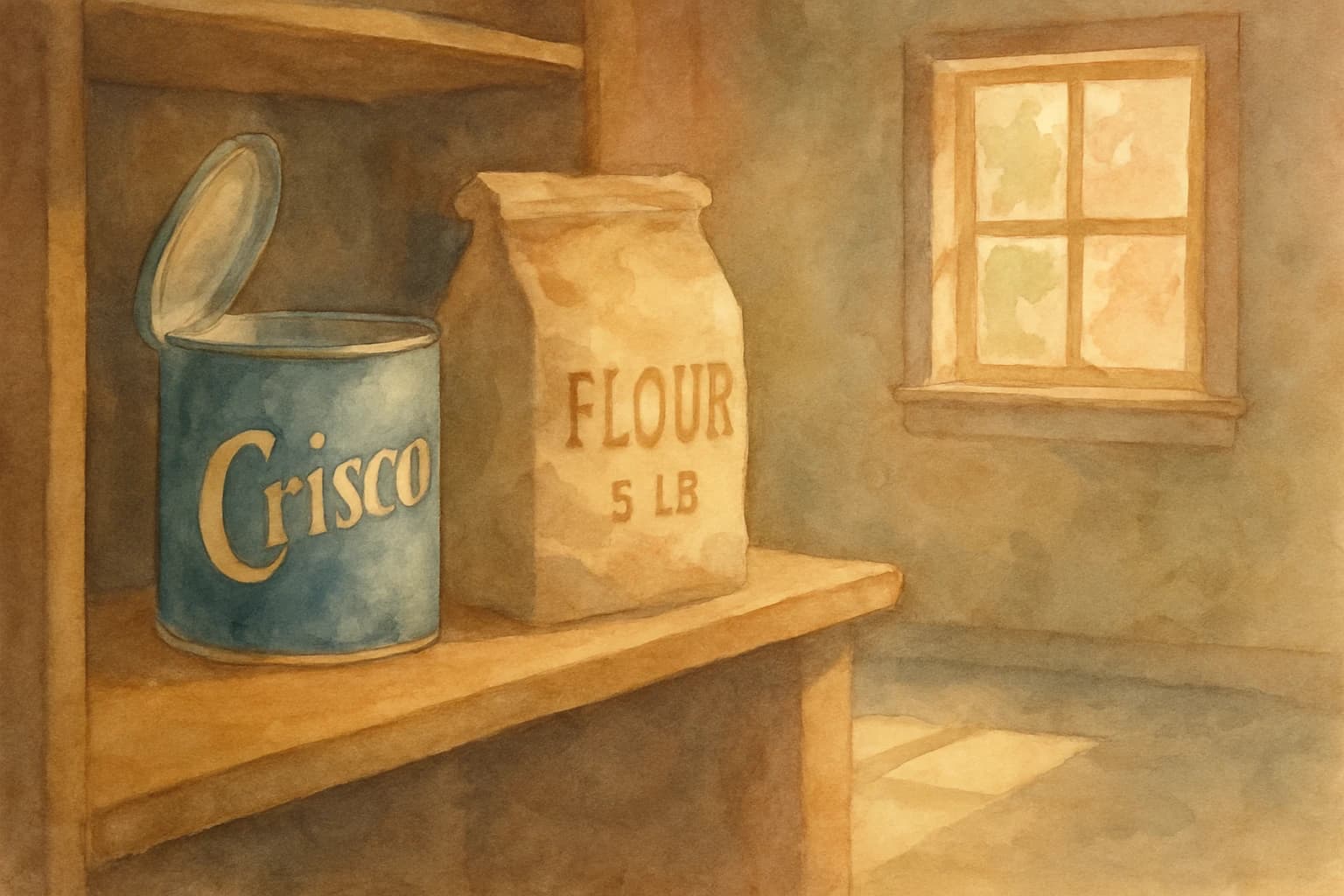
The Smell That Told You You Were Home
Grandma's pantry had a smell you could identify from the hallway.
Not a bad smell, and not exactly a good smell either -- more like a catalog. Flour and paper bags and something faintly sweet from the sugar canister and something faintly medicinal from the shelf where she kept the canning supplies. You opened the door and the smell told you exactly where you were.
The pantry itself was usually a closet off the kitchen, or sometimes just a wall of open shelving behind a curtain, or in older houses a whole separate room with a window and a concrete floor. Whatever the architecture, the contents were remarkably consistent across millions of American households from the 1940s through the 1980s. You could visit a grandmother you'd never met before and find the same ten items in the same kinds of containers, arranged with the same logic.
Here are ten of them.
1. A Five-Pound Bag of All-Purpose Flour
Not a modest bag. Not a box. The five-pound paper bag, usually Gold Medal or Pillsbury, sometimes with flour dust printed faintly into the outside from previous openings. In houses where the baking was serious, the ten-pound bag. The bag sat on the shelf or inside a large canister with a lid that required two hands, and it was never empty because the moment it got low, it went on the list.
This was foundational. Everything came from the flour. The biscuits, the gravy, the pie crust, the dredging for fried chicken. Flour wasn't a baking ingredient so much as a kitchen utility, like a screwdriver, needed for a dozen different purposes and always required to be on hand.
2. Crisco
The blue can, usually the large one. White shortening, solid at room temperature, smelling of nothing in particular until it hit a hot pan. Crisco was introduced in 1911 and by the middle of the century was in virtually every American pantry, because it was shelf-stable, versatile, and cheap, and because the cookbooks of the era were written around it.
Grandma used it for pie crusts. She used it for biscuits. She fried in it when she was cooking light batches and saved the lard for the big ones. She greased pans with it. She may have used it for non-cooking purposes the details of which are lost to history. The can lasted a long time because a little went a long way, and when it was finally empty, you bought the exact same can to replace it.
3. Vanilla Extract
A brown bottle, usually McCormick, usually pure vanilla rather than imitation if she was particular about her baking. The bottle was never more than half full and never quite empty. It had been on the same shelf since before you were born. You opened it and the smell was completely specific -- sharp and sweet at the same time, nothing else smells like that exactly -- and it meant something was being baked.
The bottle lasted because you used a teaspoon at a time.
4. A Coffee Can Full of Bacon Grease
This wasn't purchased. It was accumulated. The coffee can -- Maxwell House, Folgers, whatever brand she bought -- sat on the back of the stove or on the lowest pantry shelf, and every time she cooked bacon she poured the fat off into the can. The can was never washed. The contents were never discarded, or very rarely, only when they'd gone rancid, which happened infrequently because the can cycled through fast enough.
She used it for greasing skillets. She used it to season cast iron. She put it in cornbread batter. She fried potatoes in it. Some grandmothers put it directly on vegetables during cooking, or used it where a recipe might call for butter if butter was running low. The flavor it produced was not subtle. If you ate at her table for any length of time, you knew the flavor without being able to name it.
The coffee can of bacon grease was one of the genuine working tools of the mid-century American kitchen, not decorative, not sentimental, just functional. It was the byproduct of one thing being used to make another thing, which was how the kitchen was supposed to work.
5. Evaporated Milk
The squat can, usually Carnation. One or two extras on the shelf, sometimes more. Evaporated milk was shelf-stable in a way that regular milk was not, and it had been a pantry staple since the Depression, when keeping a cow wasn't an option and refrigeration wasn't reliable. By the 1960s and 1970s, the original practical reasons had mostly gone away, but the recipes hadn't changed, and neither had the habit.
She put it in pumpkin pie. She put it in fudge. She used it in places where cream would have been the obvious choice, because the can was always on the shelf and cream required a trip to the store.
6. Cornmeal
The bag looked like the flour bag, same size, same weight. Yellow or white depending on the region of the country and the family's background, and grandmothers in the South had opinions about this that were not negotiable.
She used it for cornbread, obviously. She used it to dredge fish. She dusted the bottom of bread pans with it. She might have made mush with it on cold mornings, a dish that has almost entirely disappeared from American tables. The cornmeal was just always there, and the baking it produced was different from anything that came out of a box mix -- denser, plainer, less sweet.
7. Baking Soda and Baking Powder
These always sat together. Usually the orange box of baking soda and a metal can of Calumet baking powder, the one with the Native American headdress on the lid. They looked like a pair because they were used as a pair, though not in the same recipe at the same time, and grandmothers understood the chemistry of when to use which one even if they couldn't have explained it in those terms.
The baking soda had a second life as a refrigerator deodorant, sitting open on the shelf with its top torn back, absorbing smells. Grandma replaced it roughly every six months.
8. A Jar of Peanut Butter
The large jar, usually Jif or Peter Pan or Skippy, smooth. On the shelf where the grandchildren could reach it, which was not always an accident. Peanut butter was a hedge against the problem of a grandchild who didn't want what was being served, but it was also a genuine pantry staple used in cookies and on celery and eaten directly off a spoon by grandmothers who would deny this if asked.
9. Canned Tomatoes
Multiple cans. Usually whole or crushed, name brand or store brand, it depended on the budget and the recipe. If she'd done any home canning herself, there were Mason jars of tomatoes instead, or in addition to. She put them in soups and in the sauce for meatloaf and in the winter stew that used up whatever was left in the freezer. The pantry that had canned tomatoes in it was a pantry that could produce a meal on short notice, and grandmothers understood this in a structural way that went beyond recipe-following.
10. Powdered Sugar
The box, one-pound usually, with the pour spout. It got used in frosting and in certain cookies and in the powdered doughnuts she made at Christmas. It sat on the shelf year-round for eleven months, and then December happened and the box was gone and replaced and sometimes gone again.
What shouldn't come back
Some of what was in that pantry deserves to stay in the past. Crisco has been mostly replaced by butter and olive oil in contemporary baking, and the health case for that swap is real -- the partially hydrogenated vegetable oils that made Crisco what it was turn out to have been genuinely hard on the cardiovascular system. The results of the old recipes were good. The long-term effects were not.
The coffee can of bacon grease is another one that requires some honesty. The flavor was excellent. The habit of never washing the can and leaving rendered fat at room temperature for weeks at a time was not, from a food-safety standpoint, a practice that should come back at scale. Do it if you want, and you'll survive it, but don't be surprised if the health inspector has a different view.
And evaporated milk, which anchored so many Depression-era and postwar recipes, mostly just went into those recipes because fresh dairy wasn't always available. Now it is. The recipes that required it have been updated, and the updates are usually better. The pantry that keeps evaporated milk on hand in 2025 is mostly doing it for nostalgia, not necessity.
The pantry itself, though -- the physical fact of a well-stocked shelf that could produce a meal without a trip to the store -- that part holds up. The ingredients change. The principle doesn't.
What did your grandmother always have on hand? Was there something in her pantry you've never found anywhere else? We'd love to hear about yours in the comments.
Get a new story every Sunday morning.
One email a week. No spam. Unsubscribe anytime.
If this brought back a memory, you might also like
15 Things Every Kid's Bedroom Had in 1985
You had to duck under a Duran Duran poster to knock, and recorded radio songs by pressing play and record while hoping the DJ stayed silent.