15 Things Every Kid's Bedroom Had in 1985
The door had a sign on it.
Sometimes it said KEEP OUT. Sometimes it was a name plate from the fair, embossed in fake brass, hung at eye level as an official declaration. Sometimes it was a poster of a band taped across the upper panel so you had to duck under Duran Duran to knock. The point was the same: this room belonged to someone, and entry required acknowledgment of that fact.
The American kid's bedroom of 1985 was a territory, a museum, and a construction project all in one. It held everything its occupant cared about, in whatever arrangement they had decided on that month. What follows is a record of what was in it.
1. A Boom Box on the Dresser
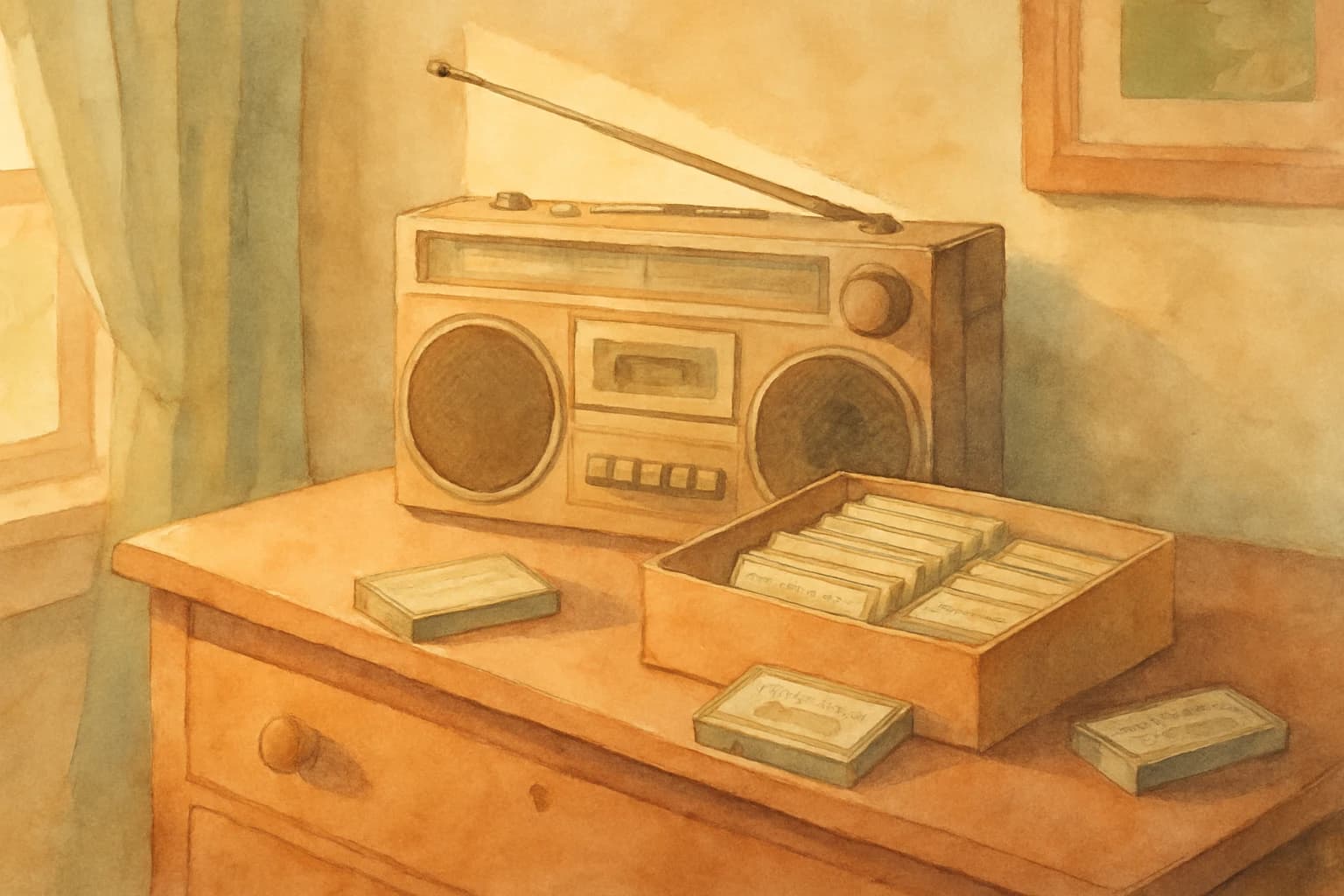
Not a stereo system. A boom box: a single unit with two speakers, a handle on top, an AM/FM tuner on one end, and a dual cassette deck so you could record off the radio onto a blank tape. The model your family could afford sat on the dresser, and you ran it off four D batteries or the AC adapter you could never find.
You recorded songs off the radio by pressing play and record simultaneously and then sitting very still, hoping the DJ wouldn't talk over the end. The cassette tapes accumulated in a shoebox or a carousel on the dresser. Each one had a paper label filled in with a ballpoint pen, with the song titles in whatever handwriting you used at fourteen.
The volume knob had a dead spot somewhere around seven. You learned to work around it.
2. A Poster Situation That Had Outgrown Its Wall
The posters came from Walgreens, from Spencer Gifts at the mall, from fan club envelopes, from magazine pullouts. They were tacked or taped or stapled to the wall in a layering system that built up over years. The bottom layer was the original inhabitants, whoever you liked in sixth grade. The top layer was who you liked now.
The wall behind the door was the gallery wall. The wall above the bed was reserved for whoever you were most serious about. Some kids got matching frames. Most didn't. The corner where two walls met always had a drift of overlapping edges because you ran out of flat wall before you ran out of posters.
3. A Shelf of Paperback Books With Broken Spines
The books from school were somewhere else. The books on this shelf were yours. Judy Blume. Stephen King. The Hardy Boys or Nancy Drew in the older editions, paperback, read so many times the spine was white along the crease. Choose Your Own Adventure, multiple copies, the endings you'd already picked marked by a torn corner.
The shelf was not organized. The books were stacked horizontally on top of vertically shelved books because there were too many of them. Nobody cared. The disorder was part of it.
4. A Desk That Didn't Get Used for Homework
The desk was against the wall under the window, or in the corner, or squeezed next to the closet. It had a lamp on it, a cup of pencils, and whatever the occupant was currently building, drawing, or taking apart. Homework got done on the bed, or on the kitchen table, or at the last possible minute in the morning before school.
The desk drawer had a particular inventory: broken pencils, rubber bands, a dried-out pen or two, a few coins, a friendship bracelet that lost its wearer, a birthday card from a year ago. Nobody ever cleaned it out. It just accumulated.
5. A Sleeping Bag on the Floor
Kept for sleepovers, draped over the foot of the bed between uses. The good one had a plaid flannel interior. The less good one had thin synthetic fill that bunched at the bottom by 2 a.m. Either way, it was always out. Putting it away implied it wouldn't be needed soon, and it was always needed soon.
6. A Collection of Something
Baseball cards in a binder with plastic pages, one card per slot. Or Garbage Pail Kids in a rubber-banded stack. Or Hot Wheels on a low shelf arranged by color. Or stuffed animals packed across the top of the bookcase, some from years back, kept not because they were played with but because getting rid of them felt wrong.
The collection was the room's statement of intent. It said: I am the kind of person who keeps track of things. Some kids had one clean collection. Some had three or four going at once, in varying states of organization. The mess was the autobiography.
7. Glow-in-the-Dark Stars on the Ceiling
The plastic ones that came in a bag from Toys R Us, pressed onto the ceiling in whatever arrangement seemed right at the time. Some kids did constellations. Most did a rough scattering that was more optimism than astronomy.
They lost their charge fast. By the time you'd been in bed long enough to actually need them, they were dim. But for the first ten minutes in the dark, before sleep, they were there. That was enough.
8. A Television Set (If You Were Lucky)
Not a flat screen. A 13-inch CRT, heavy, with a dial or a row of buttons down the front face. Given by grandparents, or handed down when the living room upgraded. Sat on the dresser or on a low shelf with the rabbit ears adjusted to a position that had been found through trial and error and then never touched again.
Cable was not guaranteed. In some bedrooms it was three clear channels and two snowy ones, and you watched what was on, or you didn't watch. The privilege of a TV in your room was considerable. It was understood as such.
9. A Phone (If You Were Very Lucky)
A separate line was a fantasy. What you had, if you had anything, was a second handset on the household line, cord trailing under the door and down the hall. You pulled it into your room by the cord. Your parents could pick up the other phone and listen, and you knew it, and you talked anyway.
The phone in the bedroom in 1985 was not private. It was the illusion of privacy. The conversations happened regardless.
10. A Mirror With Things Stuck in the Frame
The mirror above the dresser, or the full-length one on the back of the door, accumulated a border of tucked-in objects. Photos from school picture day. Notes from friends, folded into squares. A birthday ribbon. A ribbon from a race. A ticket stub from a concert or a movie.
The frame was the bulletin board for things too fine-grained or too personal for the poster wall. It was the private record, visible only to whoever stood close enough to look.
11. A Pile of Clothes That Wasn't Quite Dirty
The chair in the corner, or the floor in front of the closet, held the middle category. Not clean. Not dirty enough for the hamper. Worn once, or twice, and waiting for a decision that never came. Every kid's bedroom had this pile. Most adult bedrooms still do.
12. A Flashlight Under the Pillow
Or in the nightstand drawer. For reading after lights-out, for the walk to the bathroom at 3 a.m., for the camping trip that was coming up in a month. The batteries were usually low. The beam was usually yellow instead of white. You read by it anyway, under the covers, close enough to the page that the warmth of the bulb was noticeable.
13. Sports Equipment That Didn't Have a Better Place
A baseball glove on the closet shelf, draped with the ball inside to keep the pocket shaped. Shin guards propped against the wall. Roller skates under the bed. A tennis racquet that hadn't been strung in two years. The bedroom was the equipment room because no one had built a better solution for where the things you used seasonally were supposed to go.
14. A Bulletin Board With a System Nobody Else Understood
Cork board, usually, in a wood frame, hung above the desk. Covered in layers. Class schedule in one corner, pinned to stay. Report card somewhere behind something else. Phone numbers written on index cards. Photos. A map torn from a magazine. A few pins with no function beyond being pins.
The system was clear to the person who made it. Nobody else needed to understand it. That was the point of having a bulletin board in a room with a sign on the door.
15. A Lock That Didn't Work Very Well
Or a hook-and-eye latch that could be popped with a credit card, or a doorknob lock that the key had been lost for, or a chair wedged under the handle in the international gesture of wanting to be left alone. The security was not the point. The statement was.
The bedroom said: this is mine, I am here, knock first. The lock was the architectural version of the sign on the door.
What Shouldn't Come Back
Let the record show: the glow stars lost their glow before you fell asleep. The boom box ate tapes at random. The rabbit-ears television got three channels clearly and two more if you held the antenna and stood at an angle the whole time. The chair pile was a genuine fire hazard. The phone your parents could pick up and listen to was not a great arrangement for anyone.
And the room was cramped. Often shared. Often cold because it was above the garage, or hot because it faced west. The privacy was partial and theoretical. The freedom was real, but the room itself was modest in a way that memories tend to edit out.
What it had was density. Every square foot held something that belonged to someone. The mess was information. The collections told you who was in there. The posters told you what they cared about. The flashlight under the pillow told you they weren't ready to stop yet.
That density is harder to replicate than it looks. You can buy new furniture. You can hang a bulletin board. You can put a boom box on the dresser if you want to go looking for one. The density comes from years of accumulation, from treating a room as a place where everything you care about eventually lands. The kids who had rooms like this didn't design them. They just lived in them long enough.
What was in your bedroom in 1985? What's the one thing you remember most clearly? Drop yours in the comments -- we'd love to hear it.
Get a new story every Sunday morning.
One email a week. No spam. Unsubscribe anytime.
If this brought back a memory, you might also like
The Faded Ritual of the Two-Finger Wave
Two fingers lifted briefly from the steering wheel, tilted upward then down, lasting only half a second to buy a piece of local goodwill on a gravel road.