The Faded Ritual of the Two-Finger Wave
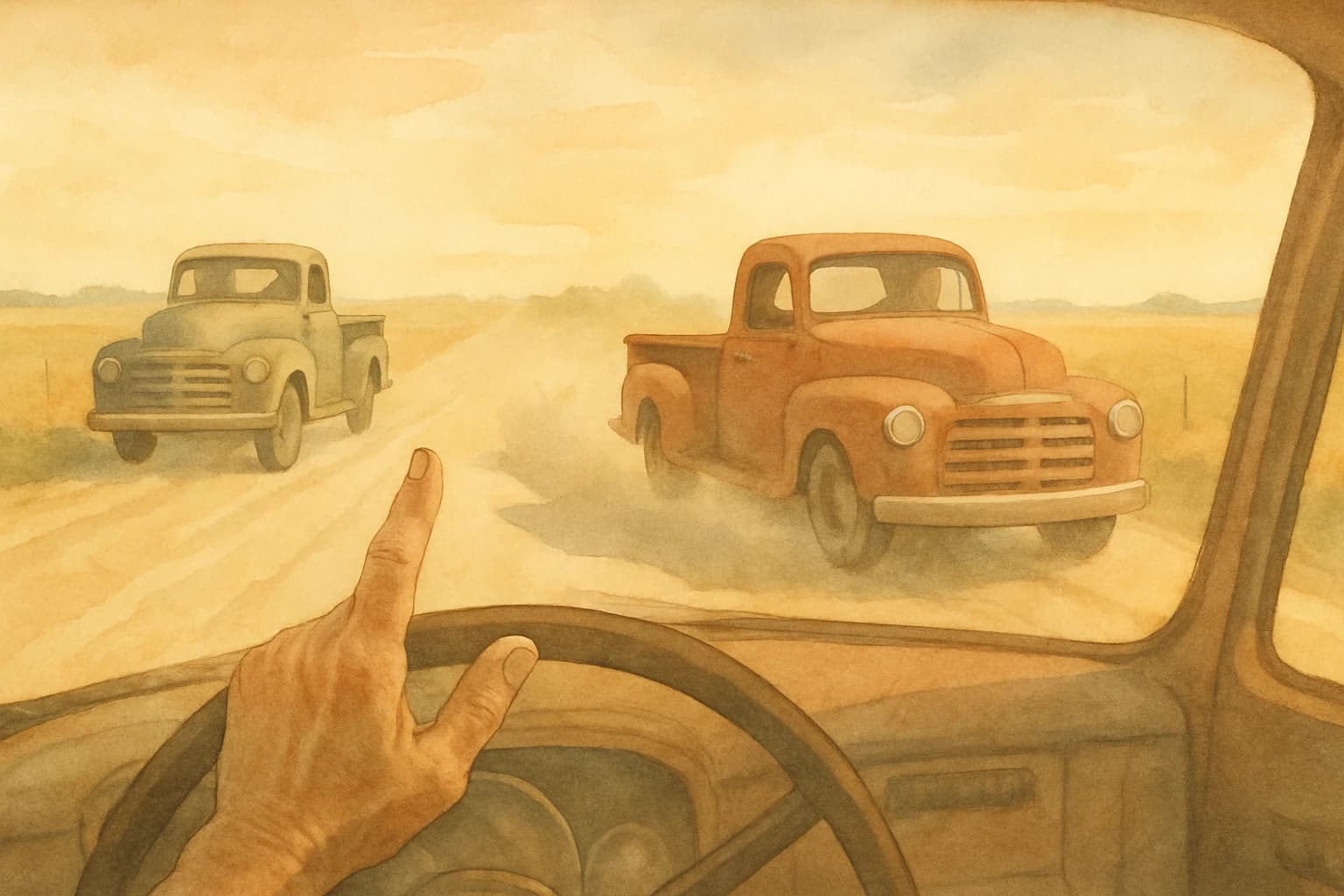
You lifted two fingers off the steering wheel, and the other driver did the same, and that was it.
No eye contact, usually. No full hand wave. Two fingers, or maybe a full flat hand raised briefly off the wheel, tilted slightly upward, then down. The whole thing lasted about half a second. The other car went by. You kept driving. Nothing else happened.
This was the driver's wave, and if you grew up in rural America or a town of any kind, you did it automatically. You did it the way you said excuse me when you bumped into someone -- not because you were thinking about it, but because not doing it would have required an active decision to withhold.
It happened because you probably knew the other person, or knew someone who knew them, or would shortly be encountering them in a church or a feed store or a school parking lot, and the acknowledgment cost you nothing and bought a piece of goodwill in a place where goodwill was the local currency.
Where It Lived
The driver's wave was always a rural and small-town phenomenon. If you grew up in Chicago or Los Angeles, this piece of writing may read like anthropology. The urban driver did not wave, and for good reason -- on a city expressway at rush hour, acknowledging every car you passed would occupy both hands and your entire attention simultaneously.
But on a two-lane county road in Missouri, or a mountain highway in western North Carolina, or a gravel road outside a Nebraska town of eight hundred people, you waved. The road was narrow. The traffic was thin. And when you passed someone, there was a reasonable chance that person was your neighbor, your cousin's husband, the man who ran the grain elevator, the woman whose kid played on your kid's baseball team. You didn't know for certain who was in the oncoming car, but you knew the car well enough. A green Ford pickup with a dent in the rear quarter panel -- that was the Hendersons. You waved.
In the smallest towns, some drivers recognized every single vehicle in the county by sight. They didn't need to see the driver's face. They knew the truck, and they knew who drove it, and the wave confirmed the recognition. It was a distributed social database running on two-lane roads.
The Hierarchy
The wave had gradations that were never written down but were universally understood.
Strangers got the index-and-middle-finger lift. Two fingers off the top of the steering wheel, held for a beat. This was the minimum polite acknowledgment. It said: I see you. We are both using this road. I mean no harm. It cost nothing and expected nothing in return.
Acquaintances got the full hand lift. All four fingers off the wheel, sometimes with the palm slightly outward. This was recognition without warmth.
Neighbors and people you actually liked got the full open hand, sometimes held a moment longer, sometimes accompanied by a nod of the head.
And then there were the people you were genuinely glad to see, and on the back roads with no one else around, both cars would sometimes slow down and window-to-window a conversation lasting thirty seconds about whether the creek was flooding or whether the weather had broken yet, and then both drive on, and this was also considered normal and not at all inconvenient.
What It Required of the Roads
The driver's wave required conditions that have mostly been engineered away.
It required slow speed. At sixty-five on a four-lane highway, you can't manage a wave in time. At thirty-five on a county road, you have several full seconds of awareness that another car is approaching, time enough to read the vehicle and decide.
It required low traffic volume. When you are passing forty cars in ten minutes, the wave becomes impossible to sustain. It was designed for roads where passing another car was an event, not a constant background condition.
It required driver visibility. The wave depended on seeing the other driver, and on being seen. The old trucks and cars sat high or had large windows. Tinted glass started killing the wave in the 1990s. If you can't see the driver, the exchange breaks down -- you're waving at a smoked windshield, and you feel slightly foolish.
And it required that the driver not be looking at something else. Which is where we land now.
The Honest Counterpoint
Before this gets too elegiac, there is a thing worth saying plainly.
The road culture that produced the wave was also producing something else at the same time. The surveillance was mutual. Everyone knew your car and knew approximately where you had been and for how long. If you were a woman driving alone somewhere unusual, you were noticed. If you were new in town and driving around unfamiliar neighborhoods, you were noticed. If you were not white, in certain communities in certain decades, being noticed on a back road was not a warm social exchange -- it was a risk assessment, and sometimes worse.
The web of mutual recognition that made the wave feel like community had another side, which was that it made anonymity difficult and difference conspicuous. The same infrastructure of knowing-everyone's-car that produced the friendly wave produced the phone call to a neighbor saying I saw your daughter's car at so-and-so's house on Saturday. The community fabric was tight because it bound everyone inside it, and the ones it bound most tightly were not always the ones for whom tightness was comfortable or safe.
The driver's wave came out of a culture where everybody knew everybody, and that culture was easier to romanticize from inside it than from outside it.
What Actually Killed It
The tinted window helped. The pickup truck that sat eight feet above the road and sealed you inside a climate-controlled capsule helped. The GPS that tells you you're in the right place, so you no longer need to read a road by its landmarks and vehicles, helped.
The phone finished the job.
The phone didn't kill the wave by making drivers malicious or rude. It killed it by filling the five-second interval where the wave used to live. You are now almost never simply sitting behind a steering wheel with nothing demanding your attention but the road. You have something in your hand, or you are listening to something, or you are talking to someone who isn't in the car, and the incoming vehicle on the two-lane ahead of you enters and exits your peripheral vision without ever fully coming into your focus.
You can't wave at something you haven't noticed.
Who Still Does It
The motorcycle riders still wave at each other on open roads. Different hand positions for different tribes -- the cruiser riders, the sport bike riders, the touring cyclists -- but the underlying gesture persists. Something about being on two wheels in the open air recreates the vulnerable-and-aware posture that produces the instinct to acknowledge.
Rural county roads still have it, in places. There are parts of Montana and the Ozarks and the Carolina piedmont where the two-finger lift is still the default. The conditions that produce it -- sparse traffic, known vehicles, a community tight enough that any car is potentially someone you should acknowledge -- haven't disappeared everywhere. They've just become rarer.
Old-timers will sometimes wave on roads where waving stopped being the norm thirty years ago, because the habit is deep enough that it doesn't require reciprocation to continue. They wave and the other driver doesn't wave back, and they wave at the next one anyway. The reflex outlasted the context that built it.
The Ordinary Thing That Was Real
The driver's wave was never about the wave.
It was about the acknowledgment. You are in a machine traveling at speed through a shared space, and the other person in the other machine is also your neighbor, or might be, or might become one. The lift of two fingers said: I know you're there. We're using the same road. We're fine. In a landscape where you might not see another vehicle for twenty minutes, that exchange was the social infrastructure of the road.
We mostly drive now without acknowledging anyone around us. The car is a sealed environment, and the other cars are obstacles and variables to be managed, not people to be registered. The roads are faster and more complex than they used to be, and highway driving requires a kind of focused attention that isn't compatible with social exchange. That part is understood.
But something was communicated by the two-finger lift, for decades, on the back roads of this country, that doesn't get communicated anymore. The acknowledgment that you are not alone out here. That the person coming the other direction is a person.
It took half a second and it cost you nothing and it's mostly gone.
Do you still wave at other drivers? Did you grow up somewhere the wave was automatic? We want to hear your version in the comments.
Get a new story every Sunday morning.
One email a week. No spam. Unsubscribe anytime.
If this brought back a memory, you might also like
The Last Icebox Cake
Layered chocolate wafer cookies sat overnight in an icebox, absorbing cream until they sliced like cake, a technique lost when the wafers vanished from shelves.