Church Picnics, Potlucks, and the Foods That Held Communities Together
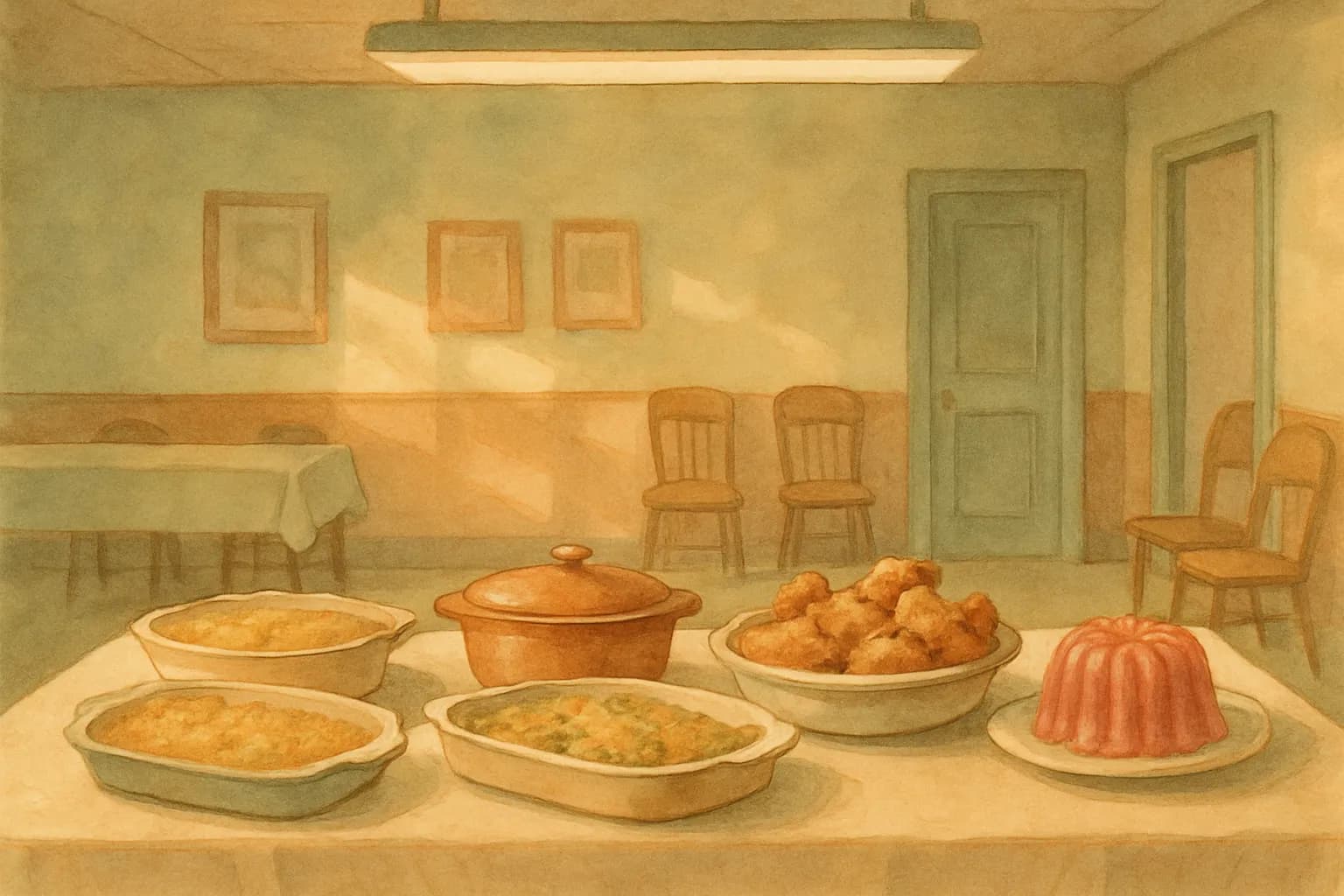
The folding tables came out of the church basement at nine in the morning, set up end to end in the fellowship hall, covered with paper tablecloths that were taped down at the corners against the wind from the propped-open door.
By eleven, the tables were full. Tuna noodle casseroles still warm from somebody's oven. Three different versions of green bean casserole, in three different glass dishes, brought by three different women who would later compare. A ham, sliced thin. A platter of fried chicken from the woman who was famous for it. Deviled eggs under plastic wrap. A pot of macaroni and cheese. A glass dish of Jell-O salad with mandarin oranges suspended in it. Rolls, butter, pickles, olives.
At the end of the tables: the desserts. Pies of every kind. A 13×9 pan of brownies. A coconut cake. A lemon bar tray. A bowl of fruit salad that no one would touch until everything else was gone.
This was a church potluck. There was one in every small town in America, every Sunday or every other Sunday, for most of the twentieth century. They are mostly gone now, and what's gone with them is more than the food.
Before we go further: this is not really a religious piece. The church potluck was a community mechanism that happened to use the building of the church to do its work. The same thing existed in other forms -- union halls, lodge meetings, grange hall suppers, school cafeteria fundraisers. The church one is the most universally remembered version, and the most thoroughly lost.
What the potluck actually was
You brought a dish. The rule was unspoken: bring enough to feed your family plus four. The result was an enormous quantity of food, every Sunday, with no central planning and no budget, that fed everyone who showed up regardless of whether they had brought anything.
A widow in her eighties who could no longer cook could still eat well at the potluck. A young family who'd hit a rough month could feed all four kids and not be charged. A traveling visitor could be welcomed in. A teenager who'd come because his friend dragged him got a plate, and the women fussed over him about whether he was getting enough.
It was redistribution by abundance. Nobody had to ask for help, because there was always more food than people. The dignity of the people who needed it was protected by the structure of the meal itself.
This is harder to engineer than you'd think. Most modern attempts at community meals require sign-ups, food stamps, donation forms, eligibility checks. The potluck required none of it. You walked in. You ate.
The dishes were the people
You knew who had made what. After two or three potlucks, the regulars learned every cook's specialty.
Mrs. Henderson made the fried chicken -- and only the fried chicken, because everyone wanted hers and she didn't have the time to make anything else. Mrs. Kowalski's pierogies were the dish you got to first because they ran out. The Baptist deacon's wife had the lemon meringue pie that won the county fair three years running. The young mother who was new in town brought a Jell-O salad with cottage cheese and pineapple that nobody quite knew what to do with, but everybody took a polite spoonful, and over the next two years she developed a repertoire that was hers.
The dishes carried the stories. That's the cake Beverly made for her son's homecoming from Vietnam. That's the bread recipe Aunt Ruth brought from Hungary in 1948. That's the same potato salad Helen's mother used to bring before Helen took over. The meal was a slow, edible archive of the community's history, served on paper plates.
When a woman died, her signature dish disappeared from the table, and everyone noticed. Sometimes a daughter took it up. Sometimes nobody did, and the dish was gone for good. The absence was felt as a small grief, every potluck, for years.
What it did that nothing else has replaced
The deepest work of the potluck wasn't the food. It was the mixing.
Three generations sat at the same long table. The teenager who would never have voluntarily talked to a 75-year-old farmer found himself across from one, eating green bean casserole, and over the course of forty minutes they talked about engines, or weather, or the high school football team, and the teenager left with one more adult in his life who knew him.
The wealthy family in the third pew sat down next to the family whose father was in and out of work. They ate the same food. Their kids played together afterward in the parking lot. Class was not erased -- everyone knew who had money and who didn't -- but it was lowered into the background by the structure of the meal. You can't preserve class hierarchy while passing the rolls.
People who were grieving were absorbed into the meal. Newcomers were absorbed into the meal. The lonely man whose wife had died last year was absorbed. The young couple from out of state who'd just moved in was absorbed. You can't engineer this. It happened because everyone was eating in the same room at the same time, with no agenda, on a recurring schedule, for a hundred years.
What killed it
A few things, none of them dramatic.
Church attendance has been declining in America for fifty years. The potluck depended on the church being the gravitational center of a community's social life. As the gravity weakened, the meal weakened with it.
Two-career families had less time to cook. The casserole that took an hour to assemble on Saturday afternoon got swapped for a tray of store-bought cookies, then for a bag of chips, then for nothing -- we'll just bring ourselves this week. Eventually the math stopped working.
Food safety concerns arrived. Health departments in some jurisdictions began regulating community meals, requiring commercial kitchens and food handler permits. The casual potluck -- a hundred women's home-cooked dishes on a folding table -- became technically illegal in some places. Most churches kept doing it anyway, but the ones that didn't quietly stopped.
And finally, our suspicion of strangers grew. Eating food prepared in a stranger's kitchen, by a hand you can't see, requires a baseline trust that has decayed in measurable ways since 1970. We are more careful now. We are also lonelier.
What the secular versions are trying
The function the potluck performed is real, and the absence of it shows up in surveys about loneliness, in the rising rates of social isolation among older Americans, in the decline of casual cross-generational contact.
A few movements are trying to bring it back. Block parties are getting more organized in some neighborhoods. "Community fridges" have appeared in cities. Mutual aid networks did real work during the pandemic and some of them have continued. Some community gardens host monthly suppers. A handful of secular potluck dinner movements have emerged in cities.
Most of them work, somewhat. None of them work as well as the original, because the original had a building, a weekly recurrence, and a 200-year tradition of showing up. You can't manufacture two hundred years of habit.
What you can do
If your church still does a potluck, go. Bring a dish. Bring enough to feed your family plus four.
If it doesn't, organize one yourself, in any structure that's available to you. A neighborhood. A workplace. A circle of friends. The mechanism is simple: pick a recurring day, set up a table, ask everyone to bring something, and don't charge admission. Do it monthly for a year. Watch what builds.
The dishes don't have to be fancy. The Jell-O salad is allowed back. The casserole is allowed back. So is the lemon bar tray.
The point was never the food, but the food is how the work gets done.
The point was never the food, but the food is how the work gets done. It always was.
Get a new story every Sunday morning.
One email a week. No spam. Unsubscribe anytime.
If this brought back a memory, you might also like
Recipes Your Mom Made From Almost Nothing -- and Why They Still Taste Better
Made from what was in the pantry, what was on sale, and what was left over from Sunday. These Depression-era recipes cost almost nothing, fed the whole family, and tasted better than half of what we eat now.