The Quiet Generation: Why Our Fathers Didn't Talk About Themselves
He came home at 5:45.
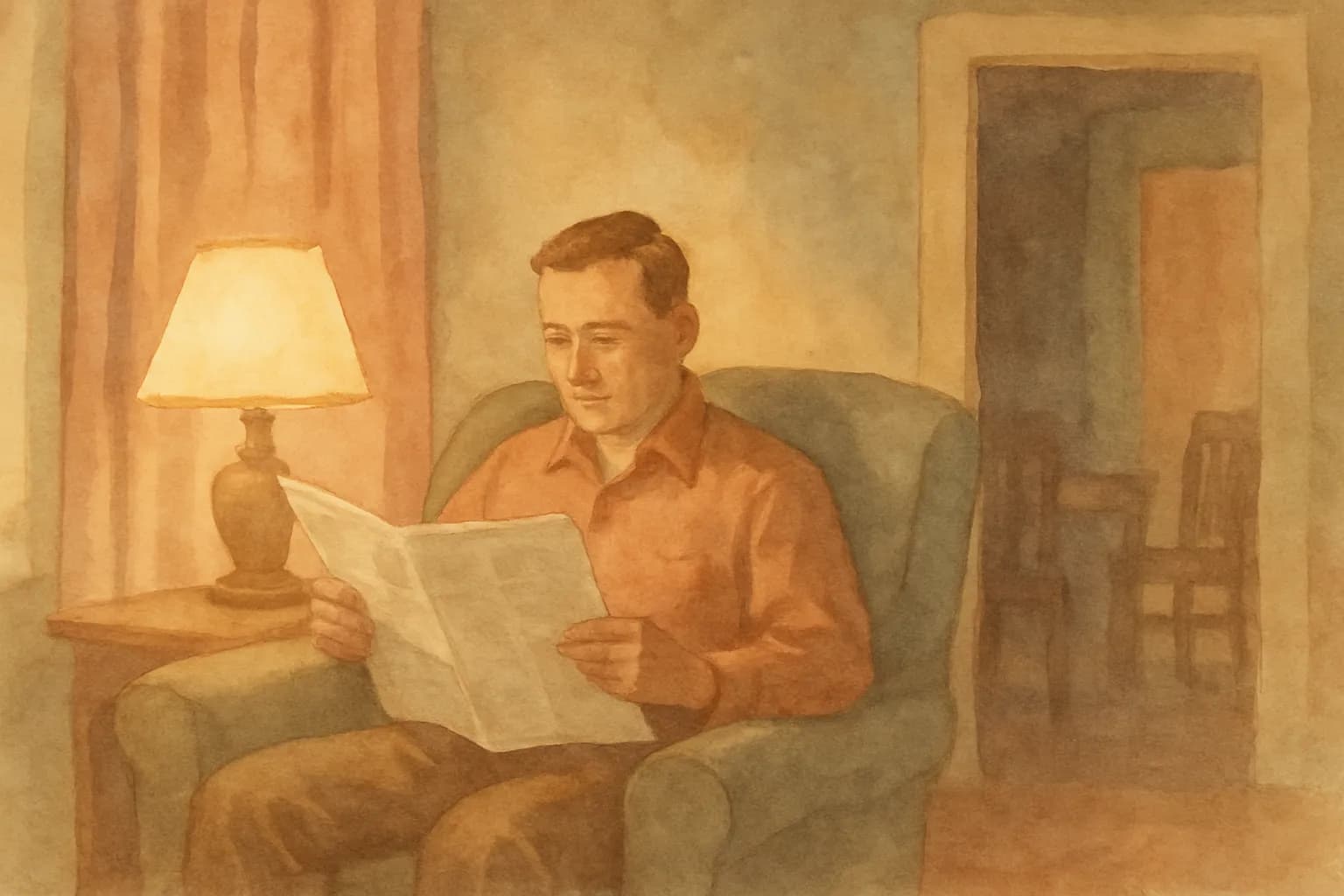
He took off his work boots at the back door. He hung up his jacket. He washed his hands at the kitchen sink. He sat down at the table and ate the dinner your mother had spent the afternoon making, and he asked you about school, and he listened, and he didn't say much about his own day. Then he watched the news. Then he fell asleep in the recliner. Then he got up and did it again the next morning.
If you grew up with a father like this, you probably didn't think about him much. He was there. He was steady. He was not, by any visible measure, a man with a complicated inner life. Or if he was, he kept it to himself.
A lot of American fathers between roughly 1945 and 1990 were like this. They are still like this, the ones who are alive. They did not talk about themselves. They did not share feelings. They did not write memoirs or unpack their childhoods or process their losses out loud. They just did the work, every day, for forty years, and then they retired, and then they got old, and then they died, and a lot of what was inside them died with them.
This Father's Day is worth spending a moment on what that generation was, and what we got from them, and what was paid for what we got.
The men who didn't talk
The fathers I'm describing came home from a war, mostly. World War II for the oldest. Korea for the next batch. Vietnam for the younger ones. The ones who didn't fight worked through the same decades and knew the ones who did.
They came back, and they didn't talk about it. Not to their wives, not to their children, not to anyone outside the men they had served with. Some of them met those men once a year at a Legion hall and talked there, briefly, before going home and not talking about it again.
This silence was not a personal failure. It was the cultural shape of American masculinity in their era. The men of that generation had been raised by men who did not talk about themselves either. The expectation, passed down through several generations, was that a man's job was to provide and to endure, and that the parts of himself he wasn't using for those two purposes could remain private.
The cost of this was real, and we should be honest about it. A lot of those men drank too much. A lot of them were emotionally distant from their children, even when they were physically present. A lot of them carried trauma they could have processed in therapy but didn't, and the trauma showed up sideways in shorter tempers and longer silences and marriages that worked but did not exactly thrive.
We've spent the last thirty years correcting for this. The current generation of American fathers is, on average, more emotionally available than their fathers were. They go to therapy. They cry at their kids' games. They tell their sons they love them out loud. This is mostly progress, and the men of the Quiet Generation, even when they don't fully approve of it, mostly recognize that their own grandchildren are getting something they themselves didn't get.
But it would be incomplete to talk about what their silence cost without also talking about what their silence built.
What you got from them anyway
He may not have told you he loved you. He showed you by getting up at five in the morning for forty years to go to a job he mostly didn't like, so that you could have shoes and braces and a college fund.
He may not have talked about his childhood. He drove you to your own childhood at six in the morning on a Saturday to your hockey game, sat in a cold rink with a cup of bad coffee, and watched you skate for an hour without complaining.
He may not have processed his feelings about his own father. He did the things his father had not done. He came to your school plays. He helped with your homework. He taught you to drive in the parking lot of the grocery store on Sunday mornings, with patience he had never been shown himself.
He may not have explained any of his theory of parenting. He had no theory. He just did things. The things accumulated, over the eighteen years you lived in the house, into a kind of unspoken curriculum of how to be a steady adult, and you absorbed it whether you meant to or not.
A man who shows up at five-forty-five every evening for forty years has communicated something, even if he has not said much. The communication is in the showing up. The fact that you cannot quote him on his philosophy of fatherhood does not mean he did not have one. It means his philosophy was demonstrated in his actions, on a daily basis, for the entire span of your childhood, and you may have failed to recognize it as philosophy because it didn't come with a speech.
What we learned at their funerals
The funerals of these men are often surprising. People who hardly knew you stand up and tell stories about your father that you never heard.
The widow he gave the lawn mower to without telling anyone. The teenager he hired at the shop and quietly mentored for ten years. The check he wrote to a friend in trouble in 1982 that nobody knew about. The Sundays he spent helping his neighbor rebuild a deck without being asked. The men he served with whom he kept in touch with for fifty years through Christmas cards.
You learn, at the funeral, that your father had a whole life you knew nothing about, and that the life consisted mostly of small kindnesses he never mentioned to anyone, and that there are now twenty people in the room because of those kindnesses, and you didn't know about any of it.
This is a specific and disorienting grief. You realize you didn't know him the way other people did. The version of him you knew was the one he chose to show his family, which was the steady provider, the man at the dinner table, the recliner-sleeper, the lawn-mower-fixer. The other versions of him, the ones his friends and coworkers and former soldiers knew, are now permanently inaccessible, and the people telling you about them are the only record left.
If your father is still alive, and he is the kind of man who doesn't talk about himself, you have a small window to find out who he was when he wasn't being your father. Ask him. He may not tell you. He may tell you more than you expected. The asking is what matters.
A note on what they would not want us to say
Most of these men would be uncomfortable with this article.
They did not want to be lionized. They did not consider themselves heroic. They thought they were doing the basic thing a man does, which is take care of the people in his charge, and they did not understand why anyone would write about that.
We are writing about it anyway, because the generation of men who built American postwar life mostly didn't get the acknowledgment they earned, and most of them are now in their seventies and eighties, and some of them are gone, and the window for acknowledgment is closing.
If your father is alive, call him this Father's Day. Don't make a speech. Don't try to get him to talk about feelings he doesn't have words for. Just call. Ask him how he is. Listen to what he says about the weather and the lawn. He has been listening to you for fifty years. You can listen back for fifteen minutes.
If your father is gone, take an afternoon and remember what he did when nobody was watching. Then tell your kids one thing he did that they never knew. The chain of his quiet work continues, in small ways, as long as somebody is still passing the stories down.
He didn't talk about himself. He didn't need to. The work spoke. We just needed time to learn how to hear it.
He didn't talk about himself. He didn't need to. The work spoke, and it is still speaking, long after he stopped.
Get a new story every Sunday morning.
One email a week. No spam. Unsubscribe anytime.