15 Things in Every Grandmother's Kitchen Drawer That Nobody Owns Anymore
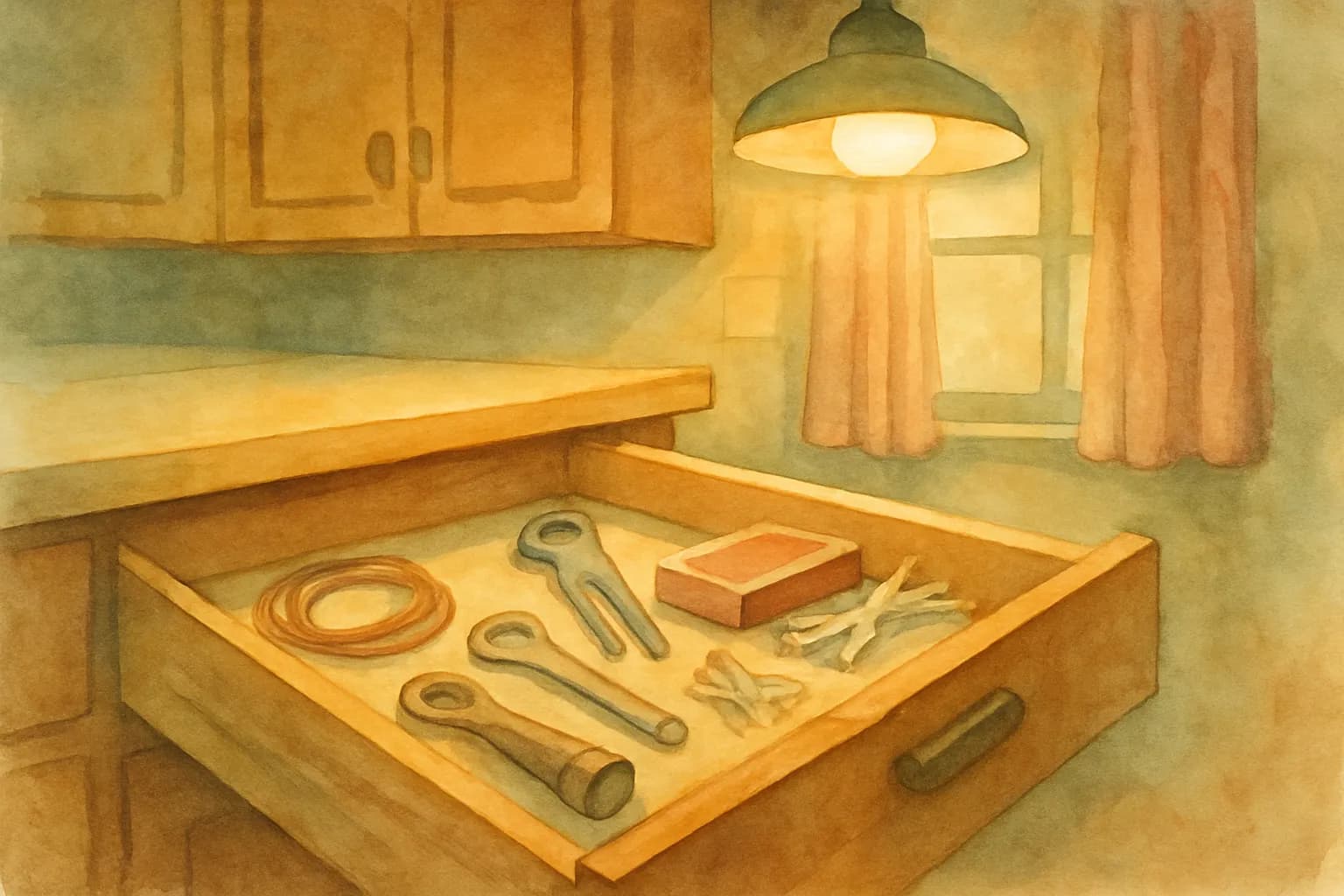
Open the second drawer down in any American grandmother's kitchen between about 1955 and 1990, and you would find roughly the same collection of objects.
Some of them she used every day. Some of them she used twice a year. Some of them she had not used in a decade and could not have explained why she was keeping. But they were all in there, in the same arrangement, getting moved around as she rummaged for the one she actually needed.
Here are fifteen of them. Most of you reading this can picture the drawer right now.
1. The wooden rolling pin with the red handles
Heavy enough to bake with, heavy enough to use as a weapon if she needed to, smoothed by forty years of flour and use. The red paint was chipped at the ends. She knew exactly how much pressure to apply for a pie crust versus cookie dough, and she could feel the dough's readiness through the wood.
2. The metal flour sifter with the squeezable handle
A tin canister with a wire mesh in the bottom and a hand-crank or squeeze trigger on the side. She used it for cake flour, mostly. It made a soft mechanical whirring sound, and a fine cloud of flour came out the bottom, settling onto whatever surface you'd put underneath.
These still exist. Almost nobody buys one anymore. The store-bought "sifted" flour replaced the need, but the texture isn't quite the same, and a baker who knew what she was doing always sifted.
3. The egg timer that ticked
The white ceramic one shaped like a chicken, or sometimes a chef, or sometimes just a featureless round dial. You twisted the top to set the time. It ticked loudly enough to hear from the next room. When it went off, the bell was sharp and unmistakable.
You can buy digital timers now that do the same job silently. They are not the same. The ticking told you the kitchen was working. The silence of a digital timer feels, by comparison, slightly wrong.
4. The recipe cards held together with a rubber band
Index cards, written in her handwriting, sometimes spotted with butter or vanilla. The rubber band was old and slightly stretched out. Some cards were her grandmother's, in someone else's handwriting from sixty years earlier. Some were her own. A few were in her sister's hand, copied during a visit in 1973.
When she died, the rubber band stack was the most valuable thing in the kitchen, and the person who got it knew it.
5. The pastry blender
A curved handle with five or six U-shaped wire blades attached to the bottom, used for cutting cold butter into flour for pie crust. You pushed it down through the butter, rotated, lifted, pushed again, until the mixture looked like coarse meal.
Younger bakers now use a food processor for this. The pastry blender does it better, slower, and with a feel for the dough that the food processor cannot give you. She would have laughed at the food processor.
6. The hand-crank can opener
Not the wall-mounted electric one, though some of you had those too. The handheld kind, with the gear and the cutting wheel and the wing handle you turned. It took twenty seconds to open a can. It never needed batteries. It outlasted everything.
Most modern can openers are designed to fail within five years so you'll buy another one. Hers worked for forty.
7. The grease can on the back of the stove
Usually an old Crisco can or a coffee can, with the original label still on it. The lid stayed on. The inside was full of bacon grease, slowly accumulated over months, used for frying eggs and seasoning cast iron and adding flavor to greens.
Every Southern grandmother had one. A surprising number of Northern grandmothers did too. The bacon grease was not waste. It was an ingredient.
8. The metal measuring cups with the wire handles
Set of four, nested, with the wire loop handles that hooked into a metal ring. The cups were stamped with the measurements on the side. They had been hers for fifty years.
The plastic ones you have now will be cloudy and warped in ten. The metal ones still measure perfectly.
9. The cookie press
A cylindrical metal tube with a plunger and a set of interchangeable disks that shaped the dough into pinwheels, snowflakes, flowers, and Christmas trees. You filled it with dough, pressed it onto a cookie sheet, and got identical cookies, twenty at a time.
It came out at Christmas. The rest of the year it lived in the back of the drawer, with the disks loose in a paper bag.
10. The handheld nut chopper
A glass jar with a metal lid that had a hand crank and rotating blades. You dropped in walnuts or pecans, turned the crank, and got finely chopped nuts in the bottom of the jar. The whole thing was for one purpose, and it did it perfectly.
You can buy one online now for thirty dollars. You can also use a food processor. She would have used the nut chopper because it took thirty seconds and there was nothing to clean.
11. The metal ice cube tray with the lever
Aluminum, with a center divider that lifted up and pulled the cubes out in a row. Pre-plastic, pre-bagged ice. You filled it from the tap, set it in the freezer, and pulled the lever an hour later to free fourteen perfect cubes.
The plastic trays that replaced these are flimsy and never quite work. The metal one with the lever was, in retrospect, one of the better-designed objects in any American kitchen, and we threw it away for no good reason.
12. The cookbook with the broken spine
Usually a Betty Crocker, a Joy of Cooking, or a Better Homes and Gardens. The spine was broken at her three favorite recipes. The pages around those recipes were stained with grease, water rings, and an unidentifiable yellow that may have been butter or may have been age.
She didn't really need the cookbook anymore. She knew the recipes by heart. But it stayed in the drawer because it had always been in the drawer.
13. The good wooden spoon
She had several wooden spoons. One of them was the good one. It had a slight scorch on the handle from being left on the edge of a hot pot in 1968, but it was perfectly balanced, and it was the one she used for stirring on Sundays.
The other spoons were for the rest of the week. The good one came out for the gravy, the cake batter, the pot of jam in August. It was technically the same kind of spoon as the others. It was not the same spoon.
14. The pot holders made by a grandchild in 1973
Square, knit on one of those little metal looms, in colors that did not match anything else in the kitchen. Slightly unraveling at one corner. Probably also slightly burned from forty-five years of use.
She had nicer pot holders. She did not use them. The grandchild's pot holders were the ones in service, and they would be the ones in service until she died, at which point they would be thrown away by someone who didn't understand what they were.
15. The kitchen shears
Heavy, slightly rusted at the joint, stiff to open. Used for cutting open bags of flour, snipping the string on a roast, cutting parsley directly into a pot, opening packages, trimming the fat off chicken.
Every kitchen had one pair, and only one pair, and you knew exactly where they lived. Now most kitchens have several pairs scattered in different drawers, and nobody can find any of them.
Most of these objects still exist. You can order all of them online. What's harder to find is the drawer they all lived in together, in the kitchen they belonged to, in the house where the cookies came out at Christmas and the pie crust got rolled out on Sundays.
If you have her drawer, intact, somewhere in your kitchen now, you have something most people don't have anymore. Keep it organized the way she did. Use the rolling pin. Stir with the good spoon. The objects work the way they always did. They just need a kitchen.
The drawer is still there, in someone's kitchen, with the rolling pin and the good spoon and the recipe cards held together by a rubber band that has somehow lasted fifty years. The objects are waiting to be used. They always were.
Get a new story every Sunday morning.
One email a week. No spam. Unsubscribe anytime.
If this brought back a memory, you might also like
10 Items in Every American Garage in 1975
The garage was your father's room. Every American garage in 1975 had roughly the same ten objects in it. Some of you can still smell the room.