10 Items in Every American Garage in 1975
The garage was your father's room.
He wasn't allowed much in the rest of the house. The living room belonged to your mother. The kitchen belonged to your mother. The bedrooms belonged to your mother. But the garage, with its concrete floor and its peg-boarded walls and its smell of motor oil and sawdust and lawn-mower gasoline, was where he lived when he wasn't at work.
Every American garage in 1975 had roughly the same ten objects in it. Some of you can still smell the room as you read this.
1. The pegboard with the tool outlines drawn in marker
The whole back wall was pegboard, painted white or beige, with the outline of every tool drawn around its hook in black Sharpie. Hammer outlined. Wrenches outlined. Screwdrivers outlined in a row, sized smallest to largest.
The point was that you could tell at a glance which tool was missing, because the outline was empty. The point was also that your father was the kind of man who drew tool outlines on pegboard, and this said something about him you wouldn't fully understand until you became one yourself.
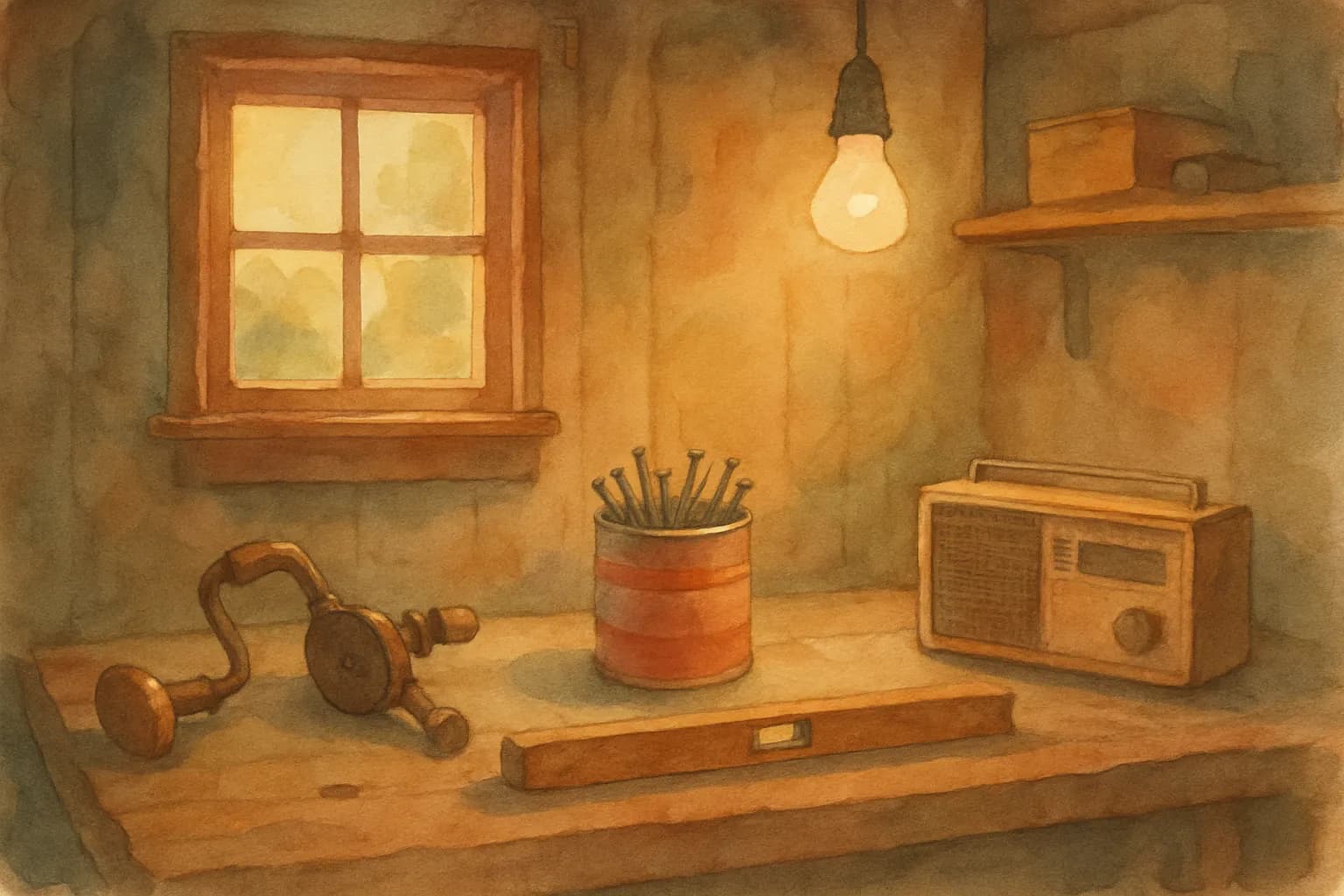
2. The Folger's coffee can full of mixed nails and screws
He never threw a nail away. Every nail he pulled out of a board, every screw he removed from anything, went into the coffee can. The can was three-quarters full at all times. The contents were unsorted, oxidized, and entirely sufficient for any small project he ever undertook.
He could reach in, rummage for ten seconds, and pull out exactly the right size nail for whatever he was working on. You couldn't. It looked like a mess to you. It wasn't.
3. The push mower
Reel mower or rotary, depending on the year and the budget. If rotary, gas-powered, with a pull cord that took three to seven yanks to start, and a smell of cut grass and exhaust that meant Saturday morning.
He sharpened the blade once a year. He drained the gas before winter. The mower he bought in 1968 was still running in 1985, because he maintained it the way he maintained everything, with patience and a small set of tools and the assumption that nothing should ever have to be replaced if it could be fixed.
4. The Coleman cooler with the metal latches
Forest green, with the white interior and the two metal swing latches that clicked when you closed them. It came out for picnics, fishing trips, baseball games, and the annual family vacation, packed full of bologna sandwiches, hard-boiled eggs, and cans of Tab.
The cooler outlasted four cars and three lawn mowers. Some of you still have it, somewhere. The latches still click. The lid still closes square.
5. The shop vac with the missing attachment
A loud, ungainly, gray-and-yellow drum that he used to vacuum up sawdust, leaves, the inside of the car, and once or twice an unfortunate mouse. The hose was always slightly cracked. The crevice tool was always missing. He'd had it since 1971 and would have it for the rest of his life.
It was loud enough to scare the dog. Your mother would not allow it in the house. It lived in the garage, where it belonged.
6. The workbench he built himself
Two-by-fours and plywood, four feet long, sturdy enough to hold an engine. The vise was bolted to one end. The surface was scarred from a thousand small projects and stained with motor oil in one corner where he'd set down a leaky pan in 1973 and never quite cleaned it up.
This was the surface where he repaired the toaster, sharpened the lawn mower blade, glued the broken chair leg, and, briefly, rebuilt a carburetor on a Saturday morning that took most of a weekend. The bench is probably still there, in whatever house he last lived in, doing what it always did.
7. The old refrigerator from 1962
When your mother got a new fridge for the kitchen, the old one went to the garage. It still worked. It would work for another twenty years. He filled it with the beer he wasn't allowed to keep in the kitchen, the worms he used for fishing, and on hot days, a watermelon his wife didn't want taking up space.
Every American garage had the old fridge. It hummed loudly. It had been avocado green or harvest gold once. Now it was just the garage fridge, and it was the most reliable appliance the family owned.
8. The tackle box
Steel, hinged, painted red or green, with the trays that fanned out when you opened it. Inside: lures, hooks, sinkers, line, bobbers, a small pair of pliers, and a knife. Some of the lures had been his father's. Some he had bought at a Western Auto in 1959.
He used it three or four times a year. The rest of the time it sat on the shelf above the workbench, ready. The smell of an old tackle box — fish, oil, metal, paint — is one of the most specific smells in American memory, and you cannot reproduce it with anything new.
9. The string and twine collection
A nail driven into a wall stud, with a hank of every kind of string he had ever come across hung on it. Baling twine. Kite string. Brown package string. Christmas ribbon. Fishing line. A piece of clothesline rope from 1964.
He could never find the exact kind he was looking for in five seconds, but he could always find something. Every project that required string got resolved at the nail, with him pulling down two or three options and choosing the one that would do.
10. The car you weren't supposed to touch
The good car was in the driveway. The other car, the one being worked on, lived in the garage. Maybe it was running. Maybe it was up on jack stands. Maybe it had been on jack stands for six months, while he waited for a part to come in from a guy he knew.
You were allowed to sit in the driver's seat sometimes, if he was in a good mood and you didn't touch the parking brake. You were not allowed to push the buttons on the radio. You were definitely not allowed to use any of the tools on the workbench.
He was teaching you, slowly, in a way you didn't recognize at the time. The garage was a classroom. You were learning by being allowed to stand in there with him.
Most of these things still exist somewhere. The pegboard is still on someone's wall. The coffee can of mixed nails is in someone's basement now. The Coleman cooler is at a tailgate or a hunting camp. The tackle box is in a closet.
What's harder to find is the garage they all lived in together, with the door open on a Saturday morning, and your father bent over the workbench, and the smell of gasoline and sawdust drifting out into the yard.
The tools are still on someone's pegboard, the outlines still drawn in marker. The garage door is open on a Saturday morning, somewhere, and the smell of sawdust and gasoline is drifting out into the yard.
Get a new story every Sunday morning.
One email a week. No spam. Unsubscribe anytime.