The American Kitchen That Worked, Not Showed
The American kitchen in 1972 was a working room.
Not a showroom, not an entertainment space, not a design statement. The refrigerator had a handle worn smooth from ten years of being grabbed the same way. The linoleum had a pattern you stopped seeing after about two weeks of living on it. The kitchen was the room where the actual work of feeding people happened, every day, without ceremony or complaint.
Here are fifteen things you would have found in nearly every one of them.
1. The Percolator
Not the drip machine. That was coming -- Mr. Coffee arrived in 1972, actually, just barely -- but in most American kitchens the coffee was still made in a percolator, stovetop or electric, with the little glass knob on top that showed you the color of the brew. You watched it to know when the coffee was done. The water darkened slowly, cycling up through the tube, and when it looked right you turned the burner down.
The coffee was strong and slightly bitter, boiled past what most people would accept today. Nobody cared. It was coffee. It was hot.
2. The Jell-O Mold
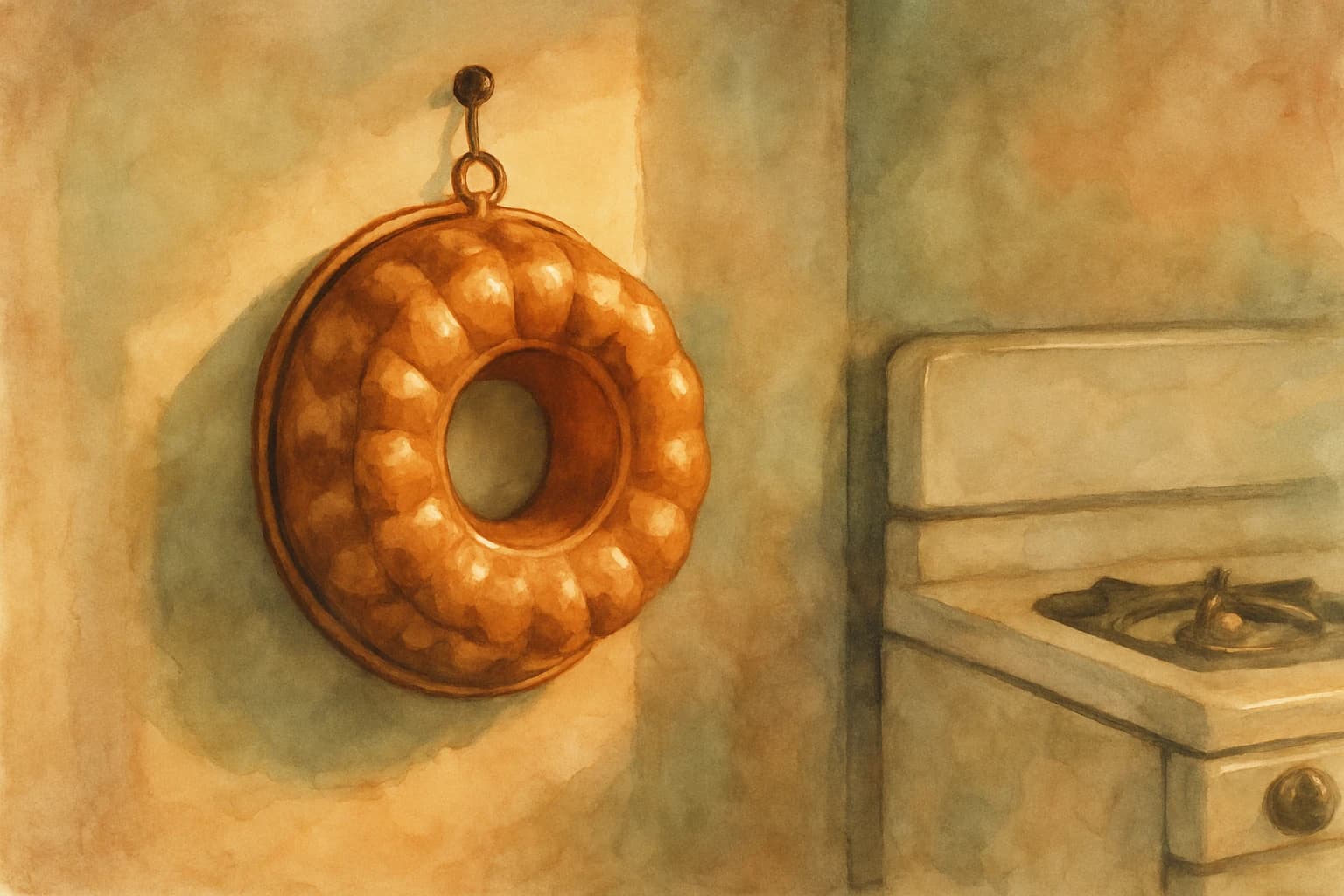
Not as a decorative object -- as a functional one. The copper or aluminum ring mold hung on a nail near the stove or sat in a cabinet with the baking pans. It was used. Gelatin salads with fruit or shredded carrots were standard luncheon food, standard potluck food, standard Tuesday food in millions of American homes. The mold was necessary equipment.
3. A Can Opener Mounted to the Wall
Not a drawer gadget. A cast-metal wall-mount can opener with a rotating wheel and a handle, bolted to the edge of the cabinet near the stove. It had been there since the house was new, and it would be there when the house was sold.
There was also probably a handheld backup in the drawer, in case company was over and someone needed to open something in a different part of the kitchen. But the wall mount was the primary tool. It opened cans of tomato soup, cans of green beans, cans of cream of mushroom, cans of fruit cocktail. It opened them all without drama and without requiring you to hunt through the drawer.
4. The Avocado Green or Harvest Gold Appliances
The refrigerator was not white. The stove was not white. The dishwasher, if there was one, was not white. In 1972 the dominant appliance colors were avocado green and harvest gold, two shades that are impossible to describe as attractive and that nevertheless blanketed millions of American kitchens for nearly two decades.
Sears sold them. Montgomery Ward sold them. They were aspirational colors, suggested by manufacturers as modern alternatives to plain white. Whole kitchen design schemes were built around them. Towels, canisters, curtains, pot holders -- all coordinated. It was a coherent design choice that has not aged well, which is the charitable way of putting it.
5. A Cookie Jar With Loose Lid
The cookie jar sat on the counter. It was ceramic, probably in the shape of something -- a barn, a fat chef, a hen on a nest. The lid fit loosely enough that a child in socks could lift it quietly, though not quietly enough. The jar was restocked every Saturday or Sunday. It was usually half-depleted by Wednesday.
6. The Bread Box
A metal bread box with a roll-up door, sitting on the counter near the toaster. It held one or two loaves of bread, maybe a package of hot dog buns, maybe a bag of dinner rolls from the grocery store. The bread went stale faster outside the box, so the box worked, and in a kitchen without much counter space it did double duty as a surface for setting things on top of.
Wonder Bread lived in there, or Sunbeam, or the local dairy brand. Homemade bread, in the households that made it, lived in there too.
7. A Grease Can next to the Stove
A coffee can, or a dedicated grease pot with a strainer lid, sitting next to or just behind the stove. Bacon fat went in it, then was used for cooking eggs, then for seasoning cast iron, then for flavoring beans or greens. Nothing came out of the pan that couldn't go into the can, and nothing out of the can that couldn't improve something else.
The health advice on this came later and hit hard. By the 1980s the grease can was becoming a relic. For now, in 1972, it was standard practice in most kitchens, and the cooking that relied on it tasted unmistakably of itself.
8. The Junk Drawer
One drawer -- usually to the right or left of the sink -- that held everything the kitchen could not otherwise categorize. Rubber bands. A birthday candle left from someone's cake in 1968. Twist ties. The spare key to something, the lock for which was probably in the garage. A screwdriver for odd tasks that didn't warrant going to get the real tools. A measuring tape. A book of matches from a steakhouse that had closed.
The junk drawer was not disorganized. It was a category. The category was: things that live here now.
9. Church Cookbooks in a Stack
Not Joy of Cooking exclusively, though that was usually somewhere nearby. The cookbooks in heavy daily rotation were the spiral-bound community cookbooks produced by local churches, women's clubs, and hospital auxiliaries. They were typed on manual typewriters, photocopied, and sold for fundraising, and every recipe had a name attached: Eleanor Patterson's Tomato Aspic or Mrs. Roy Hendricks' Hot Fudge Sauce.
These books were specific to the community that made them. They carried the food culture of a particular set of families, in a particular place, and they were annotated in pencil with notes about which recipes had been doubled for a family of eight, which needed less salt, which were the ones to bring to a funeral.
10. A Dish Towel That Dated to the Eisenhower Administration
Not a decorative towel on a hook. A working towel, worn white in the middle, that had been washed hundreds of times and was still doing the job. The dish towel drawer had at least six of these, in various states of retirement. The newest ones were used for drying dishes. The oldest ones were kept back for cleaning up spills, for wrapping bread, for the irregular tasks that required cloth and not paper.
Paper towels existed in 1972. Some kitchens had them. Others didn't bother, because the dish towels were already there and worked fine.
11. The Spice Rack
A wooden rack holding glass jars with metal lids, mounted on the wall or sitting on the counter, organized roughly alphabetically or by frequency of use. Garlic powder. Onion salt. Paprika, used mostly for color on deviled eggs. Celery salt. Dill weed. Ground cloves.
The spice jars might have been four or five years old. Some of them were older. The question of when a jar of dried thyme loses its flavor was not widely asked. You used what was in the jar. The food tasted like itself.
12. A Lazy Susan in the Cabinet Corner
The corner cabinet that would otherwise have been nearly unreachable -- the deep one at the angle of two counters -- held a two-tier lazy Susan loaded with canned goods. Tomato sauce. Chicken broth. Cream of celery. Cans of tuna. You spun it to find what you needed.
The lazy Susan was a genuine problem-solving device that worked, and most of the ones installed in 1965 were still spinning smoothly in 1972 and beyond.
13. The Kitchen Clock With the Second Hand
A battery or wind-up clock on the wall above the door, or built into the stove. You checked it constantly, because kitchen work ran on time -- the roast had been in at 350 for two hours, the rolls needed another twelve minutes, the children needed to be sitting down in fifteen. The clock was the room's reference point. A kitchen without a working clock was a kitchen working without its instrument panel.
14. Glass Measuring Cups, Two or Three Generations Old
A Pyrex two-cup measuring cup that had come over with the set of dishes from the old house. Maybe a set of metal measuring cups on a ring, bought at the hardware store sometime before the children were born. The measuring cups were old because measuring cups don't break, and they don't go bad, and there's no reason to replace something that measures correctly.
The two-cup Pyrex is, for the record, still made. Essentially the same design. The one in your cabinet right now may be from 1972, and you would have no way of knowing.
15. A Telephone on the Wall
The kitchen phone was on the wall, with a cord that stretched to the table and sometimes all the way to the doorway. It was a second line off the living-room phone, or the only phone in that wing of the house. It rang during dinner. You answered it during dinner. There was no other option.
The kitchen phone meant the cook was reachable while cooking. It meant conversations happened over the sound of something frying in a pan. It meant that the kitchen was the room where the family was most likely to receive news -- good news and bad -- because the kitchen was the room where someone was almost always working.
What Doesn't Need to Come Back
The grease can was not good for anyone's arteries, and the cardiologists who eventually made the case against it were right. The avocado appliances were a mistake the era itself eventually recognized. The Jell-O salad had virtues if you like Jell-O salads, but its dominance at the church potluck reflected a processed-food culture that was not doing the American diet any favors.
And the spice jars from 1967 -- the ones with the gray, flavorless dust in the bottom -- were producing inferior food, and nobody should miss them. Fresh spices are better. There is no argument to be made against fresh spices.
The honest version of this list is: these kitchens worked hard, wasted very little, and were built around the reality that someone cooked in them every single day. That part is worth keeping. The particular tools have moved on, and the best replacements are genuinely better. But the kitchen as a working room -- as the serious center of the house -- is the thing worth holding onto, and it's the thing most in danger of being lost to a generation raised on takeout and sheet-pan delivery kits.
What do you remember from your family's kitchen in the 1970s? Is there something you still own from that era? Tell us yours -- we'd love to hear it.
Get a new story every Sunday morning.
One email a week. No spam. Unsubscribe anytime.