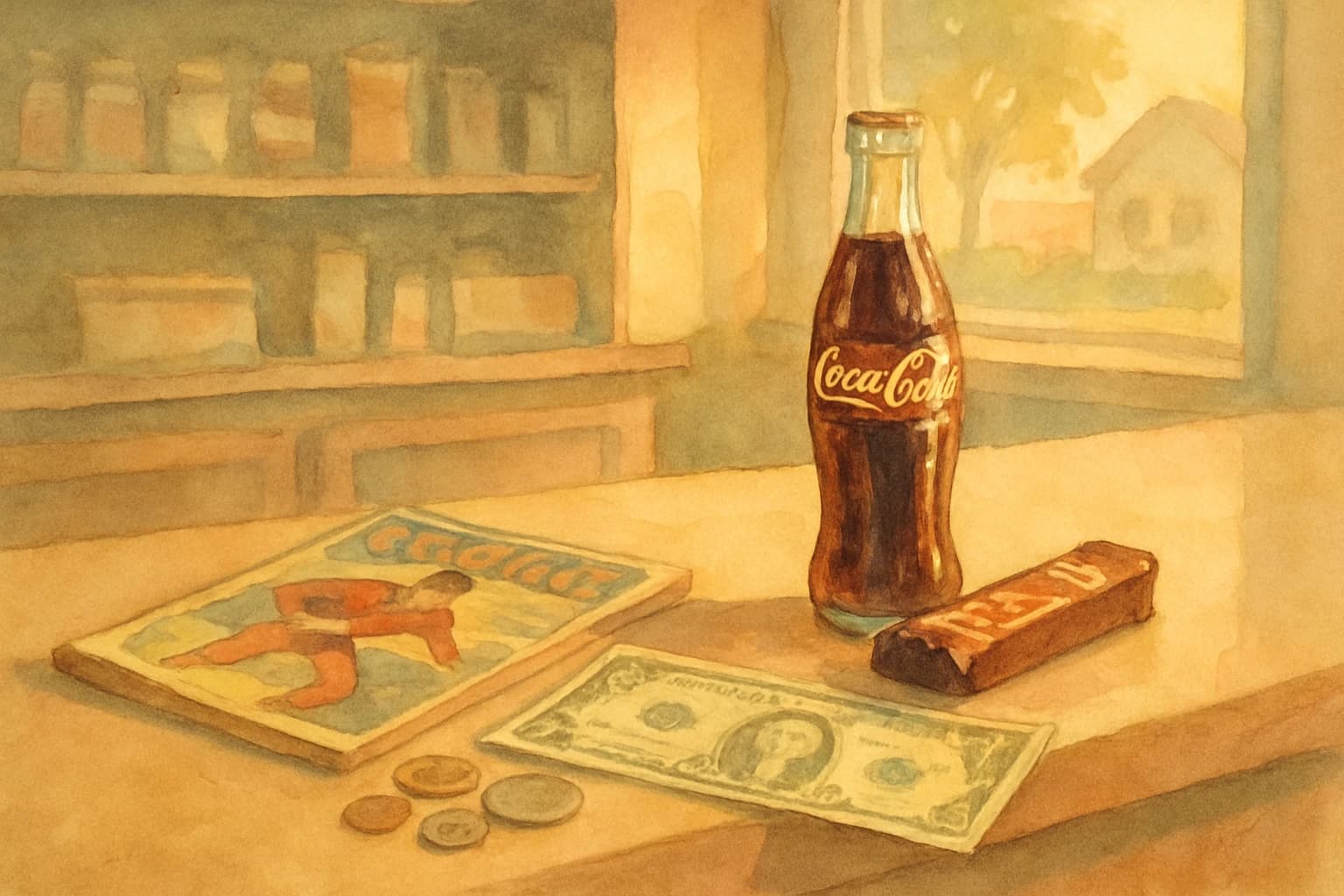
15 Things You Could Buy for a Dollar in 1975
A dollar in 1975 bought a lot more than people remember.
A dollar today buys very little. A small candy bar. A cup of gas station coffee, on a good day. A song on iTunes, almost. The dollar bill itself is worth, in inflation-adjusted terms, about a fifth of what it was worth fifty years ago, which means that the things you could buy for a single dollar in 1975 are mostly things that now cost four or five dollars, and sometimes much more.
But the inflation math is the boring part. The interesting part is what a dollar bought, in 1975, and what that says about the texture of daily American life at the time. Here are fifteen.
1. A gallon of gas, with change
The average price of regular gasoline in 1975 was about 57 cents per gallon. A dollar got you a gallon and a half, easily, with two pennies' change. A five-dollar bill filled the tank of most cars, with money left over for a Coke at the pump.
You didn't talk about gas prices much, because the price was low enough that filling up was a routine errand, not an event. The gas price became a cultural fixation later, in the 2000s, when it started showing up daily on the news as a political indicator. In 1975 it was just the price of gas.
2. A McDonald's lunch
A burger, fries, and a small drink at McDonald's in 1975 cost about a dollar even, depending on the franchise. The Big Mac itself was 65 cents. You could feed yourself adequately, in fast-food terms, for a single dollar bill.
McDonald's was already a national chain by 1975, but it hadn't yet undergone the menu inflation that would push the price of a basic meal toward ten dollars over the next fifty years. The dollar lunch was real and accessible to anyone, and it was a meaningful piece of teenage economic life -- pooling change to feed yourself and your friends after school.
3. A movie ticket (in many cities)
The national average movie ticket price in 1975 was about $2.05, but in smaller cities and at matinee showings, you could see a movie for a dollar. The neighborhood theaters that still existed, the discount second-run houses, the small-town single-screens -- all priced lower than the urban first-runs.
A dollar at a matinee got you the movie. Sometimes there was money left for a small popcorn. The whole afternoon could be financed by a single bill, especially for kids whose admission was discounted further.
4. Twenty Tootsie Rolls
Or thereabouts. The exact candy economics in 1975 had a Tootsie Roll at about 5 cents each, sometimes less in bulk. A dollar at the corner store became twenty small candies, or four full-size candy bars, or ten lollipops, depending on what you wanted.
The whole institution of "penny candy" was already fading by 1975, but its descendants -- nickel candy, dime candy -- still meant that a dollar was a real shopping trip at the candy counter. Children spent dollars at candy counters with a sense of meaningful purchase power that has not really been reproduced.
5. A paperback book
A standard mass-market paperback in 1975 ran $1.25 to $1.75. A dollar got you close -- you needed a quarter or two more -- and on sale, or used, you could find paperbacks for under a dollar without difficulty.
The drugstore paperback rack was the lending library of mid-century America. A great many adults read constantly from these racks. The economics worked because a paperback was approximately the same price as a movie ticket or a meal, which meant a single dollar produced a real evening of entertainment.
6. A comic book and a candy bar
A comic book in 1975 cost 25 cents. A candy bar cost about 15 cents. A dollar covered a comic, a candy, and 60 cents in change, which was enough for another comic.
The American child of 1975 went to the drugstore on Saturday morning with a dollar bill and came back with two comic books and a candy bar and 35 cents to put in a piggy bank. The whole transaction was the economic foundation of a particular kind of childhood.
7. A Coca-Cola from a vending machine and a phone call
A 12-ounce bottle of Coke from a vending machine was around 25 cents in 1975. A pay phone call was a dime. You could buy a Coke, make four calls, and have a quarter left over, for a single dollar.
The pay phone economy was a real thing. A dollar in dimes was a small communication budget, and adults who traveled -- salesmen, especially -- kept rolls of dimes in their car for the phone booths along the highway. The dollar that bought the Coke also bought the dignity of being reachable from the road.
8. A pack of cigarettes
A pack of Marlboros in 1975 cost about 50 cents. A dollar bought two packs. Smokers smoked through a dollar a day without thinking about it.
The price has gone up considerably faster than inflation, partly because of taxes designed to discourage smoking and partly because the underlying product cost has risen too. A pack now costs ten times what it did in 1975 in nominal terms. The economic punishment of smoking that has been deliberately built into the pricing did not exist then. The cigarettes were just cheap, and smoking was just normal.
9. A haircut at the right place
A basic men's haircut at a barber shop in 1975 was about $1.50 to $2.00 in most places, but in small towns and at less fancy shops, a dollar got you a haircut. The kid's cut at the barber shop, especially, was often a single dollar.
The economics of the barber shop have changed in ways that go beyond inflation. The single-chair, neighborhood barber has mostly disappeared. The chains and salons that replaced him operate on a different cost structure. A dollar haircut is not just a price-history artifact; it's a piece of a vanished small-business landscape.
10. Two gallons of milk on sale
The average price of a gallon of milk in 1975 was about $1.57, but on sale you could find it under a dollar, and a smart shopper buying two gallons on the right week of the month spent a dollar each.
The dollar gallon was within reach. Milk was a daily-life staple priced in line with the dollar bill, which meant a young mother could send a kid to the corner store with a dollar and a note and get back milk and change. The transaction was simple and the economics worked.
11. The Sunday paper, in many cities
The Sunday paper in 1975 cost 35 to 50 cents, depending on the city and the size of the edition. A dollar got you the Sunday paper and the next week's daily papers stacked together. You bought the paper from a coin-operated box on the corner.
The paper, in those days, was a real object -- sometimes four pounds of newsprint with multiple sections, supplements, comics, and inserts. It took hours to read. A dollar was reasonable compensation for the labor that had gone into producing the paper, and the paper's price was a reasonable expense for the household's information needs.
12. A burger at a diner with a coffee
A diner cheeseburger and a cup of coffee at a small-town American diner in 1975 ran about a dollar, sometimes less. A dollar fed you breakfast or a quick lunch with change for a tip.
The diner economy is mostly gone now, as we've written about elsewhere, but the price point that supported it -- the dollar lunch -- was the foundation of its survival. The dollar that fed you at the counter was the dollar that kept the diner in business, and when the dollar stopped going that far, the diners closed.
13. A bus fare, plus the return
City bus fare in 1975 averaged about 35 cents. A dollar got you to work and home again, with change. The public transit economy was structurally cheap enough that a workday cost was a small fraction of a workday's wage.
The decline of cheap public transit is one of the underappreciated economic shifts of the last fifty years. A dollar that used to get you across town now does not.
14. The matinee admission to the bowling alley
You could bowl a string of bowling for under a dollar in 1975, at most alleys, with shoe rental sometimes thrown in or available for an additional quarter. A dollar bought an hour of bowling for a teenager, which was a real entertainment budget.
The American bowling alley as a community institution was at its peak in 1975 and has been declining since. The economics that supported it -- the dollar string of bowling -- were the foundation of league night, family night, the date at the lanes. The pricing held it together. When inflation broke the dollar string, the alleys started closing.
15. The babysitter for an hour
A teenage babysitter in most American suburbs in 1975 charged 50 to 75 cents an hour. A dollar bought you an hour and a half of childcare, which was enough for a quick dinner out or a movie.
The economics of teenage babysitting depended on the dollar being meaningful to a teenager. A few dollars in babysitting money was a real evening's earnings, and a few evenings of babysitting per month was a respectable income for a fifteen-year-old. The teenage babysitter was once a real labor category, with its own internal economics and apprenticeship patterns. It has thinned considerably as both wages and child-supervision norms have changed.
The list could go on. A loaf of bread (28 cents). A first-class postage stamp (10 cents in 1975, going to 13 in 1976). A pay parking meter (an hour for a quarter). A copy of TV Guide (20 cents). A dollar in 1975 was real money that touched a wide range of small daily purchases, and it took a meaningful chunk out of any of them.
The interesting fact isn't just that prices were lower. It's that the dollar bill itself had a different relationship to ordinary daily commerce. You could go through a normal day with a dollar in your pocket and feel like you had options. The dollar was a unit of meaningful purchase, not a unit of approximately-nothing.
That relationship is mostly broken now. The dollar is now mostly the amount you tip the valet, or the amount of change you don't bother to pick up. It is no longer a unit that lets you participate in the economy in any substantial way. Whether this matters -- beyond simple inflation -- is worth thinking about. A society where a single coin or bill is meaningful is different from a society where it isn't. We've moved from the first kind to the second, and the texture of small daily transactions has changed along with it.
What's the last thing you remember buying for a dollar? What did a dollar mean in your house growing up? Tell us in the comments -- we'd love to hear.
Get a new story every Sunday morning.
One email a week. No spam. Unsubscribe anytime.