The Quiet Art of Hanging Laundry on a Line
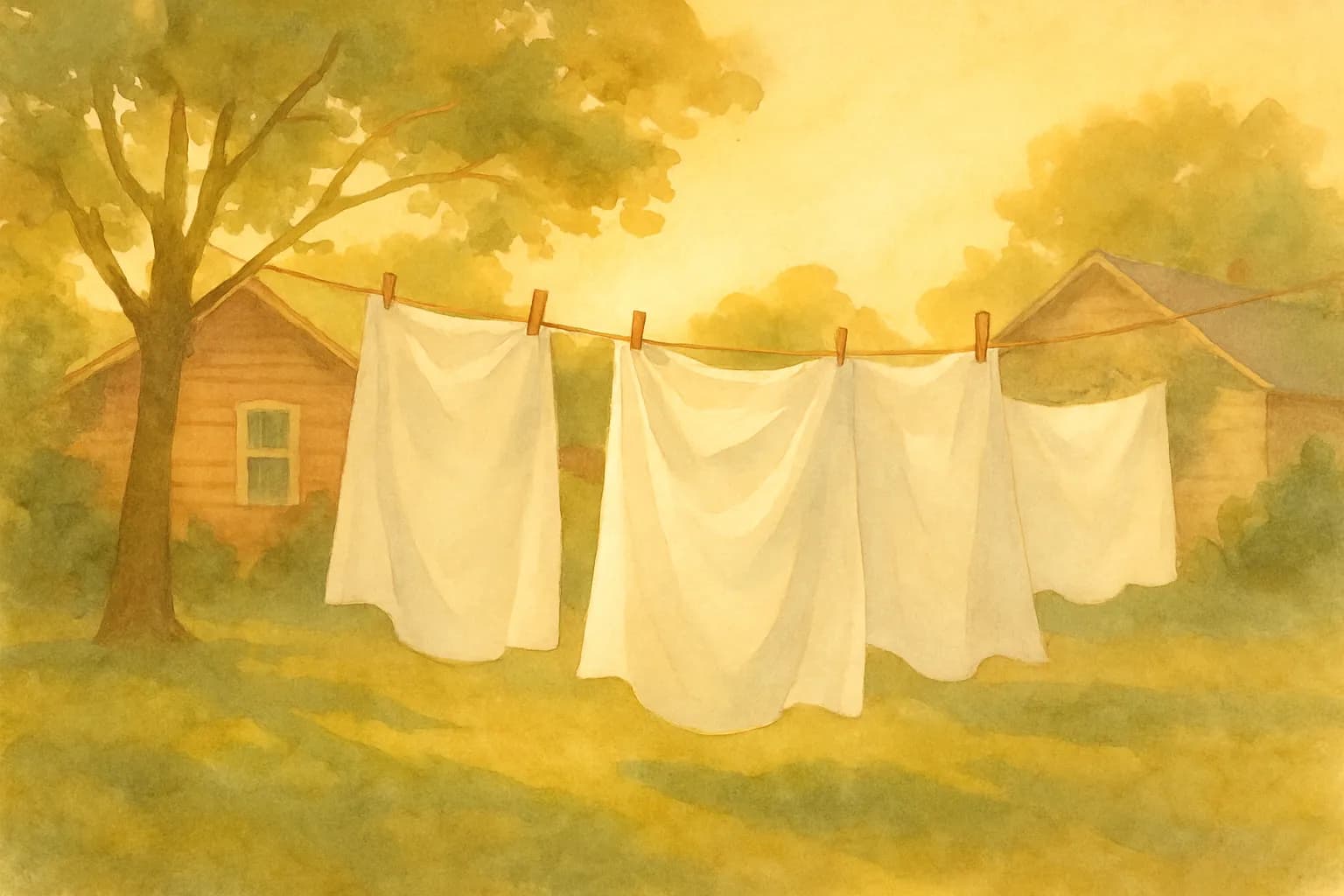
The basket of wet laundry was heavy on her hip. She walked it out the back door, across the yard, to the clothesline strung between two metal T-posts your grandfather had set in concrete twenty years before.
She set the basket down in the grass. She pulled a sheet out, snapped it sharply once to shake out the wrinkles, and threw it over the line in a single motion. Two clothespins from the bag pinned to her apron pocket. The sheet was up.
She moved through the basket in order: sheets first, then shirts, then pants, then small things. She knew without thinking which items needed full sun and which could go in the partial shade near the maple tree. She arranged by color, by weight, by drying time. The whole basket was on the line in fifteen minutes. By suppertime, everything would be dry, and would smell, for the next several days, like the specific outdoors of that specific yard in that specific season.
This was hanging out the laundry. It used to be a daily or weekly part of every American woman's life. It has almost completely disappeared, and what was lost when it did is more than people understand.
The work was real, and the skill was real
A modern reader might assume hanging laundry was simply drying -- that the line was a primitive dryer, replaced by an obviously superior machine. This is half right.
The line did dry the clothes. But it also did several other things, all of which the dryer either cannot do or undoes.
The sun bleached whites without bleach. A sheet that had developed a slight yellow cast over the winter would come off the line in July as bright as the day it was bought. Mothers would deliberately hang baby diapers in the strongest sunlight for this reason. Lemon juice and sun were how stains came out in 1955, and sun was the more important of the two.
The wind softened fabrics in a way a dryer doesn't replicate. Towels that came off the line had a particular texture -- slightly stiff at first, then breaking soft on the body -- that towels from a dryer never have. The dryer's tumbling action and chemical softener produce a different softness, more uniform and less alive.
The air killed mildew and odor in ways that no machine has matched. A wool sweater that had developed a stale smell over the winter could be hung on the line on a windy March day and come down smelling like new wool. Modern dry cleaning is, in many cases, an inferior approximation of what a few hours on a clothesline would have done.
And the line did all of this for free, with no electricity, no gas, and no operating cost beyond the clothespins, which lasted forever and broke about one a year.
The technique that no one teaches anymore
There were rules.
You hung shirts from the bottom hem, not the shoulders. Shoulders on the line stretched the fabric and left permanent peaks where the clothespins had pinched. Bottom-hem hanging meant the shirt dried in its natural shape.
You hung pants by the cuffs, upside down. The weight of the wet waist pulled them straight as they dried. Belt loops were never used; they would stretch.
You hung sheets folded over the line, taking up two spaces of pin. You overlapped the pin between two sheets to save a pin, a small efficiency every clothesline user knew. A queen sheet took three pins. A king took four. You knew this without counting.
You hung underwear and intimate items between the larger items, hidden from the street, so the neighbors wouldn't see them when they drove by. This was not prudishness exactly -- it was just consideration. You did the same for them.
You went out and brought everything in if it started to rain, regardless of what you were doing. Wet laundry rained on was wet laundry that had to be rewashed.
You took clothes off the line when they were dry, not before, not much after. Clothes left on the line overnight got dew on them. Clothes left in the sun too long faded. There was a window. You knew when to come back.
None of this was written down. Daughters learned it from mothers, who'd learned it from theirs. The whole body of practical knowledge was passed person to person for a hundred years, and then in about two decades, between 1955 and 1975, most of it stopped being passed.
What replaced it
The electric dryer arrived in American homes in volume in the early 1950s, and by 1970 most new houses came with one as standard. The math was obvious. The dryer took an hour. The line took most of a day, weather permitting. Working women, and increasingly there were many, did not have most of a day.
The suburban HOA banned clotheslines in many new developments, starting in the 1960s. The grounds were aesthetic -- visible laundry was considered, by some homeowners' associations, to look "poor." A great many American women lost the option of line-drying not because they didn't want to, but because their neighborhood had decided they shouldn't be allowed to.
The dryer also gave women back several hours a week, which was real and valuable. The criticism of the dryer is not that it was wrong to adopt. It is that the adoption was nearly total, and that the skill it replaced has almost entirely disappeared, even in households where line-drying would still work fine.
What was lost, beyond the laundry
The clothesline was a women's space in a way that very little American architecture has replicated. The backyard, on a sunny morning, with the basket and the line and an apron full of pins, was a place where women worked, alone or sometimes with a sister or a neighbor, in a rhythm that allowed for thinking.
You can't hear over a vacuum cleaner. You can't think while folding from a dryer at ten in the evening when you're exhausted. You can think while hanging out a basket of laundry on a windy Tuesday morning, with the screen door propped open and your young children playing in the yard. The work was light enough to allow for the mind to drift. The setting was outdoors, in air and sun. It was, in retrospect, almost meditative.
A great deal of what got worked out in American women's lives -- the difficult thoughts about the marriage, the children, the family -- got worked out at the clothesline, and is not now being worked out anywhere similar. There is no replacement venue. The minds that used the clothesline did not get a substitute for the clothesline. They got an electric dryer in the laundry room, and that was different work in a different room with different cognitive properties.
There was also the social piece. The neighbor's clothesline was visible from yours. You could see when her family had a new baby (the diapers). You could see when company was coming (the good tablecloths). You could see if she'd been ill (no laundry for a week). You waved over the fence. Sometimes you walked over.
The privacy fence has now, in many American suburbs, made the back yards of neighbors invisible to each other. The clothesline was one of the last visible signs that a household was still functioning. When it disappeared, so did the visibility.
The small revival
A clothesline movement, of sorts, has been growing for about fifteen years. It is overlapping with the homesteading movement, the sustainability movement, the off-grid movement, and a more general nostalgia among certain young families for the older domestic rhythms.
In some states, "right to dry" laws have been passed, overriding HOA bans on visible clotheslines. Florida was first. Several others have followed. The cases were usually brought by homeowners who wanted to save energy, but the underlying argument is that line-drying is a basic American practice that should not be illegal in your own back yard.
Some of the revival is environmental. A dryer uses a meaningful amount of electricity over the course of a year. A clothesline uses none. The household savings are small. The cumulative savings, if a million households switched, would be large.
Most of the revival, though, is something else. It is people in their thirties and forties who never grew up with a clothesline, who tried it once for some other reason, and who discovered that hanging laundry on a line is one of the most pleasant repetitive tasks available in a modern household. The sheets dry better. The whole basket smells like outside for a week. The fifteen minutes in the yard, with the basket and the basket of pins, is a fifteen minutes the rest of modern life does not particularly offer.
It is not coming back at any scale. The dryer is too convenient. The HOA rules are too entrenched in some places. The cultural expectation has moved on.
But on certain back yards, on certain warm days, you will see it again. A basket on the hip. Sheets snapping in the wind. The yard smelling, for an afternoon, the way yards used to smell.
If your grandmother hung her laundry on a line, you remember the smell, and you remember the rhythm. Try it once this summer. The whole skill is in your hands somewhere, waiting.
The sheets are still snapping somewhere, if you know where to look. The skill is still in your hands.
Get a new story every Sunday morning.
One email a week. No spam. Unsubscribe anytime.
If this brought back a memory, you might also like
Church Picnics, Potlucks, and the Foods That Held Communities Together
The folding tables came out at nine. By eleven they were full. Tuna casseroles, fried chicken, Jell-O salad with mandarin oranges. The food was the excuse. The community was the point.