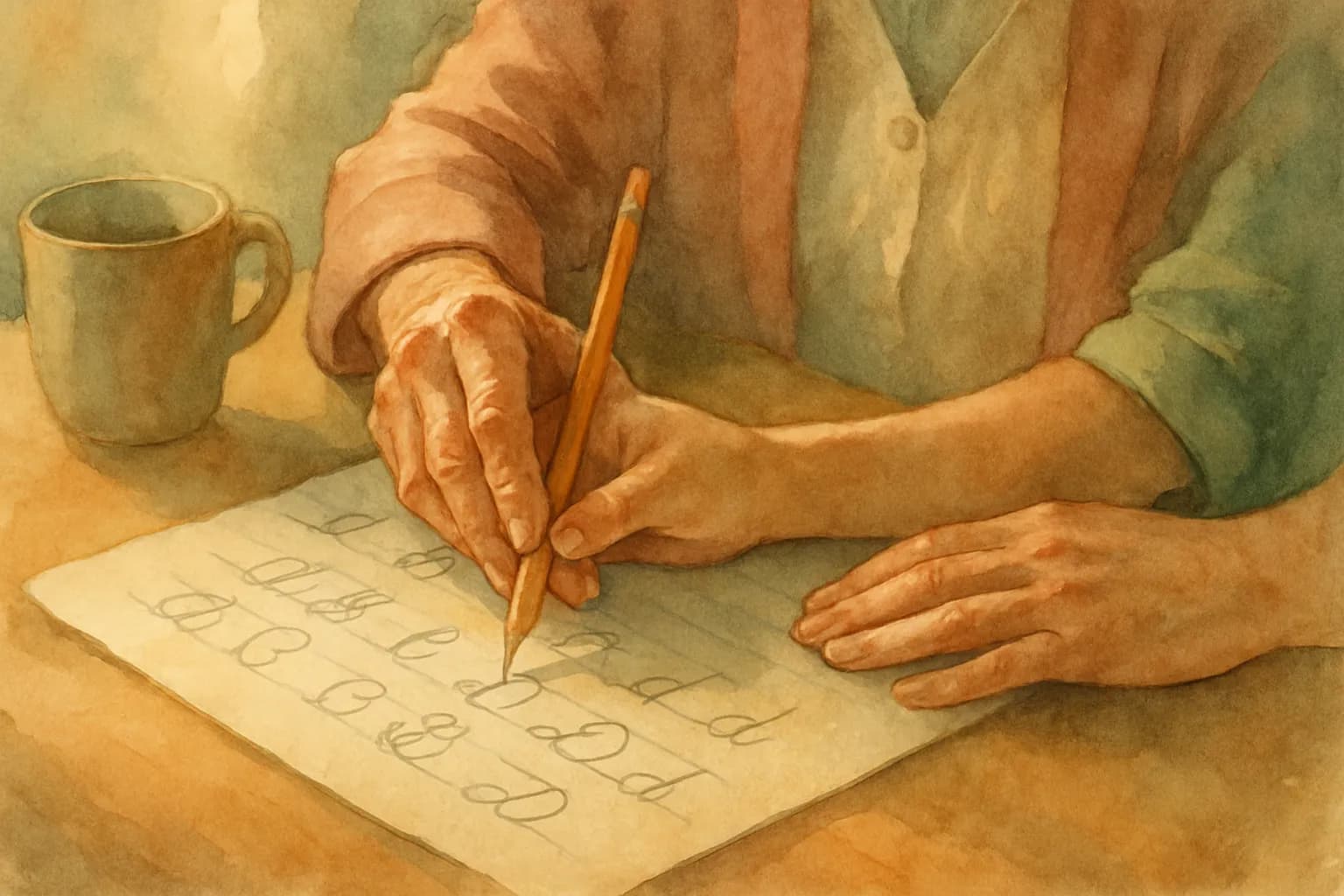
Cursive Is Dying -- and Schools Are Quietly Bringing It Back
For about fifteen years, a generation of American children grew up unable to read their own grandmothers' letters.
It happened quietly. In 2010, most states adopted the Common Core State Standards, a new national framework for what kids should learn in school. Cursive handwriting wasn't on the list. Keyboards were the future, the thinking went. Cursive was a relic. Schools quietly dropped it from the curriculum, freed up the time for typing and other priorities, and moved on.
A decade and a half later, the country is starting to notice what it lost -- and a growing number of states are passing laws to bring cursive back.
The quiet comeback nobody covered
In February 2026, Pennsylvania became the most recent state to mandate cursive instruction in public and private schools. Governor Josh Shapiro signed Act 2 of 2026 into law, requiring cursive to be added to the elementary curriculum statewide. Pennsylvania joined 18 other states requiring cursive to be taught in school, depending on how the count is done, with most trackers placing the total at somewhere between 24 and 26 states.
The trend isn't new, but it has accelerated dramatically. Less than 10 years ago, only 14 states required schools to teach cursive. That number has nearly doubled. California, New Hampshire, Kentucky, Iowa, and Pennsylvania have all moved in just the past three years. Maine, Missouri, New Jersey, and several other states have bills working through their legislatures right now.
The votes have not been close. California's bill passed in 2023 with a final vote of 79-0. Pennsylvania's passed 42-5 in the state senate with broad bipartisan support. In a political era where almost nothing is bipartisan, cursive somehow is.
Why lawmakers -- and parents -- are pushing back
The arguments for bringing cursive back have shifted from sentimental to practical over the past decade.
The first is cognitive. A growing body of research links handwriting -- and cursive specifically -- to brain development in ways that typing does not replicate. Writing letters by hand activates regions of the brain associated with memory, language processing, and learning. Kids who write notes by hand remember the material better than those who type. The flowing, connected motion of cursive engages fine-motor pathways that print writing doesn't, and that screens don't touch at all.
The second is historical literacy. Most original American documents -- the Declaration of Independence, the Constitution, the letters of Lincoln and Washington and almost every president before Eisenhower -- were written in cursive. A generation that can't read cursive can't read its own founding documents in the original. Family letters, old recipes, journals, deeds, and historical archives become inaccessible. A 22-year-old who can't decipher a card from his grandmother is the small-scale version of a country that can't read its own past.
The third is practical. As one Pennsylvania state representative noted during committee testimony, watching his own daughter try to endorse her first paycheck was "quite the interesting experience on a human level." Signatures -- the legally binding kind required on contracts, loans, marriage licenses, and yes, the back of a check -- are still cursive. A young adult without one is a young adult who can't fully participate in the legal and financial world. Lawmakers in several states have also argued that a cursive signature is harder to forge than a printed one, with real consequences for identity security.
The other side of the argument
Not everyone is convinced. Teachers, in particular, have been split on the issue, and not unreasonably.
The school day is finite. Every hour spent teaching cursive is an hour not spent on something else -- reading comprehension, math, science, computer skills. When the National Education Association surveyed its members, some teachers pushed back hard. "Cursive is outdated. Typing is a current skill that students need. There is only so much time in the school day," one wrote. The point lands. If we want kids to be ready for the modern world, isn't keyboarding the higher priority?
And there's a fair argument that cursive's practical use has genuinely declined. Almost nothing is hand-signed anymore. Documents are e-signed, letters are typed, notes are texted. The cursive-literate adult of 1975 was practicing a daily skill. The cursive-literate adult of 2026 is practicing a hobby.
Defenders of the comeback counter that the cognitive and historical reasons stand on their own -- that cursive isn't just a writing system but a developmental exercise, and that abandoning it has measurable costs even if its day-to-day use has shrunk.
What this is really about
Strip away the policy debate and what the cursive comeback really represents is something quieter: a generation of parents, now in their fifties and sixties, looking at their grandchildren and noticing what those grandchildren can't do.
Can't read the family Bible with the names written in the front. Can't make out the recipe on the index card in great-grandma's box. Can't write a real signature. Can't sign their own wedding certificate without practicing first. Can't read the Constitution as it was written.
The skills our grandparents took for granted, the skills we learned without question, the skills our children half-learned and our grandchildren never learned at all -- those skills are being noticed in their absence, and a critical mass of parents has decided they want them back.
That's why the votes are 79-0. That's why Republicans and Democrats are co-sponsoring the bills. It isn't really about handwriting. It's about a generation that grew up holding a pen, watching the next two generations grow up holding a phone, and feeling -- correctly or not -- that something essential has been mislaid.
A small act, with real momentum
Twenty-six states is a long way from fifty. There are still entire generations of kids being raised in classrooms where cursive will never come up. The comeback is real, but uneven.
If you're a grandparent, you don't have to wait for the state legislature. Teach your grandkids yourself. Write them letters in cursive and ask them to write back. Pull out the old recipe cards and read them aloud together. Show them the loop of a capital L and the swoop of a Q. It takes ten minutes a week and they will remember it for the rest of their lives.
A letter in cursive from a grandparent is a small, quiet gift. It would be good if the next generation could read it.
Get a new story every Sunday morning.
One email a week. No spam. Unsubscribe anytime.