The Pharmacy Counter Where Sodas Were Made by Hand
The pharmacist knew how to make a cherry Coke.
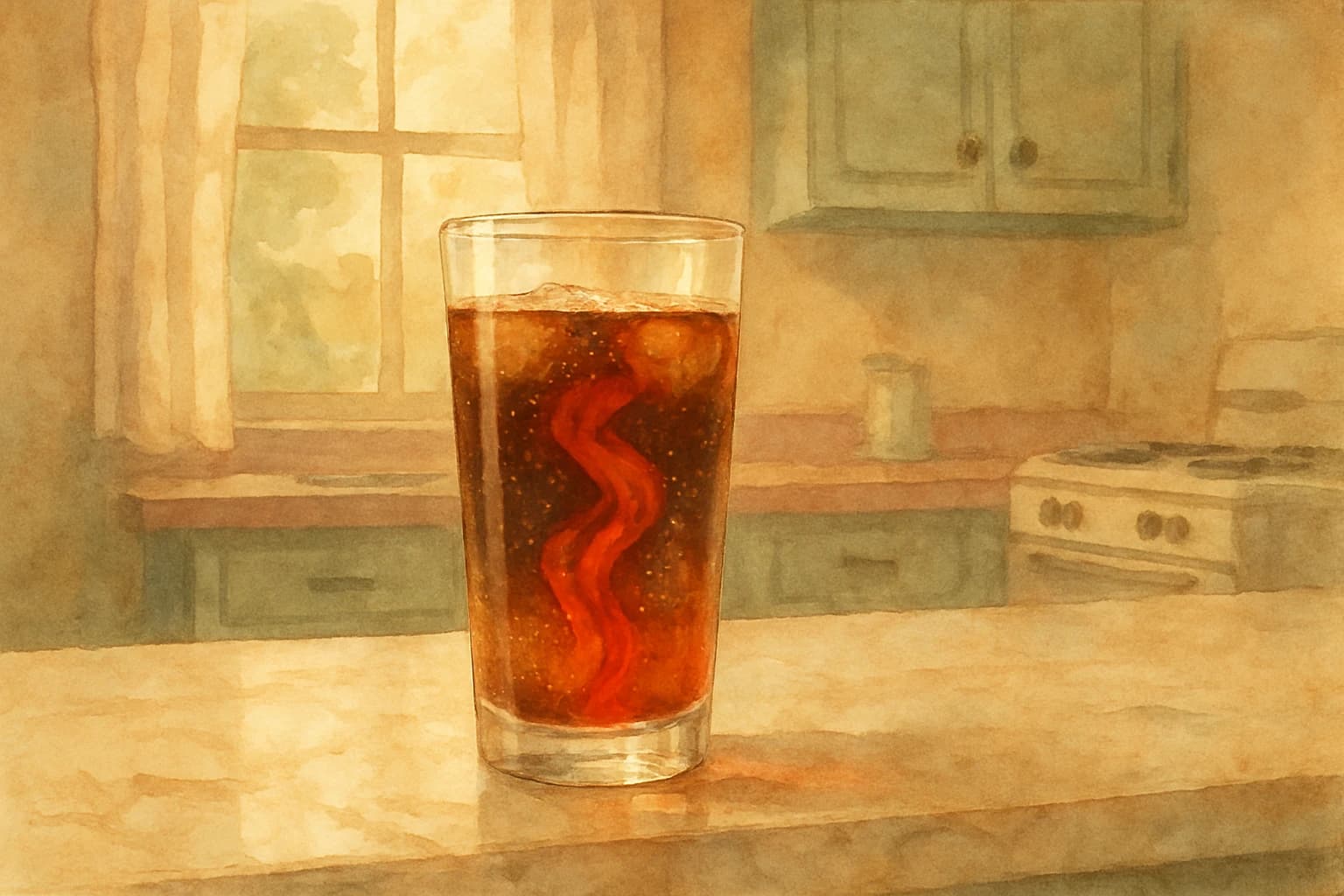
Not the canned kind, and not the two-liter kind. The real kind, which required a glass, a measure of Coca-Cola syrup from a metal canister behind the counter, carbonated water from a spigot with a handle, and a deliberate quantity of maraschino cherry syrup squeezed in at the end. He did it without a recipe because the recipe had long since moved from his head into his hands. You told him what you wanted, he turned around, and a minute later he set it on the marble counter in front of you. It tasted different from anything you could buy in a bottle, because it was.
This was the soda fountain, and by 1975 it was already disappearing. By 1985 it was mostly gone. By 2000, what remained was a handful of survivors in small towns where the drugstore hadn't been bought out yet and the owner was too old or too stubborn to change the counter over to something else.
What it was
The soda fountain occupied a particular piece of real estate inside the American drugstore. A marble counter, usually, with round stools bolted to the floor. A mirrored back wall lined with glasses and syrup canisters and the machinery of carbonation. A white-aproned counterman, sometimes called a "soda jerk" without insult -- the name came from the jerking motion of the carbonated water handle.
The fountain served sodas, yes. But also ice cream, in the form of sundaes, malted milks, and banana splits. Also egg creams, which contained neither egg nor cream, but were a New York preparation of chocolate syrup, milk, and seltzer that tasted like nothing else. Also phosphates -- a carbonated drink made with flavored syrup and a splash of phosphoric acid that added sharpness without sweetness. The menu was short and the preparations were skilled.
The pharmacist often ran the fountain himself in smaller towns, or had a young employee who had been taught the preparations carefully. There was craft to it. The malt had to be blended to a precise thickness. The sundae had a fixed architecture: ice cream, then sauce, then whipped cream from a can applied in a particular way, then a maraschino cherry placed at the top with intention. The banana split had its own rules. The egg cream, done wrong, was simply wrong.
How it fit into daily life
The soda fountain was attached to the drugstore for practical reasons. The late nineteenth century pharmaceutical industry used flavored syrups to mask the taste of medicines, and the same syrup-and-carbonation equipment that handled medicines was easily adapted to non-medicinal drinks. The fountain was originally a service. It became a destination.
By the 1940s and 1950s, the soda fountain was where teenagers gathered after school. It was where the first date happened. Where you sat with your mother on a Saturday afternoon after she picked up a prescription. Where older men occupied the same stool every morning for coffee and conversation. The counter was a communal surface -- strangers sat next to each other, elbows occasionally touching, with no expectation of sustained conversation but a basic acknowledgment of shared space.
This was different from a restaurant. You didn't need a reason to go in. You didn't need to be hungry. A nickel, later a dime, later a quarter, got you something cold and something to do for twenty minutes. The threshold was low enough that it was accessible to kids, to elderly people on fixed incomes, to teenagers without much money who still needed somewhere to be.
What killed it
Several things converged in the 1960s and 1970s, and once they converged there was no recovering.
The bottled and canned soft drink. Coca-Cola and Pepsi pushed hard into grocery stores and vending machines starting in the late 1950s, and by 1965 the bottle of Coke was everywhere. The soda that had once required a fountain could now be purchased at the gas station, the grocery, the vending machine on the corner of your school cafeteria. The fountain lost its monopoly on the experience.
The pharmacy chains. Independent drugstores, which had the room and the inclination for a fountain counter, started being replaced by chain pharmacies built around a different model. The chain pharmacy had a checkout counter and a pharmacy counter and a lot of shelf space. It had no interest in a marble counter with a skilled employee.
The cost of labor. Running a fountain properly required someone who knew how to run a fountain. As wages rose and the number of trained countermen aged out of the workforce, the economics stopped working. A chain pharmacy that could staff a register for minimum wage had no interest in paying for a malted milk specialist.
And, honestly, the car. The drive-in replaced the walk-in. You could get a milkshake at the drive-in, at the Dairy Queen, at the A&W, without getting off your seat. The fountain counter required you to be a pedestrian in a town built for pedestrians. Once the suburbs spread and the car became mandatory, the foot traffic that sustained the fountain dried up.
What shouldn't come back
The romanticized version of the soda fountain tends to leave out a few things. The counter was often segregated. In the South and in many Northern cities, Black customers were not served at the lunch counter or the fountain, and the history of the sit-in movement is inseparable from this geography. The polished marble counter and the charming counterman are the version of the story that leaves out the people who were turned away from it.
The physical experience also had limits. The marble stool was hard. The counter was narrow. The conversation, such as it was, happened between strangers who hadn't agreed to have one. Introverts did not love the soda fountain. People who wanted privacy were simply visible there.
The fountain also served, in its way, as a monitoring station for young people. The counterman knew everyone. If you were somewhere you shouldn't be, someone would know, and someone would tell. The loss of this may be something some people mourn and others do not.
The better parts of what the soda fountain offered -- the third place, the low-threshold gathering point, the communal surface -- are available in good coffee shops and decent diners, if you have them in your town. They require investment, but the underlying function survives in other forms. The fountain itself is not the thing that's irreplaceable.
What actually is
What's gone is the integration of something pleasurable into a daily errand. You went to pick up a prescription, and while you waited for the prescription, you sat at the counter and had a cherry Coke. The pleasant thing was embedded in the necessary thing. They shared a building.
The modern pharmacy errand is purely functional. You go in, you wait if you have to, you leave. There is no reason to linger. There is nowhere to sit. The building is designed around throughput, not duration. You get your medicine and you go home.
This turns out to matter more than it sounds. A great deal of incidental social contact -- the kind that happened while you were doing something else -- was built on the existence of places worth lingering in. The soda fountain was one of those places. So was the hardware store with a bench out front. So was the barber shop. These were not primarily social destinations. They were errand destinations that happened to support social contact as a side effect of their design.
We have built a world that is very good at errand efficiency and not particularly good at supporting the incidental life that used to fit in around the edges of errands. The soda fountain is one clean example of what that cost. You didn't go there for the social contact. You went there for the cherry Coke. The social contact happened anyway.
What remains
There are places. Certain old drugstores in small towns have kept their counters and kept their menus because the owner is seventy years old and plans to keep doing it until he can't. Some ice cream parlors have preserved the form if not the pharmaceutical setting. A few deliberate revivals have appeared in cities, though they tend to run at brunch-spot prices and serve ironic egg creams to people who have read about egg creams rather than grown up with them.
If you find a working soda fountain counter, order whatever the regular customers order. Sit on a stool long enough to finish it without checking your phone. Leave a reasonable tip. The counterman has a skill that is not being taught to anyone new.
Did your town have a soda fountain? Do you remember what you ordered? Tell us in the comments -- we'd love to hear your story in the comments.
Get a new story every Sunday morning.
One email a week. No spam. Unsubscribe anytime.