The Schoolyard Games We Stopped Passing Down
The schoolyard was a functioning civilization, and the kids running it were six years old.
No adult organized most of it. The games were passed down from older kids to younger ones the way recipes used to be passed down -- by watching, then doing, then teaching someone smaller. A third-grader who had mastered Four Square became its unofficial commissioner. A fifth-grader who knew all the rules of Red Rover knew them because a sixth-grader had explained them two years earlier. The knowledge transferred, year after year, without being written anywhere.
That chain broke somewhere. The games on this list are either gone or so rare now that most kids under twenty-five have never played them. They didn't vanish all at once. Nobody held a meeting and cancelled them. They just stopped being passed down.
1. Red Rover
Two lines of kids, twenty feet apart, hands locked. One line calls over a single runner from the other side: "Red Rover, Red Rover, send Marcus right over." Marcus runs full speed at the chain and tries to break through. If he doesn't break through, he joins the calling team. If he does, he takes someone back.
The game produced occasional bloody noses and a great many bruised wrists. This is probably why it's mostly gone. But what it also produced was the precise experience of committing entirely to something -- of choosing the weakest link in a chain and running at it as hard as you could, with everyone watching. That was the game. The stakes were real.
2. Four Square
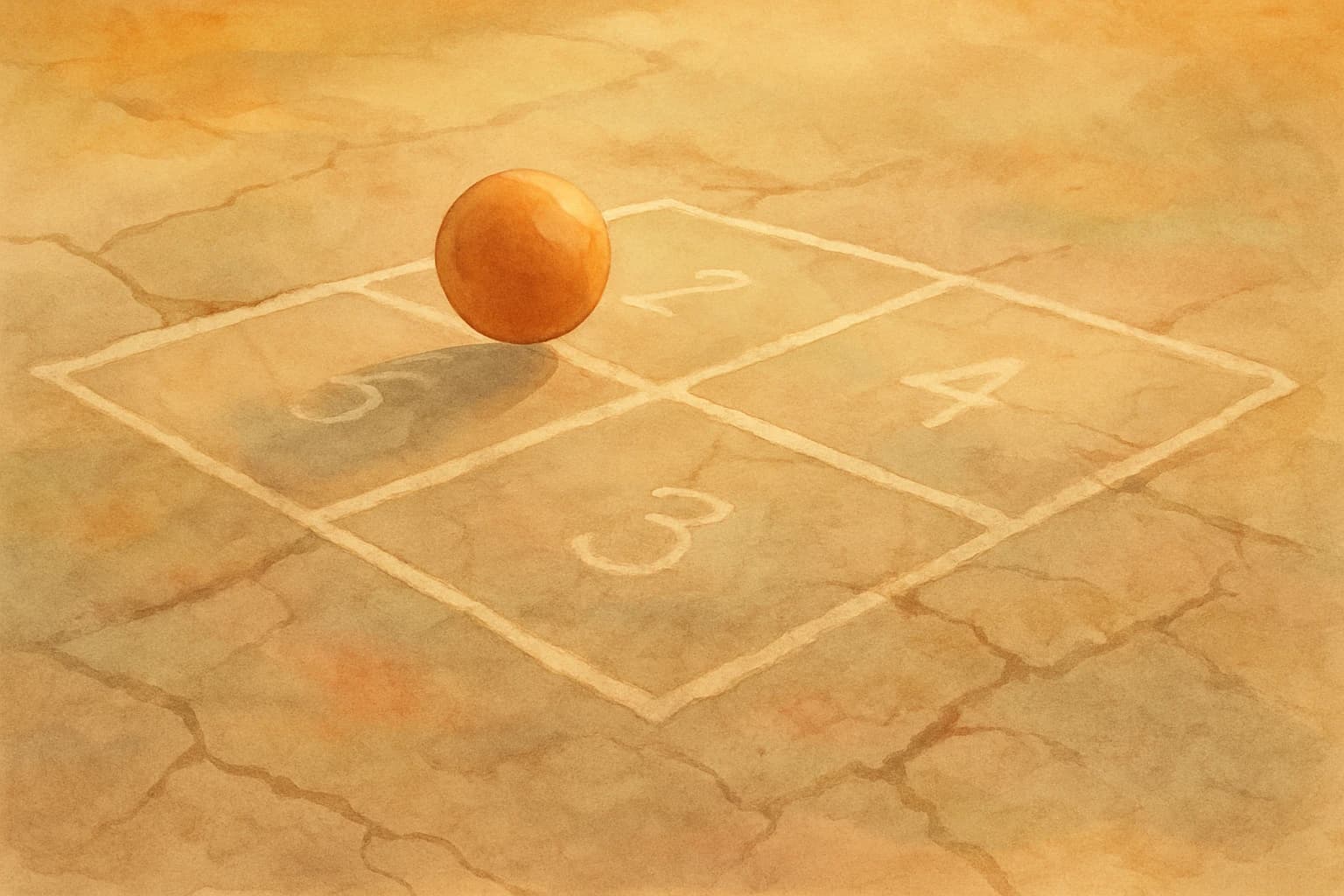
Four squares chalked on the pavement, numbered one through four. The king held square one. A rubber ball bounced between players. You got out when you missed or hit the ball out of bounds. You rotated down when you lost, or up when someone above you lost.
Four Square was infrastructure. It ran continuously during every recess at schools that had it. There was always a game going. There was always a line waiting to get in. The rules varied by school and by year, and there were elaborate custom rules -- "around the world," "bus stop," various serving rules -- that shifted from one generation of kids to the next. The ruleset of a given school in a given decade was as local as dialect.
3. Tetherball
A ball on a rope, attached to a metal pole set in concrete. Two players hit the ball in opposite directions, trying to wind the rope completely around the pole. First one to wrap it wins.
The game was loud and required no officiating and could absorb two players for five minutes or thirty. The poles are still in some older schoolyards, sometimes with the rope and ball missing, sometimes just the bare pole standing in cracked concrete. The pole is a kind of fossil -- evidence of a game that ran for decades and stopped running for no obvious reason.
4. Kickball
Not the organized recreational-league kickball that adults play now. The original: kids choosing sides, using the pitcher's mound as home plate, a playground ball rolled hard and kicked harder. Fielders who caught a fly ball could eliminate the runner. Arguments about whether the ball was fair or foul were resolved by the loudest available third-grader.
Kickball required a blacktop and a ball and nothing else. It was democratic in the way that only simple games can be -- a bad athlete could still kick the ball far enough to get on base, and a good athlete could be out on a pop fly the same as anyone. The game was also ruthless. You got hit with the ball when you were running the bases. You got hit hard, sometimes. Nobody apologized for this. It was the game.
5. Marbles
Kids don't carry marbles in their pockets anymore. In 1965 they did. In 1975 many still did. By 1985 the habit was already thinning.
The game itself had a dozen variants, but the most common version involved shooting a larger marble (your "shooter") at a ring of smaller marbles and keeping whatever you knocked out. This meant you could lose marbles. Playing "for keeps" was a real transaction with real consequences. You went home with fewer marbles than you arrived with, or more. The stakes were small but genuine.
The marbles themselves were beautiful objects -- cat's eyes, steelies, clearies, aggies. Kids collected them as game pieces and as things worth having on their own terms. A deep shooter in a blue-and-white swirl was worth something above and beyond its game utility. The collecting and the playing were bound together in a way that made the game richer than it looks on paper.
6. Freeze Tag
One kid is "it." They tag other players. Tagged players freeze in place. A free player can unfreeze a frozen player by touching them. The game ends when everyone is frozen -- if it ever ends, which it rarely did.
This one is simple enough that it should be indestructible, and yet it's mostly gone from organized recess, partly because organized recess itself has faded at many schools. The game required no equipment, no marked court, no adult supervision, and no score. What it required was a group of kids who had twenty minutes and nothing in their hands.
7. Capture the Flag
Two territories, each with a flag planted somewhere defensible. Players crossed the line to steal the other team's flag. If tagged in enemy territory, you went to jail (a designated spot) until a teammate tagged you free. First team to capture the other's flag and return it home won.
Capture the Flag needed space -- real space, a full schoolyard or a large field -- and it needed enough kids to make both territories defensible. Fifteen kids on each side was ideal. The game could run for forty-five minutes and produce the exhaustion of something genuinely competitive, where the tactics mattered and the outcome wasn't obvious in the first five minutes.
8. Jump Rope Rhymes
The rope itself is not gone. Kids still jump rope. But the accumulated catalog of rhymes -- "Miss Mary Mack," "Cinderella dressed in yella," "Ice cream soda, lemonade punch" -- has thinned considerably, and the double-dutch tradition that ran continuously in schoolyards from the 1940s through the 1980s is rare outside of particular communities now.
The rhymes were passed down the same way the games were. Older girls taught younger girls. The rhymes changed as they traveled -- names got substituted, verses got added, whole new verses appeared and spread through a school within a week. They were oral literature, collectively authored and collectively maintained, and they belonged to the culture of girls at recess in a way that almost nothing else did.
9. Dodgeball
Worth saying plainly: Dodgeball was not kind to everyone. The game had a reliable mechanism for identifying the slowest and least coordinated kid in the class and eliminating them first, publicly, in front of everyone. The kid who got hit in the face by a throw intended for their torso -- that happened, and it was not a character-building experience for the kid involved.
Schools started banning it for a reason, and the reason was not unreasonable.
What's also true is that Dodgeball, at its functional best, was the purest test available of lateral movement, anticipation, and awareness of group dynamics. A good dodgeball player read the room continuously, never stood still, always knew where the throws were coming from. The game rewarded intelligence in motion, not just speed. What replaced it -- structured cooperative activities with no real stakes -- does not teach the same things. Both of those facts can be true.
10. Wall Ball
One player, one ball, one wall. You threw the ball against the wall and caught it. Then added rules: one bounce before you catch, or no bounces, or catch it behind your back. Two players took turns. The game accumulated its own complexity through the addition of challenges.
Wall Ball asked only for a wall with no windows and a rubber ball, which meant it ran in every schoolyard that had a blank exterior wall and a kid who needed something to do. It was a solitary game that became social when someone else showed up. It could absorb fifteen minutes or an hour, and it was exactly as competitive as the players wanted it to be.
The counterpoint is worth making directly: some of what's on this list is gone for defensible reasons. Red Rover sent kids to school nurses. Dodgeball had structural cruelties built in. The schoolyard of 1970 was not perfectly managed, and not everything about it deserves recovery.
What was lost along with the games, though, is less easy to replace. Kids ran those games themselves. They negotiated rules, enforced them, argued about edge cases, resolved disputes by consensus or by the informal authority of the oldest kid present. They did this every single day, with no adult referee. The games were how they practiced managing themselves in groups. Structured recess with adult-supervised activities is safer and fairer, in many respects. It does not teach the same things. That's worth knowing.
What did you play? Is there a game here that your schoolyard ran differently -- or a game we missed entirely? Share yours in the comments -- we love these stories.
Get a new story every Sunday morning.
One email a week. No spam. Unsubscribe anytime.
If this brought back a memory, you might also like
The Smell That Told You You Were Home
The faintly medicinal scent of canning supplies and sweet sugar dusted on paper bags greeted you before you even opened the pantry door.