10 Summer Sounds You Don't Hear Anymore
Summer used to have a soundtrack.
Not a playlist, not a song. A real ambient track that ran from June to September, the same in every town, audible from any open window. You stopped hearing it after a while because it was always there. You only noticed it was gone after it had been gone for years.
Here are ten of those sounds. You'll know them when you read them.
1. The sprinkler hitting the side of the house
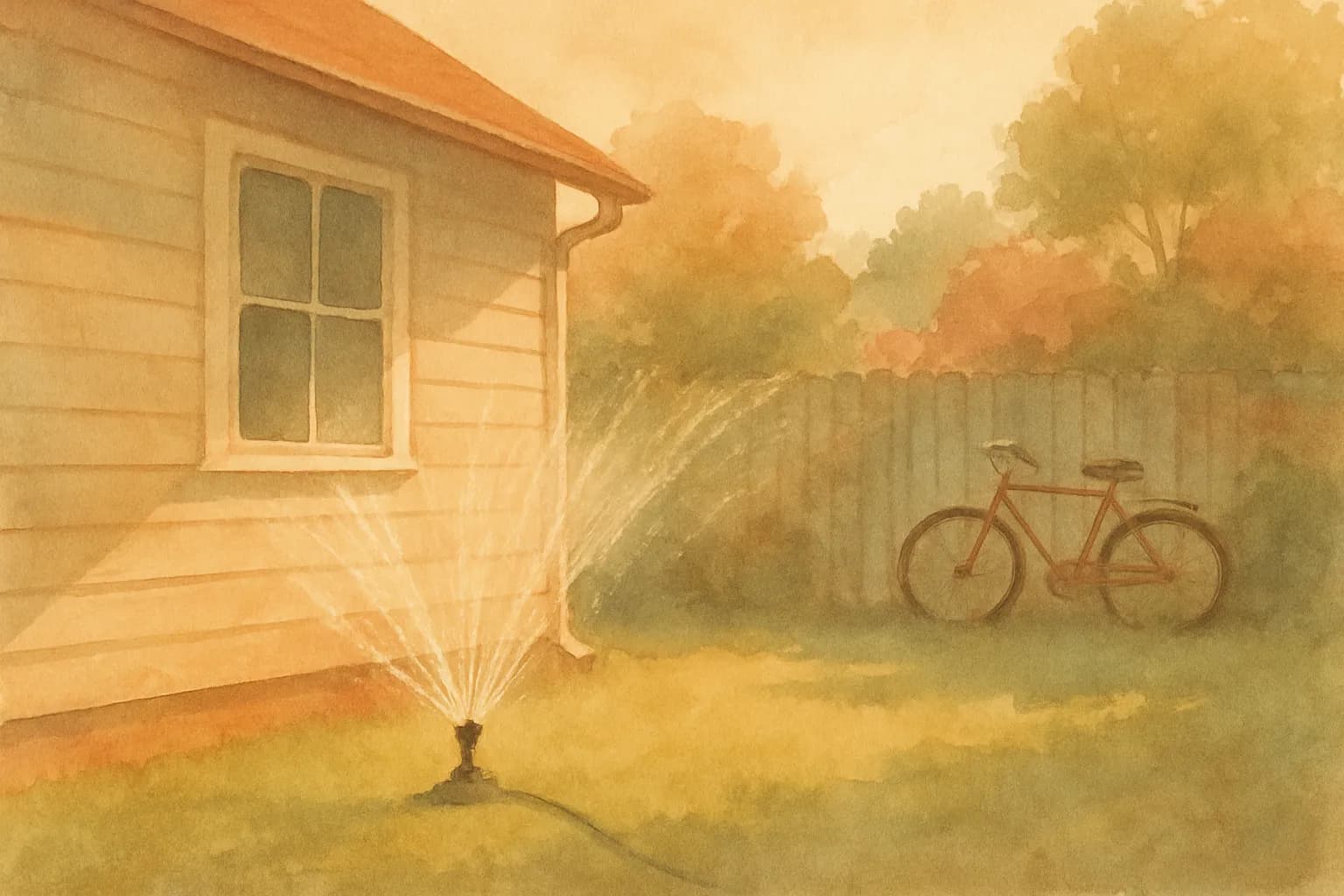
The lawn sprinkler swept back and forth, and at the end of its arc it hit the aluminum siding with a soft metallic tick. Steady rhythm. Tick. Tick. Tick. If you were inside the house with the windows open, you could time anything to it. If you were outside running through the spray, you ran on the back swing.
2. The ice cream truck two blocks over
The tinny music carried for half a mile. "Pop Goes the Weasel," or "The Entertainer," or sometimes some bit of Mozart that the truck owner had thought sounded sophisticated. You had about three minutes from first hearing the music to needing to be at the curb with a quarter.
You can still hear ice cream trucks in some neighborhoods. Most American kids today have never heard one in person.
3. The screen door slamming behind every kid
The wooden screen door with the spring hinge. It pulled itself shut after you, with a slap that announced your arrival or departure. Every kid in the neighborhood slammed one approximately a hundred times a day in summer.
The sound was so constant that mothers learned to identify their own children by the specific tempo of their slam. Your mother knew when you'd come in without looking up. The slam was the announcement.
4. The cicadas at dusk
A low wash of sound from the trees, starting around seven, thickening as the light went, peaking around eight-thirty when it filled the whole sky. The cicadas didn't make noise so much as they made the air itself vibrate, and an entire American summer evening was held together by their hum.
They still do this. Most of us are now inside with the windows closed and can't hear them. They are still out there. They have not stopped.
5. Lawn mowers, all up and down the block
Saturday morning, ten a.m., and you could stand on your driveway and hear three or four different mowers in three or four different yards. Your father's was the closest. The neighbor's was a hundred feet away. The man across the street started his around ten-fifteen.
The mowers had different voices. Yours was the one you knew. The neighborhood was a low concert of small engines, with the smell of cut grass riding the sound across the block.
6. The transistor radio on a towel at the pool
Someone always had one. The little black plastic radio with the antenna and the speaker that distorted at full volume. AM stations only, mostly Top 40, sometimes the ballgame.
At the public pool, the radios were tuned to the same station, more or less, so the music was coming from twelve different transistors at once with slight delays. You'd hear "American Pie" coming from the lifeguard chair and a quarter-second later from the towel ten feet over and a quarter-second after that from the towel twenty feet over.
7. The bell on the popsicle truck (a different truck)
In some neighborhoods, the popsicle man came in addition to the ice cream truck. His truck was smaller and slower. He had a single bell, hand-rung, no recorded music. The bell sound was distinctive, mellow, and meant the popsicles cost less than the ice cream truck's offerings.
The popsicle truck is mostly gone. The bell is a sound that almost no American under fifty has ever heard.
8. The kids in the street until full dark
Yelling at each other. Calling out the rules of capture the flag. Arguing about whether somebody had been tagged. The slap of bare feet on a driveway. The skid of a Stingray bike making a sudden stop on the asphalt. A kid screaming because she got hit with a water balloon.
This was the soundtrack of an American summer evening, from dinner until ten p.m., in every neighborhood in the country. It is mostly silent now.
9. The window fan on high
A box fan in the window of the upstairs bedroom, running all night, with a roar like a small airplane. The blades clicked against the cage on every rotation if the fan was older. The room was tolerable because of the fan, but only because of the fan, and the fan was loud enough that you had to raise your voice to be heard over it.
Sleeping next to a window fan is a specific American summer experience that is essentially extinct. Modern central air is silent. Modern people sleep in silence. The fan's roar was the sound of summer rest.
10. The bug zapper in the backyard
The blue light. The constant low electric buzz. And every few minutes, a sharp loud zzzaap as another mosquito or moth flew into it.
The bug zapper was loved in some yards and hated in others. The neighbors who hated yours could hear it from their own yard, and they had opinions. The arguments about bug zappers were one of the small recurring social frictions of an American suburban summer, which is not really a sound but is part of the soundtrack anyway.
Most of these are still possible. You can buy a sprinkler that hits the side of the house. You can leave the windows open. You can let your kids stay out until ten on a Tuesday in July. You can put a window fan in the bedroom and run it on high.
You'd be slightly out of step with your neighbors. The neighborhood would be quieter than yours, with the AC running and the windows closed. But your house would sound like an American summer used to sound, and your kids would have heard it at least once, and that's worth doing.
The sounds are still out there, most of them, waiting for someone to open a window.
Get a new story every Sunday morning.
One email a week. No spam. Unsubscribe anytime.
If this brought back a memory, you might also like
The Lost American Sunday Newspaper
The thump came around six in the morning. The Sunday paper occupied a whole morning for tens of millions of families. It has thinned to almost nothing.