The Lost American Sunday Newspaper
The thump came around six in the morning.
The paper boy threw the Sunday edition from his bicycle without slowing down, and it landed on your front walk, or in the bushes, or sometimes on the porch if he had a good arm. The Sunday paper was the heavy one, two or three times the weight of a weekday edition, sometimes thick enough that it took two hands to carry inside.
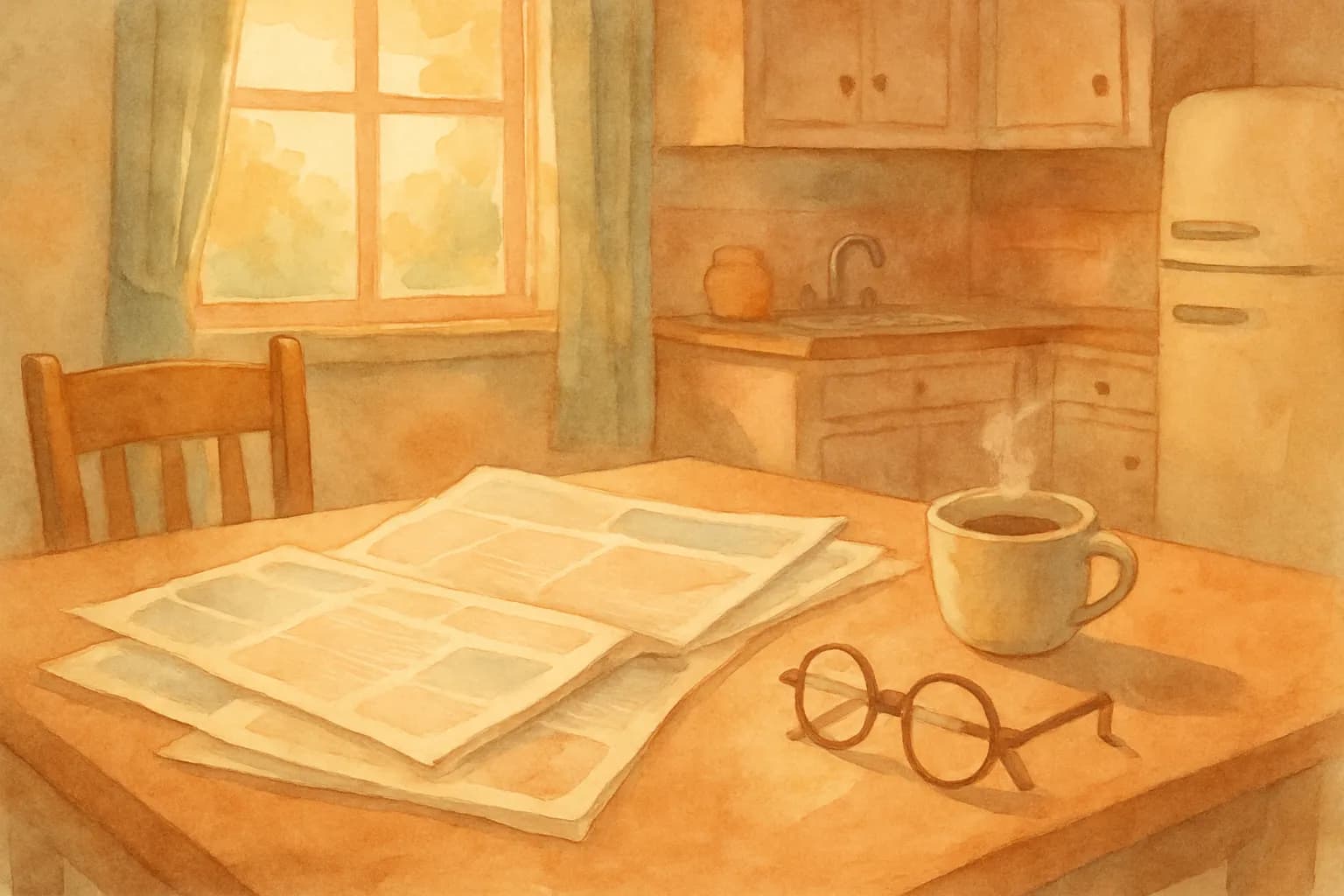
Your father got up first to bring it in. He set it on the kitchen table and started the coffee. By the time the rest of the family came down for breakfast, he had already spread the sections out across the table, claimed the front page and the sports section, and started reading.
The Sunday newspaper has been declining for thirty years. Most of you reading this still get one, or did until recently. Most of your kids do not. The thing that used to occupy a long American Sunday morning, for tens of millions of families, has thinned to almost nothing, and what was lost when it thinned out is worth saying.
The morning the paper took up
A real Sunday paper was an event. It came with a built-in agenda for the next two or three hours.
Your father took the front page, the sports section, and the editorial page. He read in the order he had been reading them since 1962, with coffee, slowly. Your mother took the magazine and the lifestyle section, and the supermarket coupons, which she would clip during a second sweep later. The kids fought over the funnies, which were in color on Sunday only, and which included the strips that didn't appear during the week — Prince Valiant, Mark Trail, Beetle Bailey at full size.
There was a real estate section, which nobody read unless they were buying or selling a house, but which was thick anyway. A travel section, which featured a destination piece written in 1973 that nobody had updated. A book review section, in the bigger papers. A classifieds section, which was where you found a used car, a job, an apartment, or a roommate, and which ran for forty pages on a good week.
The reading took the whole morning. You didn't read the paper from start to finish. You read what interested you, set it aside, came back to it, traded sections with somebody else, read some more. The paper kept the family in one room — the kitchen, mostly — for several hours, all of them reading and occasionally pointing things out to each other.
The sections nobody talks about anymore
The Sunday paper did something specific that no current information source quite duplicates: it brought you news of your immediate vicinity, in a form that took some time to read.
Your local high school's football score was in there, even if your high school had lost. The obituaries listed every death in the county for the week, with full write-ups of who they were and who they left behind, and your mother read them carefully, because she knew some of these people, or had gone to school with some of these people, or had a sister-in-law who had known one of them.
The wedding announcements were in there too. Two columns, with photos, of every couple who had gotten married in the area that week. You knew some of them. You looked at the dresses. You looked at the names of the bridesmaids to see if anyone had been left out who shouldn't have been.
The births were in there. The names of every baby born at the local hospital the previous week, with the parents' names and the addresses. Your mother knew, by reading this column, that the Hendersons had had their third boy and that the Petersons had finally had a girl after two sons.
There were small police blotters and court reports — who had been arrested for what, who had been arraigned, who had been sentenced. You read them not for the sensational news but for the social information. Bob Henderson's son got picked up for drunk driving on Saturday night. Did you see that in the paper?
The paper was, in a real sense, a community gossip mechanism that operated through a layer of formal journalism. It told you what was happening among people you knew, and it did so with a kind of dignity that the modern equivalents — Facebook, Nextdoor, the local news website — do not match.
The advertising that mattered
The Sunday paper was where you found things.
The Sears insert came in the Sunday paper. So did the JCPenney circular. The grocery store had its weekly ads, which your mother went through with a pen, circling sale items and making the shopping list for Monday. The local department store had a full-page ad showing the new fall coats or the spring dresses, and a teenage girl might cut one out and put it on her bulletin board.
The car ads were in there, with the new model year arriving each fall. The real estate listings, with photos and prices, gave you a sense of what houses in your area were worth. The local restaurants advertised their Sunday brunch specials.
This was useful information. It was also entertainment. Your mother going through the grocery ads for forty minutes on a Sunday morning was not chore-time. She was engaged, focused, and slightly competitive with herself about how much she could save next week.
The Sunday morning routine that depended on it
Sunday morning in many American households between roughly 1950 and 2005 looked like this:
Coffee. The paper on the table. Bagels or doughnuts, depending on the family. The radio on low in the background, sometimes a classical station, sometimes the weather report. Everyone in the kitchen or the living room. The kids in pajamas reading the funnies on the floor.
This was a domestic ritual that didn't require any of the people in it to do much. The paper provided the material. The kitchen provided the setting. The hours provided themselves. Nobody had to plan it. Nobody had to be entertained. The Sunday morning shape was familiar enough that you slid into it the same way you slid into the same kitchen chair.
The decline of the paper has not been replaced with anything that does the same work. The phone is not the same. Reading the news on a tablet is not the same. The household sitting in the same room together, all reading different sections of one shared document, is something that simply does not happen anymore for most American families.
What happened to it
The story of newspaper decline is mostly an industry story, and most of you have already heard it. Classifieds went to the internet. Display advertising went to Google and Facebook. Younger readers stopped subscribing. Local papers were bought by chains, then by hedge funds, then gutted. The papers got thinner. The Sunday edition shrank. Some local papers stopped publishing daily and now only come out two or three times a week. Some have stopped publishing at all.
This is mostly economic and mostly inevitable, and it is not the part of the story that interests me here.
The part worth saying is what the loss of the Sunday paper has meant inside the American household.
The shared morning is mostly gone. The kitchen-table reading is mostly gone. The funnies on the floor are mostly gone. The community information about births and deaths and weddings is gone, or it has migrated to social media platforms where it lives in different shapes and reaches different audiences. The advertising circulars are gone or are received as junk mail. The classifieds are gone.
What we have instead is each person in the household, on their own device, in a different room, reading a different stream of information. The information is, in many ways, more current and more relevant. It is also entirely individual. There is no shared paper on the table. There is nothing to point out to anybody. There is no slow Sunday morning of the family in one room, reading.
A small note on what to do
If your local paper still publishes a Sunday edition, subscribe. Even if you don't read all of it. The print paper is dying not because nobody wants it but because the business model has collapsed, and individual subscriptions are one of the few things keeping the remaining papers alive.
If your local paper is gone, find a small one that's still standing somewhere nearby and subscribe to that. There is one within driving distance of you, almost certainly, run by a small staff who are doing the work for almost nothing. Their classifieds are smaller, their funnies are reprints, their stories are mostly wire copy. But they still print the obituaries and the wedding announcements, and there are still some Sunday mornings, somewhere, that look the way Sunday mornings used to look.
The thump on the porch at six a.m. is one of the small sounds of American life that has gone quiet. You can put it back, in your own driveway, for the price of a subscription and the willingness to read a paper the next morning at the kitchen table.
Somewhere this Sunday, a family is sitting around a kitchen table with the paper spread out between them. The coffee is on. The funnies are on the floor. It is a smaller scene than it used to be, but it is not gone yet.
Get a new story every Sunday morning.
One email a week. No spam. Unsubscribe anytime.