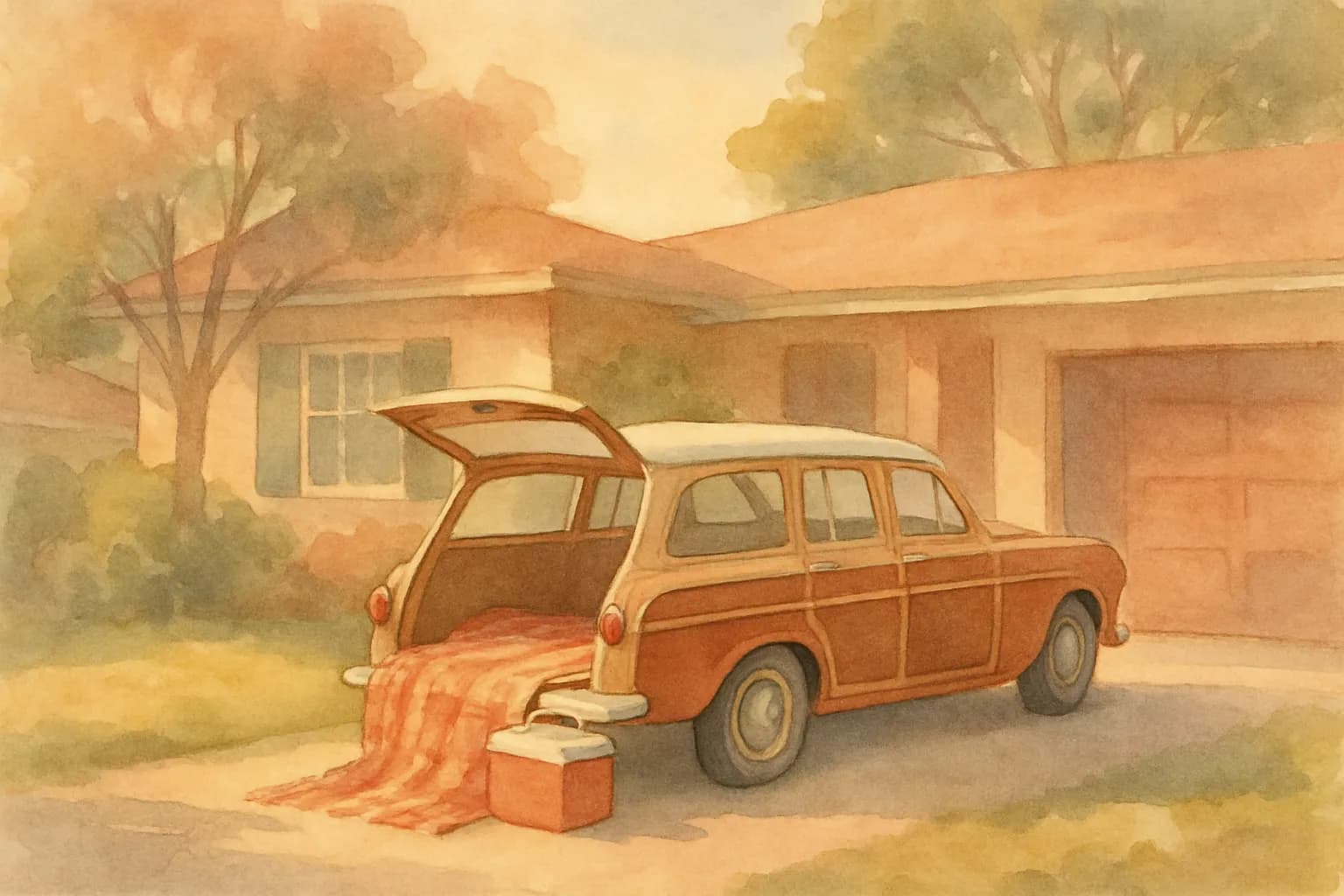
The American Station Wagon: A Eulogy
The wood paneling wasn't actually wood. It was vinyl, applied to the steel doors at the factory, in the rough pattern of a paneled library. It fooled no one and was beloved anyway.
The Country Squire. The Vista Cruiser. The Roadmaster Estate. The Pontiac Safari. The Buick Sportwagon. The Caprice Estate. Eighteen feet long, eight passengers, a V8 that drank gas like it was free -- which, in 1972, it almost was. The American station wagon was the family car for most of the twentieth century, and like the family it carried, it had certain expectations of itself.
It is gone now. Has been gone, mostly, for thirty years. The minivan took its job in 1984 when Chrysler released the original Caravan, and the SUV finished the job in the 1990s. By 2010 you could not buy a new full-size American station wagon. The category had been quietly retired.
What we drove instead is, by most measures, better. Safer. More fuel-efficient. Easier to see out of. Equipped with airbags, anti-lock brakes, backup cameras, and stereo systems that would have astonished a 1976 family.
But something was lost when the station wagon went away that none of its replacements have quite managed to recover. It is worth saying what.
The way-back
The defining feature of the station wagon was the rear-facing third-row seat -- universally known as the way-back -- that folded up out of the cargo floor and seated two children facing the cars behind you on the highway.
If you grew up in a station wagon, the way-back was the best seat in the car, and the worst seat in the car, depending on whether you got carsick. You could see the road retreating from you in real time. You could wave at the truckers behind you, who waved back. You could press your forehead against the rear window and watch the highway lines come out from underneath the wheels and stretch backward into the horizon.
You could also, if you were the youngest, get sent back there as a kind of punishment. Go ride in the way-back and stop bothering your sister.
There is no equivalent in any modern car. Minivan and SUV third rows face forward, sensibly, with airbags and headrests and seatbelts. The way-back was none of these things. The way-back was a backwards bench with a vague suggestion of safety, accessed by climbing over a folded-down middle row, in a car going 75 on the interstate, while your parents tried to find a radio station.
It built a specific kind of child. The kind who watched the world go by in reverse and was strangely fine with it.
The cargo area as a room
When the way-back was folded down, the rear of the station wagon was a flat, carpeted cargo area roughly the size of a small bedroom. On long trips, the children took up residence in it.
You had blankets. You had pillows. You had a cooler full of sandwiches and Tang. You had a paper bag of books, a stack of Mad magazines, a deck of cards, and a transistor radio. On a drive from Cleveland to Florida, you spent twenty hours back there, mostly horizontal, occasionally sitting up to look out the window at a Stuckey's or a South of the Border billboard.
Your parents were in the front, smoking, with all four windows down because air conditioning was unreliable in 1974. You could hear them talking faintly over the wind. You could see your father's elbow out the window. You were, in a meaningful sense, an unsupervised adult of seven traveling through six states in the back compartment of a Buick.
No modern child has this experience. No modern child would be allowed to. The cargo area of a modern SUV is for groceries and golf bags. The children sit in seats, with belts, where they belong. The math says they are safer. The math is right. But the math doesn't capture what was specifically there to be lost.
The vinyl seats in July
The seats were vinyl, in pale colors that absorbed every degree of summer sun the car could find. By noon in August, the seats were 130 degrees. You opened the door, sat down, immediately stood back up screaming, and waited five minutes for them to cool.
Your bare thighs in shorts stuck to the vinyl. When you got out at the gas station, the vinyl came partway with you, pulling away from your skin with a small wet sound that meant another twenty miles of red marks.
The vinyl is gone now. Cars have cloth or leather. They are better. They are also missing a specific small misery that an entire American generation shared without comment.
The tailgate that opened two ways
The Ford Country Squire had a tailgate that opened either down, like a pickup truck, or sideways, like a regular door, depending on which handle you pulled. This was called the "Magic Doorgate," and it was, briefly, the most advanced piece of engineering on any car sold in America.
The point was: you could load a refrigerator through it, or you could sit on it at a football game with your legs dangling, or you could open it like a door at the gas station to grab the cooler without dragging it across the carpet. Three vehicles in one. It was a small marvel of practical thinking.
The minivan's sliding side door is more useful. It is also, in its way, less interesting. The tailgate that opened both ways was an act of imagination. The sliding door is an act of optimization. The difference is not nothing.
The road trip the station wagon enabled
The American family road trip, as a cultural institution, was largely a station wagon phenomenon. From roughly 1955 to 1985, families piled into their wagon every summer and drove for a week or two -- to the lake, to Yellowstone, to Grandma's in Florida, to the Grand Canyon.
The car was the vehicle, but it was also the room. You ate lunch in it. You slept in it sometimes. You changed clothes in it at rest areas. You played license-plate games in it for three hundred miles. You learned the geography of your country at sixty miles per hour, through the back window, with three of your siblings.
The minivan continued this tradition. The SUV continued it less well. The current car, which is mostly a crossover with four bucket seats and a cargo well, does not really continue it at all. You can take a road trip in a crossover, but the kids are belted in, looking at screens, and the back of the car is no longer a room. It is a series of stations.
Something specific about how American families spent time together died with the station wagon, and nobody quite registered it as a loss because the replacements were arriving so fast.
What we kept, and what we let go
We kept the family car. We kept the long trip. We kept the basic shape of suburban life that required a vehicle that could carry six people and a dog and the camping gear.
What we let go was a kind of casual, slightly unsafe spaciousness that the station wagon offered as a default. The flat cargo area you could nap in. The rear-facing seat you could wave from. The carpet that ran from the front of the car to the back. The eight-foot interior. The wood-paneled exterior that looked like a station wagon at every distance, in every state, on every highway.
The minivan and SUV are objectively superior vehicles. They are also, in a very specific sense, less generous. They give you seats. The station wagon gave you a room.
The reason this matters
Nobody is going to bring back the Country Squire. Volvo and a few European brands still make wagons, in small numbers, mostly for enthusiasts. Subaru makes the Outback, which is close. But the eighteen-foot, eight-passenger, fake-wood-paneled, vinyl-seated, way-back-equipped American behemoth is gone for good.
What's worth noticing is that an entire generation of American children grew up partly inside this vehicle. The way-back is a piece of cultural infrastructure. The cargo area is a piece of cultural infrastructure. The summer road trip with three siblings in the rear compartment of a Buick is a piece of cultural infrastructure.
When the vehicle that enabled all of this disappeared, the experiences disappeared with it. Not because the new vehicles are worse. Because they enable a different kind of experience -- more contained, more individual, more screen-based, more buckled-in.
Both versions are valid. The old one had certain virtues. They are gone, and they are worth a moment of recognition.
Goodbye to the wood paneling. Goodbye to the vinyl seats. Goodbye to the way-back.
Goodbye to the way-back. It was the best seat in any car we'll ever ride in.
Get a new story every Sunday morning.
One email a week. No spam. Unsubscribe anytime.
If this brought back a memory, you might also like
10 Saturday Morning Cereal Box Toys That Defined a Childhood
The prize was the reason you wanted the cereal. The cereal was just a vehicle for the small plastic object buried somewhere inside the box.