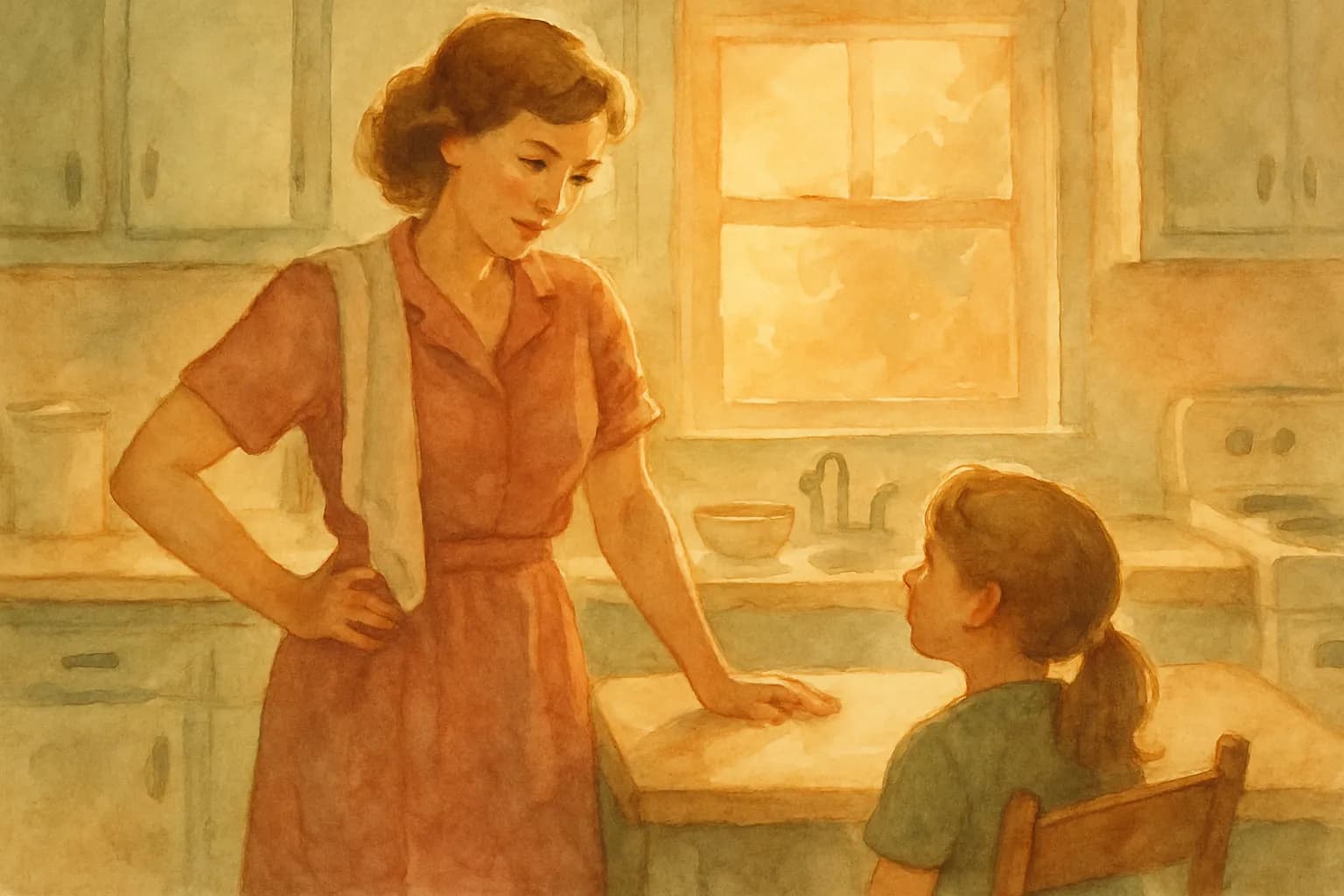
10 Sentences Every Mother Said That We Now Catch Ourselves Saying
There's a moment, somewhere around age thirty-five, when you say something to your kid and then stop, slightly horrified, because you just heard your mother's voice come out of your mouth.
She is now in your throat for life. The phrase you swore at twelve you would never repeat is the phrase you've now said three times this week, in the same tone, with the same exasperated sigh in the middle. She didn't even have to be there to win the argument. You did it for her.
Here are ten of them. You'll know them.
1. "Because I said so."
The argument-ender. The phrase that closed every appeal, ended every negotiation, and shut down every lawyerly child who tried to point out the inconsistency in her reasoning.
You hated it as a kid. You found it intellectually bankrupt. You spent years promising yourself you'd explain things to your own children, with reasons and logic and the respect they deserved as small people with developing minds.
Then you had children. Around age four they discovered the word "why." By age six, you were saying "because I said so," sometimes twelve times in a single afternoon. You said it the same way she did. You didn't even notice.
2. "Wait until your father gets home."
The threat that loaded the rest of the afternoon with dread. He hadn't actually been told yet. He didn't even know what was coming. But somewhere around five o'clock, when his car pulled into the driveway, the entire household tensed, and you knew the report was about to be delivered.
The funny thing was that he was usually tired, and your mother had usually calmed down by then, and the actual punishment was almost always milder than the four hours of waiting had suggested. The phrase did most of the work on its own. He almost didn't have to.
3. "Were you born in a barn?"
Said every time you left a door open. The screen door, mostly. The back door. The front door in winter. The garage door after you came in with your bike.
It made no literal sense. Most of us were not born in barns. But "close the door" was apparently not enough. She needed the rhetorical question, delivered with hands on hips, in a tone that suggested she had asked you this same question seven thousand times and would ask it seven thousand more. She wasn't wrong about the numbers.
4. "I'm not running a hotel."
Said whenever a child wanted a meal between the official meals, or asked for special accommodations regarding sleeping arrangements, or otherwise expected service of any kind.
The phrase made you feel briefly entitled and then immediately ashamed. You weren't asking for room service, exactly. You just wanted a snack at four in the afternoon. But the framing was so effective that you backed away from the kitchen and waited for dinner like everybody else.
You now say this to your own children. You said it last week, when one of them asked if you could make a second dinner because they didn't like the first one. The words came out before you could stop them.
5. "If your friends jumped off a bridge, would you jump too?"
The standard response to any sentence that began with "but everybody else gets to."
It was a logical trap, and you knew it was a logical trap, and you walked into it every time. Of course you wouldn't jump off a bridge. But that's not what we were talking about, was it? We were talking about whether you could go to the mall with Lisa and Stephanie on Saturday, which is not at all comparable to jumping off a bridge.
She didn't care. The point of the question wasn't to make sense. The point was to remind you that your friends were not, in fact, the people raising you, and that "everybody else" carried no weight whatsoever in this house.
6. "I'll give you something to cry about."
Used when the crying was, in her assessment, theatrical. The whining over a minor injustice. The tantrum about a denied snack. The tears that lasted just a little too long for the offense.
It sounds harsh, written out. In context it was usually said with a kind of weary affection, more weather report than actual threat. The crying would stop, because the crying had not really been about anything in the first place, and even at age seven you could read the tone and know it was time to move on.
The phrase has not aged especially well. Most of us wouldn't say it to our own kids today, or if we did, we'd feel bad about it for an hour afterward. But it was effective, and it's worth being honest that it was effective, even if we've decided to retire it.
7. "When you have your own kids, you'll understand."
The curse, delivered with a knowing smile. She said this when you accused her of being unfair, or when you swore you'd never make your own children eat broccoli, or when you announced that you would parent very differently than she had.
She was right. About all of it. About every prediction she made on this front. The day you held your own newborn and realized, all at once, the sheer scale of what your mother had done for you without any acknowledgment, was the day this sentence finally landed. She probably knew, somehow, that this was coming. She probably waited for the phone call.
8. "Don't make me come up there."
The bedtime threat. The pleading was already over. The third reminder had already been delivered. Now she was at the bottom of the stairs, calling up in that specific tone, and you had about ninety seconds to get into bed before the actual ascent happened.
She rarely had to come up. The phrase did the work. Even if she had come up, the consequences were vague and rarely severe. But the warning carried the entire weight of her authority, accumulated over years of consistent follow-through on smaller threats, and that authority was the real reason it worked.
9. "I have eyes in the back of my head."
Said to explain how she knew, exactly, what you were doing in the next room. It seemed plausible. She always seemed to know.
What you didn't realize until you became a parent yourself was that mothers don't have eyes in the back of their heads. What mothers have is a finely tuned pattern recognition system, developed over thousands of hours of monitoring small humans, that can detect the specific quality of silence that means a child has done something he or she should not have done. The silence is the tell. She didn't need to see you. She could hear the silence.
10. "You'll thank me when you're older."
Said about the things you didn't want to do. Eating the vegetable. Wearing the coat. Practicing the piano. Going to bed at the time she said. Writing the thank-you note. Calling your grandmother.
The phrase always landed with a faint air of smug certainty, as if she'd already lived your future life and was reporting back. And the worst part, which is hard to admit even now, is that she was usually right.
We did, eventually, thank her. Mostly silently. Sometimes by saying these same sentences to our own children, in the same tone, with the same exasperation, on the same kind of long afternoons.
She is still in there, in your voice, saying the things you swore you'd never say. She was right about that, too.
Get a new story every Sunday morning.
One email a week. No spam. Unsubscribe anytime.