What the Phonebook Used to Mean
It hit the porch with a thump heavy enough to wake the dog.
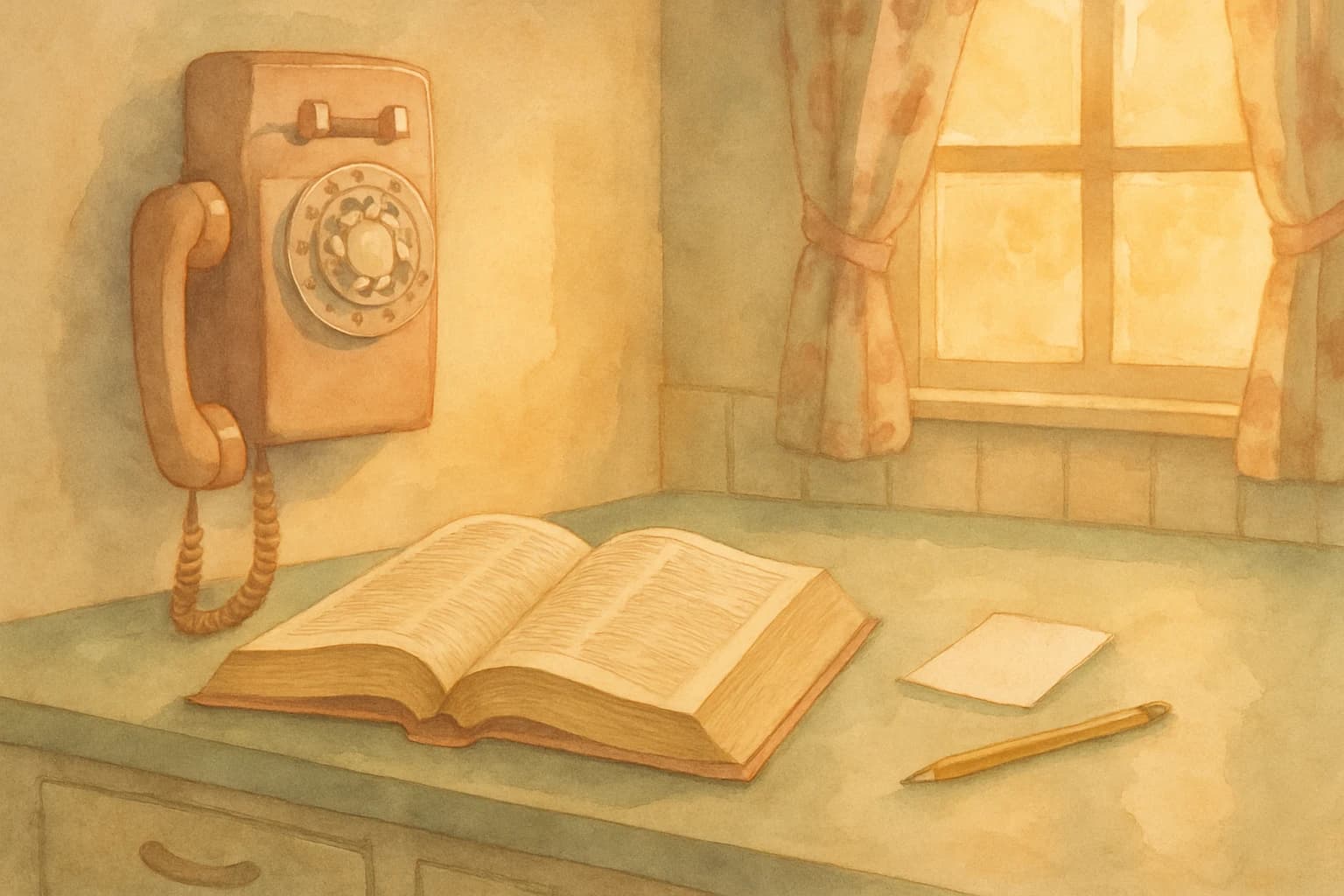
Every October, the new phonebook arrived. Sometimes one book, sometimes two -- the white pages and the Yellow Pages in separate volumes if your city was big enough to need that. The old book got pulled out of the kitchen drawer or the cabinet under the wall phone, and the new one took its place. The old one went into the basement, or got cut up by a child for a school project, or sat on a shelf for a year before getting recycled.
If you grew up before about 1995, you can still feel the weight of one in your hands. The thin Bible paper, the smell of the ink, the alphabetical edge tabs cut into the side. It was a real object, and an essential one, and almost nobody under thirty has ever held one. The phonebook went away faster than most people noticed, and what disappeared with it is worth saying.
The white pages were the town
The white pages listed every household in your service area. Name, address, phone number, in straight alphabetical order, in tiny type, going on for hundreds of pages.
This meant that anyone in your community could find anyone else in your community. You needed to call the Hendersons about the school carpool? The Hendersons were in the book. You needed to find your old high school friend who'd moved across town? She was in the book under her married name. You needed to track down the woman who used to babysit you twenty years ago? Her last name was unusual enough that you could probably find her, or her parents, in the book.
The whole town was findable. Your privacy was a function of how common your last name was -- a Smith was more or less anonymous in a phonebook, but a Pulaski was easy to locate. Otherwise the assumption baked into the white pages was that adult members of a community could reach each other. There was no opting out. There was no unlisted number unless you specifically paid extra for one, which most people didn't.
This sounds dystopian by modern privacy standards. It mostly wasn't. The information was available but limited. You got a name and a number. You did not get someone's daily location, their photo, their political opinions, their work history, or their relationships. The phonebook gave you the minimum information needed to contact someone, and that's all it gave you. By the standards of what Google and Facebook now know about everyone, the white pages were a model of restraint.
The Yellow Pages were the economy
The Yellow Pages listed every business in your service area, organized by category, with display ads for those who had paid for one. Plumber, electrician, restaurant, dentist, hardware store, attorney, locksmith, florist. The categories went on for hundreds of pages.
This was how you found anything. Your sink was leaking -- you flipped to Plumbers and scanned the ads. The bigger the ad, the more established the business was assumed to be. You picked one based on the ad design, the proximity to your house, and sometimes just on the strength of the name. There was no Yelp to check, no reviews to read, no rating system. You called the guy with the biggest border on his ad, and you took your chances.
This sounds primitive, and in some ways it was. But it produced a real local economy. The plumber in the Yellow Pages was always a local plumber. He had paid for an ad in your local Yellow Pages because he wanted your local business. The whole apparatus reinforced local commerce, because the directory was local. National chains didn't dominate the listings, because the format didn't reward them.
A small business in 1985 could be sustained by a quarter-page ad in the Yellow Pages. Tens of thousands of American small businesses lived or died on the strength of those ads. The Yellow Pages were a major advertising medium, with the directory companies making real money selling ad space, and the businesses making real money from the calls the ads generated.
The white pages told you who lived where
There was a secondary use of the white pages that nobody thought of as a use, exactly, but that was real: you could see who lived in your neighborhood.
You could look up the address of a house you'd driven past and find out who lived there. You could see how many people on your street shared your last name. You could find the phone numbers of all the houses on the block, which meant you could call any of them in a small emergency. You could trace a family by their last name across the city.
This was a kind of low-grade community knowledge that the phonebook quietly produced. Most people never used it deliberately. But it was available, and it shaped the texture of how people understood the places they lived in. A town with a phonebook was a town where most adults could find most other adults. That fact was in the air.
How it went away
The white pages went first, eaten by the cell phone and the internet. By the late 1990s, fewer people had listed landlines. By the 2000s, most adults had cell phones, and cell phone numbers were not in the white pages. The directory was still being printed, but the data inside it was becoming less complete every year. By 2010, it was a partial record of a partial population. By 2015, most cities had stopped printing it, or were printing only opt-in directories with a fraction of the listings.
The Yellow Pages went next, eaten by Google. Why flip to Plumbers and pick by ad design when you could type "plumber near me" into a search bar and get reviewed, ranked results with photos and phone numbers? The Yellow Pages directories kept getting printed for years past their usefulness, mostly because the companies that printed them had long-term contracts with advertisers who hadn't yet adapted. By the late 2010s, the books were arriving on porches and going directly into recycling without being opened. They eventually stopped arriving.
What disappeared with them
The first thing was the local-economy reinforcement. Without the Yellow Pages, the local plumber doesn't have a natural advantage over the national chain whose Google ads have a bigger budget. A great deal of small-business advertising shifted to platforms where local is just one variable among many, and where national money beats local presence. The Yellow Pages had structurally favored the local business. Nothing replaced that structural favor.
The second thing was the assumption that adults could reach each other. The white pages enforced a baseline of social connectedness: members of a community could find one another's contact information. This was a foundation that other social interactions could be built on top of, often without anyone noticing. Now, reaching someone you don't already know how to reach is much harder. You can find them on social media if they're on social media, but they might not be, and you might not be either. The connection that the phonebook used to provide for free is now mediated by platforms that may or may not have the person on them.
The third thing was the object itself. The phonebook was a thing in the house. You touched it. You knew where it was. It was as basic to a household as the salt shaker. Its disappearance from the kitchen drawer was a small architectural change in American domestic life that nobody registered as a change at the time. The drawer where the phonebook lived is now used for something else, or for nothing.
The minor revival
There are still phonebooks. The major directory publishers still produce them in many regions, at reduced volumes, for the population that requests them. Some older households keep one near the phone. Some businesses still maintain a Yellow Pages presence as backup.
These are minor holdouts, and they don't change the basic story. The phonebook as universal household object is gone, and it isn't coming back.
What's worth noticing is what the phonebook represented. It was a community-scale record, produced annually, that any adult in the community could use to reach any other adult. That kind of public infrastructure -- built by a regulated utility, distributed for free, updated yearly, taken for granted -- doesn't exist anymore for almost anything. We have richer information now, on richer platforms. We've also given up on the idea that a community might maintain its own basic directory of itself. Something specific is in that gap.
Do you remember the last time you used a phonebook? Do you still have one in the house? Tell us in the comments -- we'd love to hear.
Get a new story every Sunday morning.
One email a week. No spam. Unsubscribe anytime.