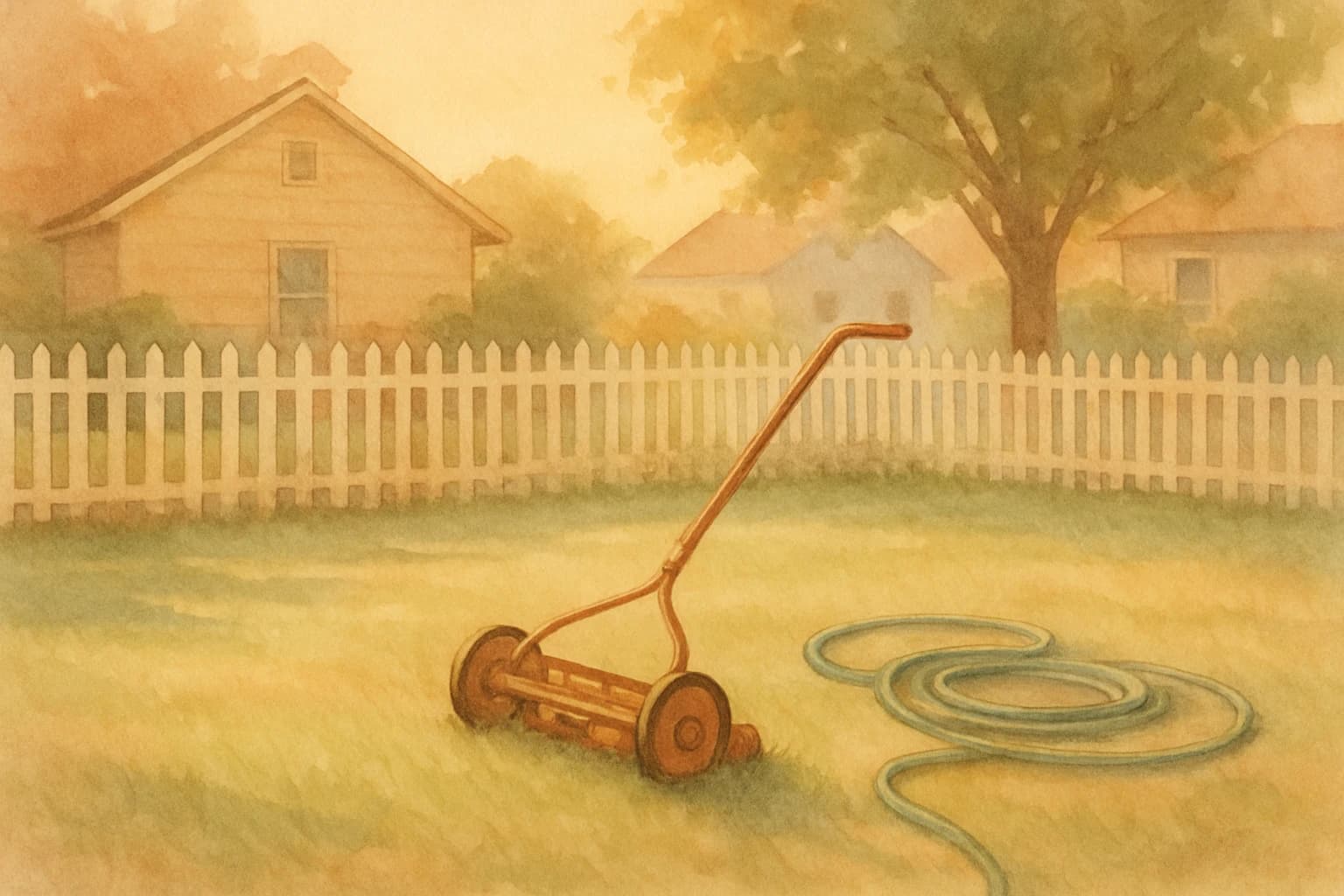
The American Lawn: A Quiet Pride That Ran the Whole Summer
Saturday morning was the lawn.
Your father got up at seven, drank a cup of coffee at the kitchen counter, and went out to the garage. He pulled the mower into the driveway. He checked the oil. He pulled the cord three or four times until it caught, and the noise filled the block. By eight, he was making his first pass along the property line, walking in straight rows, with the kind of focus that did not invite conversation.
The lawn was a project that ran from April through October, in weekly installments, for as long as he owned the house. It was rarely discussed and never skipped. He would no more have skipped a week of mowing than he would have skipped a week of paying the mortgage. The lawn was a basic adult obligation, and tending it well was a small expression of who he was.
This was the American lawn culture of the postwar decades, and it was an enormous thing, even though nobody talked about it as such. Tens of millions of American men spent thousands of hours of their lives on it. Most of them never wrote a sentence about why. They just did it, every Saturday, for forty years.
What the work actually involved
The mowing was the visible part. He did the front first, then the back, in alternating patterns so the grass would lie in different directions week to week. He did the edges with a separate tool -- a manual edger, in the early years, then a powered one by the late seventies. He trimmed around the trees by hand. He swept the cuttings off the sidewalk.
Then there was the rest of it: fertilizing in spring and fall, on a schedule he had worked out over years. Watering on a schedule the city's water restrictions didn't always agree with. Aerating in the fall, sometimes, if the lawn had compacted. Reseeding the bare patches. Pulling crabgrass by hand on Sunday afternoons. Treating for grubs, if grubs had been a problem the previous year. Bagging the leaves in October.
It was a real time commitment. A house with a quarter-acre lot demanded somewhere between three and five hours of lawn work per week during the growing season, and that wasn't counting the bigger seasonal jobs. Across a year, your father probably spent ninety to a hundred and twenty hours on the lawn. Across the four decades he lived in that house, that's four thousand hours, give or take, of pushing a mower around the same rectangle of grass.
What he was actually doing
The work itself was repetitive. The lawn never finished. Every week it grew back exactly as much as he'd cut, and the work began again. So the question of what he was getting out of it isn't trivial. He was getting something. We just have to think about it for a minute to figure out what.
He was getting time alone. The lawn was loud enough that he couldn't be talked to while he was doing it. He could not be summoned by his wife for a small household question, or interrupted by his children for a request. The mower's noise was a kind of acoustic privacy that ran for two or three hours a week, and inside that privacy he could think about whatever he wanted to think about, or not think about anything at all.
He was getting visible competence. The lawn was the only part of his life that the whole neighborhood could grade. His work at the office was invisible to his neighbors. His marriage was invisible. His finances were invisible. The lawn was right there, every Saturday, for anyone driving past to see. A well-kept lawn was a public signal that he was managing his affairs, and an unkempt lawn was a public signal that he wasn't. The judgment was real, and he knew it, and tending the lawn well was one of the small daily ways he met it.
He was getting a finished thing. Most of his life produced incremental results that didn't really have an endpoint. The lawn ended every Saturday around noon, when he pushed the mower back into the garage and looked out at the rectangle of grass and saw that it was done. The pleasure of a finished job was rare enough in adult life that he came back for it, every week, for forty years.
The conversation over the fence
The lawn was also a social object. The neighbors did theirs at the same time, and the timing was loose enough that two men working on adjacent lawns would eventually find themselves at the property line at the same moment, mowers idling, and a conversation would happen.
It was usually short. Five minutes. Sometimes longer. The conversations were about the lawn itself -- what fertilizer he was using, whether the grubs had been bad this year, the new mower somebody had just bought. They were also about other things, indirectly. The kids. The wife's mother. The boss. The conversations a man wouldn't initiate in the kitchen but would have over a chain-link fence with somebody he'd known for fifteen years.
The lawn-line conversation is one of the great vanished American social forms. It required the lawn. It required the neighbor. It required the simultaneous Saturday morning ritual that made the meeting inevitable rather than planned. A planned conversation between two suburban men is a slightly uncomfortable thing. An accidental one over the fence is not.
What was different about the era
A few things made the postwar lawn possible and important in a way it isn't now.
Most households had one working adult, who came home tired but had Saturday available. The lawn was an obvious way to use the time, and it produced something visible. In a two-career household with shorter weekends and more competing demands, the same hours simply aren't there.
The lawn was the default landscape. Other yard styles -- native plants, xeriscaping, vegetable gardens taking up the front, wildflower meadows -- existed but were rare and slightly suspect. The neighborhood expected a lawn, and the lawn delivered. The aesthetic uniformity was social pressure, but it was also social ease. You knew what your job was.
And the lawn wasn't yet politically charged. It became charged later, around water use and pesticides and biodiversity, with reasonable arguments on the other side. None of that was in the air in 1973. A man pushing a mower on Saturday morning in 1973 was just a man pushing a mower. The cultural critique came later, and it complicated something that had been simple.
What's been lost, and what hasn't
The lawn culture has thinned. Lawn-service companies do many of the lawns that fathers used to do themselves. The conversation over the fence happens less because the simultaneous Saturday morning ritual is less common. The aesthetic uniformity has cracked, in some neighborhoods more than others.
This is partly fine and partly a real loss. The fine part: the environmental costs of the postwar lawn are real, and the move toward more diverse, less chemical-dependent yards is sensible. The lost part: a great many men used to have a weekly, public, finished, social activity that ran for forty years, and most of the replacements for it are private, indoor, and screen-mediated.
If your father did the lawn for forty years, you saw a kind of steady weekly devotion that's harder to come by now. He wasn't talking about it. He was doing it. The lawn was the language he had, and he spoke it fluently every Saturday from April to October until he couldn't anymore.
Did your father mow the lawn every Saturday? Do you do yours now? Tell us in the comments -- we'd love to hear.
Get a new story every Sunday morning.
One email a week. No spam. Unsubscribe anytime.