The Small-Town Fourth of July We Lost
The parade started at ten in the morning.
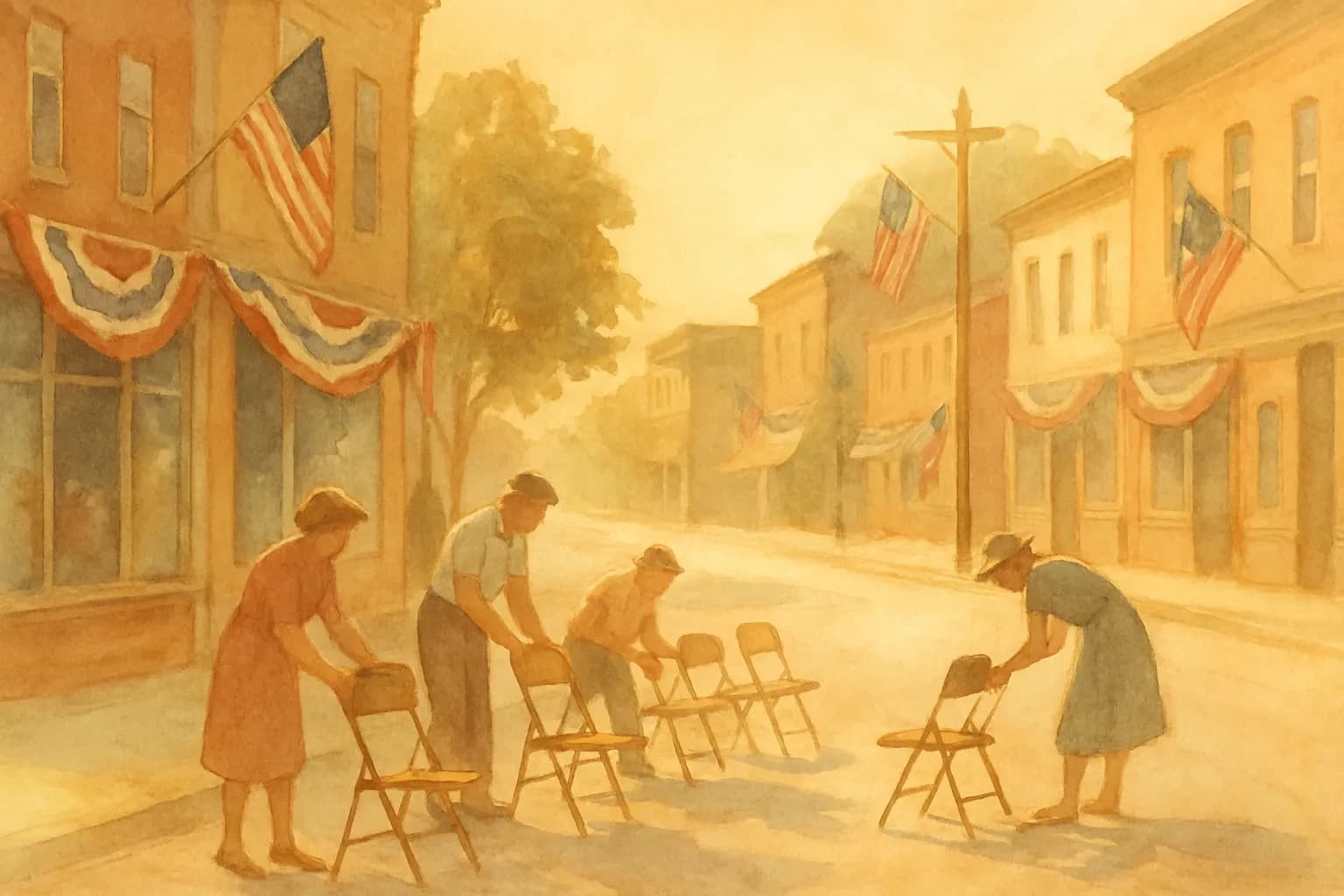
It ran for six blocks down Main Street, from the high school parking lot to the park where the speeches would happen later. The crowd was three or four people deep on the sidewalks, in lawn chairs they had set up at seven that morning to claim their spot. Most of the town was there. The rest of the town was in the parade.
A fire truck led the way, lights flashing, no siren, the firefighters waving from the back. The high school band came next, playing "Stars and Stripes Forever" out of tune in the heat. The Boy Scouts walked behind them with a flag. Then the veterans, slower every year, in their old uniforms or their Legion caps. Then the kids' bike parade, twenty children with red, white, and blue streamers laced through their spokes.
The dentist drove past on a homemade float. The mayor waved from a convertible. The local insurance agent had decorated his Ford pickup with bunting and was throwing candy from the back. A girl scout troop walked behind the pickup picking up the candy that bounced off the curb. The Methodist church had built a float. So had the Lions Club. So had the volunteer fire department, twice, because they had two trucks.
This was the small-town American Fourth of July. There used to be one in every town with a Main Street, and the day still survives in some places, but it's quieter and smaller, and most American children growing up now will never see it.
What the day actually looked like
The parade was the morning. The picnic was the afternoon. The fireworks were the night. The whole day was scheduled the same way it had been scheduled for as long as anyone could remember.
After the parade, the town walked together to the park. The American Legion had set up a tent. They were grilling hot dogs and hamburgers, which they sold for a dollar each to raise money for the post. The Lions Club had a beer tent next to them, which they were also selling for a dollar, with a small handwritten sign about supporting eye care for children.
There was a pie contest. There was a dunk tank with the principal in it, and the children of the town lined up with three baseballs for a quarter to try to dunk him. There was a watermelon-eating contest. There was a sack race, an egg-on-a-spoon race, and a tug-of-war between the two halves of town divided by some logic that had been settled in 1947.
The mayor gave a speech around two. It was always the same speech, more or less, and it lasted about eight minutes. He read the names of the boys from the town who had died in the wars. He thanked the veterans for their service. He said something about the founding fathers and something about the community. People applauded politely and went back to their hot dogs.
The fireworks were after dark. The town gathered on the high school football field, on blankets spread out across the grass, with coolers and lawn chairs and lemonade. The fireworks were not professional. They were set off by the volunteer fire department, with safety precautions that would not pass muster today. They lasted twenty minutes. Everyone cheered at the finale. Then everyone walked home together, the children half-asleep on shoulders, the streets full of families.
Why it worked
The small-town Fourth of July was a particular kind of civic event that almost no other American day produced.
The whole town was in one place at one time, doing the same things. The civic part was unforced. You weren't there because you were politically engaged or because you wanted to make a statement. You were there because the parade was happening and the parade was the parade, and you had been going since you were five.
The mixing was real. The doctor's family was on the next blanket over from the mechanic's family. The kids of the wealthy ran the sack race against the kids of the poor and nobody noticed because at the Fourth of July picnic that distinction got shelved for the day. The veteran in his Legion cap nodded to the high school senior who would be enlisting next month, and the high school senior nodded back, and the line of continuity from his grandfather's war to his own was unbroken in that moment without anyone having to say so.
The patriotism was not performative. The whole day was a kind of low-key, sincere celebration of being in this place, with these people, in this country, on this date. The flags were everywhere because of course the flags were everywhere. The veterans were honored because of course the veterans were honored. The speech was the speech, and the speech said what the day was for, and the speech was the same speech that had been given by every mayor of every town for a hundred years.
What started to change
A few things happened slowly.
The first was that small towns started losing people. The kids grew up and moved to cities. The population dropped. The volunteer base for the parade got smaller. The Lions Club had fewer members. The Legion had fewer members. The high school band had fewer kids. The parade got shorter. The pie contest got smaller. The dunk tank stopped happening because nobody wanted to volunteer to sit in it.
The second was that fireworks started to get regulated. Insurance costs went up. Some volunteer fire departments stopped doing the show because they couldn't afford the policy. Other towns consolidated their displays — three nearby towns would share one big show in the county seat, which was more spectacular but also drained the local versions of the people they would otherwise have hosted.
The third was that the suburban Fourth of July replaced the small-town one for most of the country. Suburbs don't have a Main Street. They don't have a downtown park. They have subdivisions and shopping centers and a community pool. The Fourth in a suburb tends to look like a backyard barbecue, a community fireworks show at a high school or a stadium, and not much else. The civic shape of the day, the all-town-in-one-place quality, doesn't really exist in a place that wasn't designed around a center.
The fourth was the slow nationalizing of the holiday. Cable television and then the internet meant that the Fourth of July became, for a lot of people, an event you consumed rather than participated in. The big New York fireworks. The Boston Pops on PBS. The footage from the National Mall. You watched the country celebrate on a screen, instead of standing on the football field of your own town watching your own fire department set off the same fireworks they had set off for thirty years.
What's still out there
The small-town Fourth has not disappeared. It has just retreated to the smaller towns.
If you drive ninety minutes from any American city, in any direction, you can probably find a town of three thousand people that still does the whole thing. The parade down Main Street. The Legion grilling hot dogs. The dunk tank. The fireworks at the football field. The mayor reading the names of the war dead. Lawn chairs on the curb at seven in the morning.
The crowds are smaller than they used to be. The parade has fewer floats. But the shape of the day is intact, and the people there are doing it because their parents did it, and because somebody has to keep doing it or it stops, and they understand what they are protecting.
A surprisingly large number of Americans now drive to a small town for the Fourth of July specifically because they want their kids to see what the day used to look like. There is no formal tourism around this. There is no marketing. People just hear about a town that still does a proper Fourth, and they go.
If you can
If there is a small town near you that still does the parade and the picnic and the fireworks, go this year. Bring the kids. Sit on the curb. Eat the hot dog the Legion is selling. Tip more than you have to. Watch the parade. Stay for the fireworks.
The whole day will cost you maybe forty dollars and most of a Saturday. What you will be participating in is a piece of American civic life that used to be everywhere and is now mostly in places like this. The town is doing the work of remembering for the rest of us. You can do the work of showing up.
Your kids will not understand what they're seeing. They will think it's a quaint little thing in a small town. They are not wrong. The quaintness is real. But thirty years from now they will remember a Fourth of July in a small town with a real parade and real fireworks and real veterans walking down Main Street, and they will tell their own kids about it, and the chain will hold for one more generation.
The whole country used to look like this on the Fourth of July. Most of it doesn't anymore. The towns that still do have not been told yet that they should stop.
Somewhere this July, a fire truck will lead a parade down a Main Street in a town small enough to walk across. The band will be out of tune. The candy will bounce off the curb. It will be enough.
Get a new story every Sunday morning.
One email a week. No spam. Unsubscribe anytime.
If this brought back a memory, you might also like
10 More Phrases Your Grandmother Said (Sent In By You)
Hundreds of you wrote back with the phrase your own grandmother used. We read all of them. We cried at some. Here are ten more.