Postcards: A Vanishing American Ritual
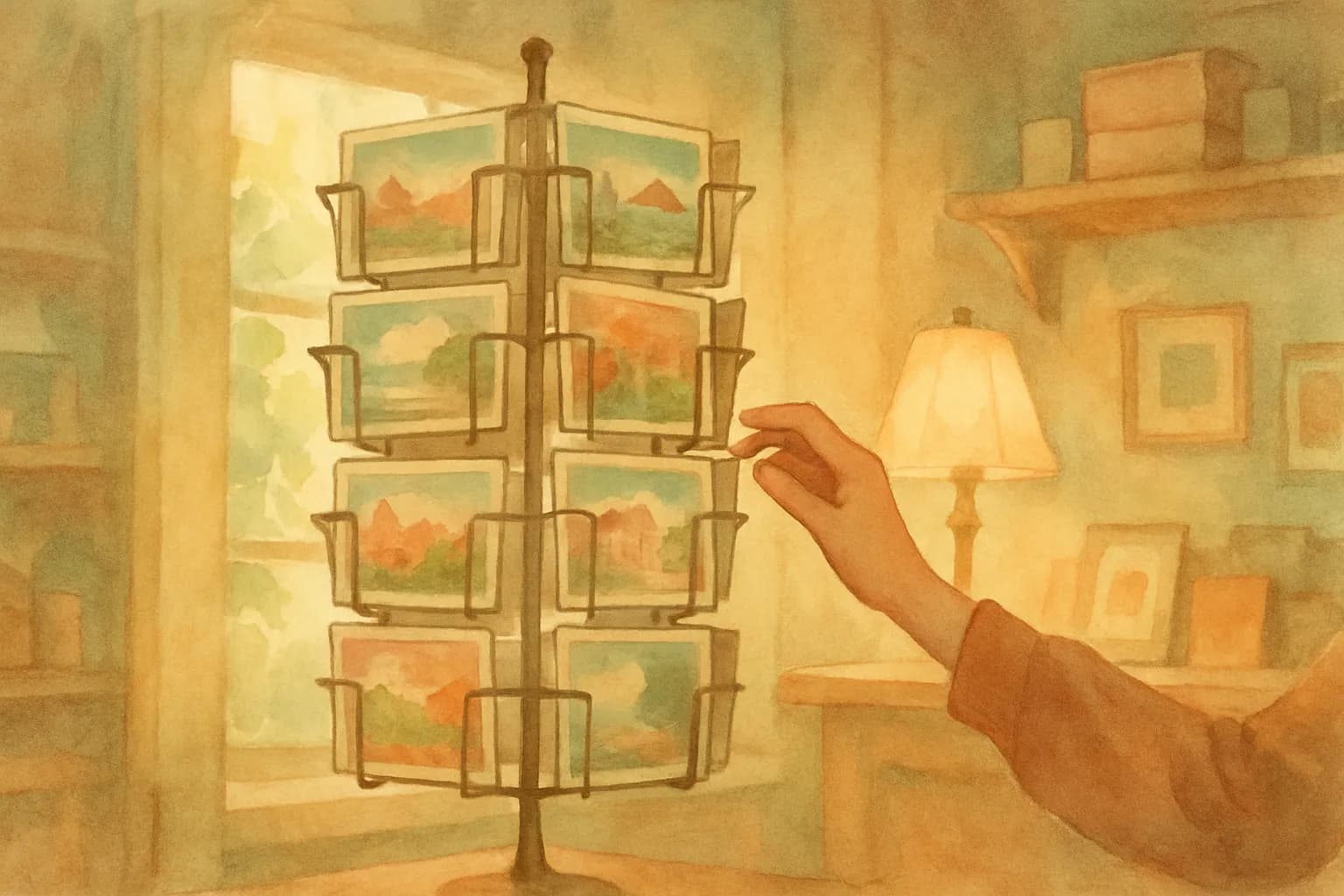
The rack stood by the cash register, a wire carousel six feet tall, holding two hundred postcards. You spun it slowly.
You were on vacation. You were in the gift shop of the Grand Canyon, or the lobby of a motel in Wall Drug, South Dakota, or a tourist trap in St. Augustine, or the corner pharmacy of any small town that thought of itself as a destination. The postcards were ten for a dollar. You picked out six.
The postcards were specific. The Grand Canyon ones showed the canyon at sunrise. The Wall Drug ones showed the giant jackalope. The St. Augustine ones showed the fort or the old Spanish quarter. The corner pharmacy in your hometown had postcards of the lake at sunset and the courthouse from the air. You bought what was for sale, addressed them to people back home, and dropped them in the mailbox before you left.
This was the American postcard, and most Americans of a certain age sent and received hundreds of them. The whole tradition is now nearly gone.
What the postcard actually was
A postcard was a specific form of communication, with rules of its own.
It was short. You had four square inches of writing space, and you used them all. Dear Mom and Dad -- Made it to the Grand Canyon yesterday. The kids are terrified of the heights. Saw a deer this morning. Love, Beth. You did not have room to be eloquent. You had room to be present.
It was public. The mailman read your postcard. The neighbor who collected your mail while you were away read it. Anyone who picked it up could read it. The postcard was not private correspondence and was not pretending to be. This meant you wrote with the assumption that several people would see it, which kept things light, kept things kind, and produced a specific kind of cheerful brevity that the modern equivalent -- the group text -- does not.
It was imagistic. The point of a postcard was the picture on the front. You sent home a piece of the landscape you were inside of. The recipient held a small physical object that connected them, briefly, to the canyon or the beach or the cathedral you were standing near. The picture mattered.
It was cheap. Ten cents to mail a postcard, in 1972. A penny postcard had been a thing within living memory before that. The whole apparatus -- the cards themselves, the postage, the act of sending -- was nearly free. A typical vacation produced twelve to twenty postcards, addressed to grandparents, aunts, uncles, neighbors, friends, the people at the office. You wrote them at the motel after dinner, in a stack.
It was traceable. The postcards arrived three to five days after you sent them. Often you had been home for a week before the recipients got them. The mismatch was part of the pleasure. The neighbor would call: We just got your postcard from Yellowstone, how was the rest of the trip? And you'd tell them.
The collection in the shoebox
Every American grandmother had a shoebox of postcards somewhere. Top of the closet. Back of the dresser. Drawer in the spare bedroom.
Inside: thirty years of postcards from everyone she knew. Her sister's trip to Hawaii in 1968. Her son's honeymoon to Niagara Falls in 1974. Her daughter's family vacation to Disney World every summer, returning to the same week in August year after year. A postcard from a friend who had moved to California and wrote to her once a year, every Christmas, for forty years.
She didn't keep them in any order. She didn't display them. She just kept them. Every once in a while, she pulled the shoebox out and went through them, slowly, on a quiet afternoon. The cards were a kind of personal archive of everyone she cared about, in their own handwriting, organized loosely by chronology.
When she died, the shoebox was usually thrown away. Her children didn't know what to do with three hundred postcards from people they'd never met or only half-knew. The whole record went into the trash within a week of the funeral, and the small history it contained went with it.
If you have your mother's or grandmother's shoebox, you have something irreplaceable. Don't throw it away.
What killed the postcard
The phone first, then email, then texts. By each step, the postcard's role became smaller, until it was vestigial.
The long-distance phone call replaced the urgent communication -- we got there, we're safe, the trip is going well. You no longer needed to send a postcard to confirm arrival; you could call from the motel. The postcard kept the lighter functions, the here we are, here's what it looks like, for a while longer.
Email then replaced even the casual update. A vacation email with attached photos in 1999 did everything a postcard had done, faster and with a real picture. By 2005 most postcard purchases had ended. The racks in the gift shops stopped getting restocked, then stopped getting replaced when they broke.
The text message and social media post finished what email had started. A photo on Instagram from the Grand Canyon, captioned the kids are terrified of the heights, reached fifty friends and family members in five minutes, with a real picture and zero cost. The postcard, by comparison, took four days, cost a dollar fifty including postage and the card itself, and was seen by one household.
The math killed the postcard, the way the math has killed many small things. It was hard to argue for keeping the postcard once the alternative existed. So nobody argued. The tradition lapsed, almost without comment.
What was lost
The first thing was the physical object. The postcard was a small physical thing that arrived in your mailbox, sat on your refrigerator under a magnet for a month, and went into a shoebox afterward. The whole life cycle was real, in space and time. A text message has no equivalent.
The second was the delay. The postcard arrived after the sender had moved on. There was a beautiful asynchrony to receiving news from a place the person was no longer at. The text message arrives in real time, which is more efficient and less poetic. You can argue that real-time is better. You can also notice that something was specifically there in the four-day delay, and that the something is now gone.
The third was the picture. The postcard's image was deliberately selected. Someone, somewhere, had chosen which view of the Grand Canyon was iconic enough to put on a postcard, and that view became the canonical version. When you received one, you received a kind of distilled cultural artifact -- this is what this place looks like, this is how this place wants to be seen. The photograph someone snaps on their phone is more personal. It is also more random. The curated postcard image was, in retrospect, doing real cultural work.
The fourth, and biggest, was the list. When you sat down at the motel to write twelve postcards, you had to think about twelve people. Send one to Aunt Helen. Send one to the Petersons. Send one to Joan from work. Send one to the grandkids. Twelve specific people, with twelve specific relationships, each getting a small piece of your trip. The act of writing them was an exercise in remembering who you loved.
The modern equivalent -- posting on social media -- is not specific. It is everyone at once, in a single message, with no individual chosen and no individual addressed. This is faster. It is also flatter. The postcard required you to think this card for this person, this card for that person. The social post requires you to think something I want strangers to know about me. Different muscle. Different relationship to the people you love.
A small revival
A postcard movement is, very quietly, beginning. Postcrossing -- an international postcard exchange -- has more than 800,000 members. Specialty shops in tourist destinations have begun stocking postcards again, sometimes from small artists, sometimes letterpressed, sometimes priced like the small artworks they are.
The revival is small. The postcard is not coming back the way vinyl came back. But the impulse is the same as the vinyl impulse -- a recognition that something was specifically lost when the format was abandoned, and that the lost thing has a value separate from efficiency.
If you take a trip this year, buy six postcards. Address them to six people. Write a sentence each. Put them in the mailbox before you leave.
The people who receive them will be surprised. The people who receive them will keep them. In some shoebox in some closet, on some quiet afternoon in 2055, the postcard you sent this summer will be pulled out by someone who barely remembers you, and you will be alive for them for a moment longer.
That is what the postcard did. It is still available. It just takes one of you to remember.
Somewhere in a shoebox, on a quiet afternoon, the postcard is still doing its work.
Get a new story every Sunday morning.
One email a week. No spam. Unsubscribe anytime.