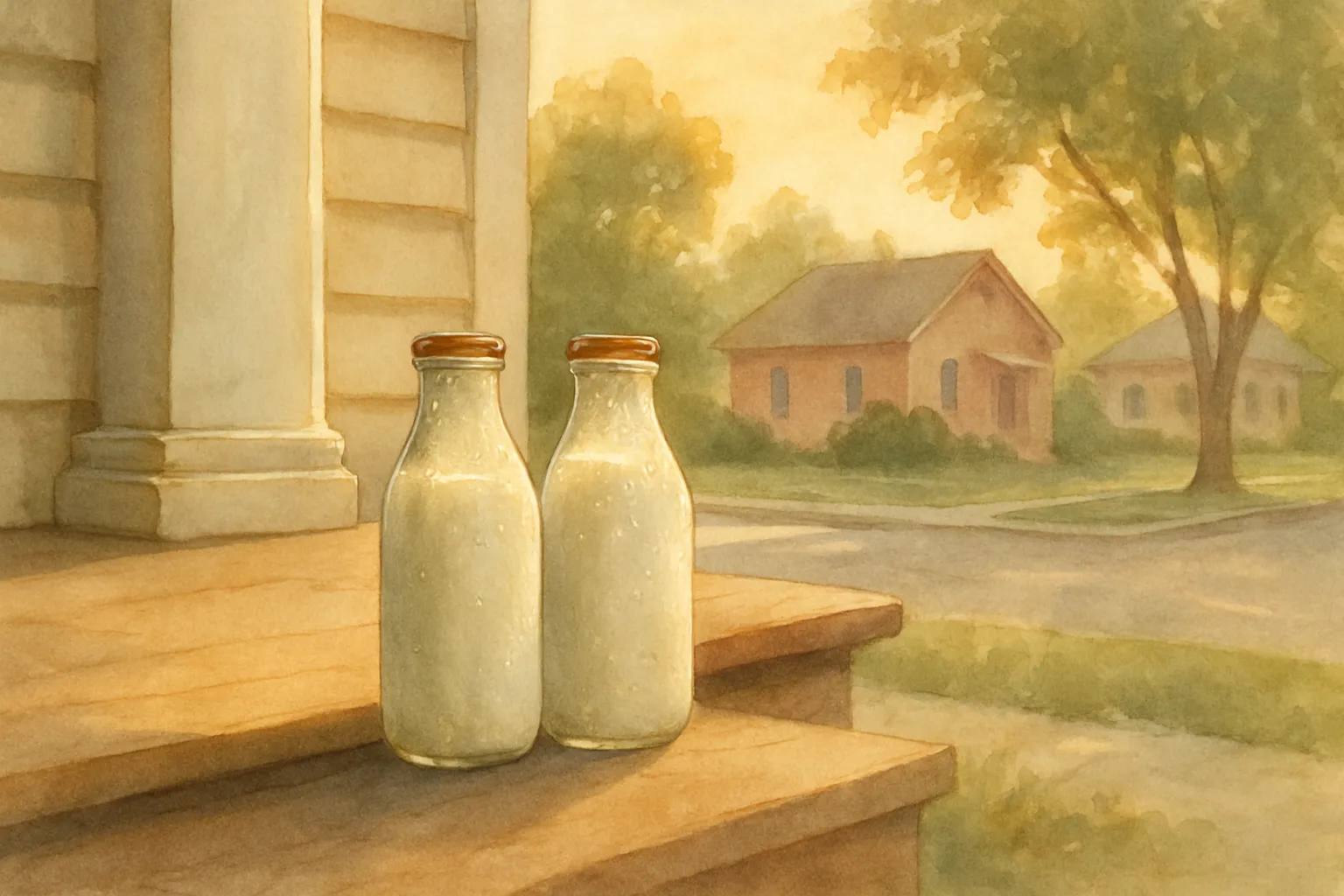
The Disappearance of the Milkman
He came before dawn.
You didn't see him, usually. You heard him -- the clink of glass bottles being set down on the porch, the soft thunk of the metal box being opened and closed, the milk truck's engine starting again half a block away. Then he was gone, and there was milk on your step.
When you got up at seven, the bottles were waiting. Two quarts of whole milk. A pint of heavy cream on Wednesdays. Sometimes a half-dozen eggs, butter, cottage cheese, depending on what your mother had written on the slip of paper she'd put in the empty bottle the night before.
This was the milkman. He came six days a week in most of America for about a hundred years. He has been almost completely gone for fifty. And what disappeared with him was more than a delivery service.
What the milkman actually was
Before refrigeration was reliable in American homes -- before the late 1940s, for most families -- fresh milk could not be stored. You bought it daily, in small amounts, or it spoiled. The milkman solved this problem.
He worked for a local dairy, often family-owned, that picked up milk from farms within a 30-mile radius. He drove a refrigerated truck on a route of 200 to 400 houses, six mornings a week, starting at four in the morning. He knew every house, every back door, every dog, every standing order. He left what the customer wanted. He took the empty bottles away. He sent a bill at the end of the month.
By 1950, more than half of American households got milk delivered. The number had been climbing for decades. The milkman was as basic to American daily life as the postman.
Twenty years later, almost no one did. By 1975, home milk delivery had collapsed to under 7% of households. By 2000, it was a curiosity. Today, in most American cities, you cannot find a milkman if you want one. A few specialty operations have survived in small markets. The rest is gone.
What ended it
Three things, all arriving roughly together.
The first was the home refrigerator. By the late 1940s, every new house was being built with one, and existing houses were adding them. A refrigerator with a real freezer meant a family could store a week's worth of milk in one purchase. The daily delivery model lost its underlying purpose almost overnight.
The second was the supermarket. The A&P, the Kroger, the Safeway, the Piggly Wiggly -- by the 1950s these chains were near every American household, with parking lots and reliable hours, and they sold milk in waxed paper cartons for less than the milkman charged for glass-bottled milk delivered to your door. The price gap widened every decade. The milkman couldn't compete with the supermarket's volume.
The third was the suburbs. The 200-house route in a dense pre-war neighborhood worked because the houses were close together. The same route in a 1960s suburb covered eight square miles instead of one. The economics stopped working. The dairies began to consolidate, the routes began to shrink, and the small family dairies that had owned the model went out of business in waves.
By 1980, the milkman was a memory in most of America.
What was lost -- and it wasn't just convenience
If the milkman had only been a delivery service, his disappearance wouldn't be worth writing about. The supermarket is more efficient. The milk is cheaper. The refrigerator works.
What disappeared with the milkman was a quieter set of things.
The first was a daily piece of social infrastructure that operated entirely on trust. He came onto your porch before you were awake. He had a standing order from your mother that he interpreted reasonably -- the Hendersons asked for an extra pint when company comes, the Kowalskis pay at the end of the month, the widow on Oak Street gets her milk left inside the screen door because her arthritis is bad. The whole arrangement worked because everyone in it was acting in good faith, and no one was checking.
This kind of small-scale trust, repeated thousands of times across every street in a town, was a foundation of the way American neighborhoods used to feel. It was not romantic. It was just a fact. The milkman had keys to nothing and trusted everything. So did you.
The second was a relationship with a specific human being who served you. The milkman knew you. He knew your mother's name. He knew when the baby was born -- your mother left a note in the empty bottle saying extra cream this week, we have a newborn and I can't get to the store -- and he brought the extra cream without comment. He knew when somebody died, because the standing order changed. He was, for many families, the one daily contact with a stranger who wasn't a stranger.
The supermarket sold the same milk for less money. It did not know your name.
The third was the bottle itself. Returnable, washable, refillable glass. The bottle came back the next day, sterilized, full of more milk. The system was elegant. It produced almost no waste. We replaced it with single-use waxed paper, then plastic jugs, and the resulting volume of dairy packaging that has gone into American landfills since 1970 is hard to fully measure. The glass bottle, in retrospect, was correct.
A small comeback that says something
You can, in 2026, get milk delivered in many American cities again. There are small dairies near most major metros that have rebuilt the model, with online ordering, glass bottles, and routes that look very similar to the ones the dairies of 1950 ran.
They charge more than the supermarket. They deliver weekly rather than daily. The customers are typically wealthier families who care about sourcing, about glass over plastic, about supporting local producers.
This isn't a return of the milkman. It is, however, a return of the idea -- the recognition that something was lost, and that the lost thing was valuable enough to pay extra for. The customers of these new delivery services are largely people too young to remember the original. They are buying their way into a version of the thing their grandparents threw away.
What they're paying for, mostly without articulating it, is the trust mechanism. The bottle on the porch. The relationship with the small dairy. The connection to a specific producer of a specific food. The waste-free packaging. The slow, reliable Tuesday morning delivery.
All of this was just normal for most of the twentieth century. It became artisanal and expensive when it was rebuilt in the twenty-first.
What the milkman represents
He was one of a class of American occupations that have mostly vanished -- the milkman, the diaper service driver, the laundry man, the bread man, the iceman before him, the rag-and-bone man before that. The route worker. The man who showed up at your house with a small useful thing, six days a week, who knew your family, and whose work was so woven into the daily rhythm that you didn't notice it until he was gone.
We replaced him with efficiency. The supermarket and the refrigerator did the same job for less money. The math was unarguable.
What we didn't notice we were also paying for -- the small daily relationships, the trust infrastructure, the glass bottles, the human face -- was free. We did not see the bill for it until after we'd stopped paying it. Now we are slowly, in small ways, trying to buy it back.
He came before dawn. He set the bottles down. He drove away. And somewhere in that small daily transaction was something we are still trying to figure out how to replace.
He came before dawn. He set the bottles down quietly. And the porch was a little less empty for it.
Get a new story every Sunday morning.
One email a week. No spam. Unsubscribe anytime.
If this brought back a memory, you might also like
Why Your Grandparents' Marriages Lasted: What We Stopped Doing
They've been married fifty-six years. He pours her coffee without being asked. She pushes the cream toward him without looking up. Here's what the long-married generation knew about staying together.