12 Skills Your Grandfather Mastered That No One Teaches Anymore
Your grandfather could fix almost anything in his house with what was already in the garage.
He didn't have YouTube tutorials. He didn't call somebody. He didn't drive to the hardware store every twenty minutes. He had a workbench, a few good tools, the patience to look at something for a while before he touched it, and a kind of practical knowledge that doesn't exist in books because it was never written down.
Some of that knowledge died with his generation. Some of it is still here, but only because a few stubborn people refused to let it go. Here are 12 of the skills he mastered -- and why each one is still worth learning today.
1. Changing a tire
He could do it in ten minutes in the rain. He could do it on the shoulder of a highway with cars going past at seventy. He knew exactly where the jack went on the frame, which way the lug nuts turned, and to crack them loose before he lifted the car off the ground.
Most American adults under forty cannot do this. They call a service. The service takes an hour and costs $150. Your grandfather did it for free with the gear that came in the trunk.
If you don't already know how, go out to your car this weekend, read the manual, and practice once on a sunny afternoon in your driveway. You will never forget it.
2. Sharpening a kitchen knife
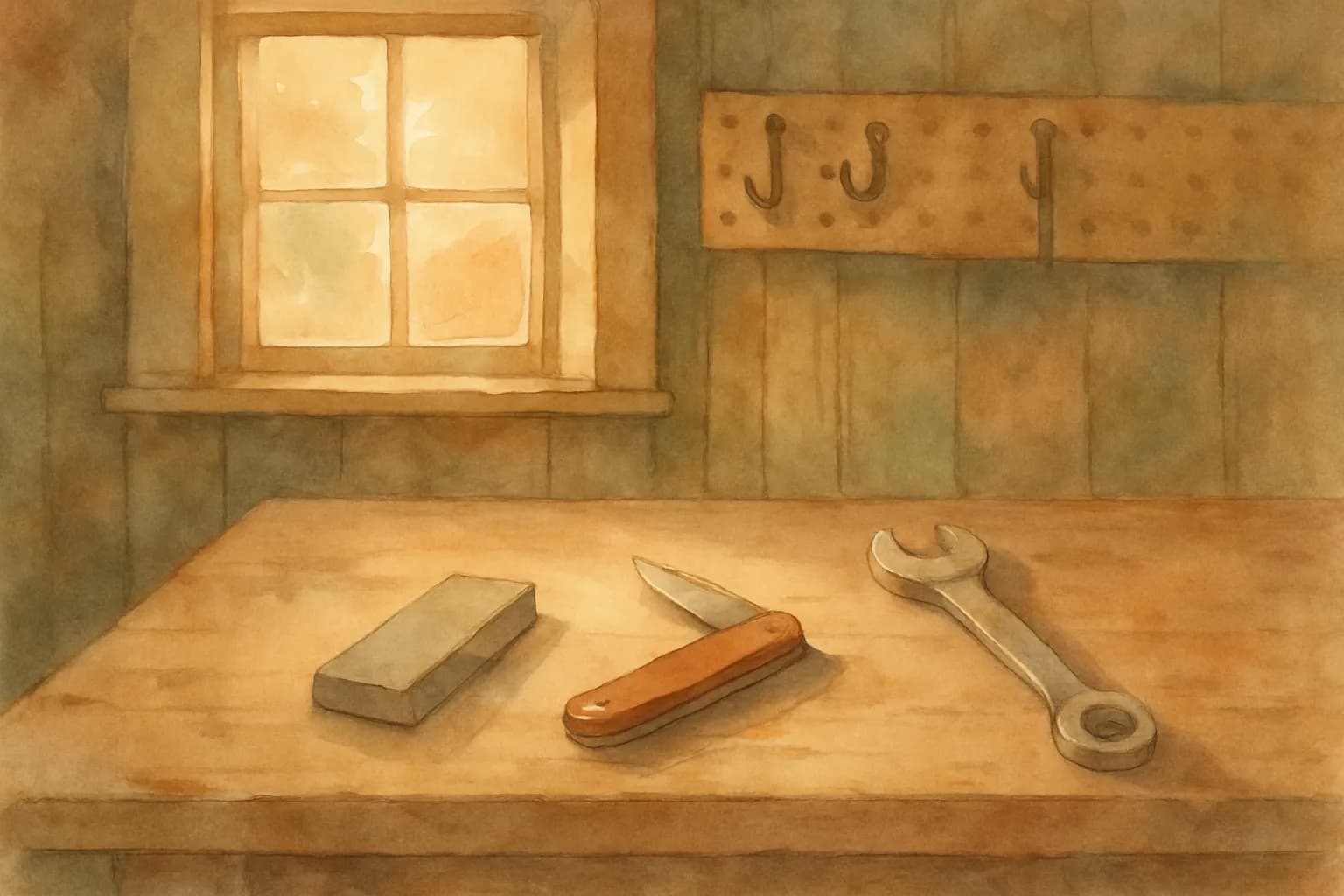
He had a whetstone in a drawer somewhere. Maybe two -- a coarse side and a fine side. Every couple of months he ran the kitchen knives across it with a steady angle and a slow, patient hand, and they cut tomatoes like butter for the next half year.
A dull knife is dangerous. It slips, you push too hard, and you cut yourself. A sharp knife is safe. Your grandfather knew this. Most kitchens today are full of dull knives because nobody learned what he learned.
Buy a whetstone. Watch one good video. It takes ten minutes a season.
3. Tying knots that actually hold
He knew three knots, maybe four, and he used them his whole life. The bowline (a loop that won't slip, won't bind, and unties easily). The taut-line hitch (for tightening a clothesline or tent rope). The clove hitch (for tying anything to a post). Sometimes the trucker's hitch, for hauling things in the back of the truck.
Knot-tying is a vanishing skill, and the bungee cord has done it real harm. A bungee cord fails. A bowline doesn't.
4. Jump-starting a car (and figuring out why the battery died)
He kept jumper cables in the trunk. He knew red to red, black to black, and the second black to a metal part of the dead car's engine -- not the negative terminal of the dead battery. He let it run for ten minutes before disconnecting.
And then, importantly, he asked why the battery died. Was it the alternator? Did somebody leave a light on? Was the battery just old? He didn't drive away assuming it was fixed. He diagnosed.
The diagnosis is the harder skill. The jump is just the warm-up.
5. Splitting and stacking firewood so it actually dries
He didn't just hack at logs. He read the wood -- looked for the cracks already in it, set the round on a chopping block, swung from the shoulder and let the maul do the work. He split it small enough to dry, stacked it bark-side-up in a crisscross pattern so air could move through, and covered just the top so rain ran off but the sides stayed open.
Wet firewood is miserable to burn. Properly seasoned firewood is a small daily pleasure for the whole winter. The difference is six months of correct stacking, and almost nobody under fifty learns this anymore.
6. Reading the weather without an app
He could look at the sky in the afternoon and tell you whether to bring the laundry in. Mares' tails meant a front coming through in a day or two. A red sky in morning was a sailor's warning. A sudden drop in temperature with a still afternoon meant a storm was building. Cattle lying down meant rain.
Some of this was folklore. A surprising amount of it was right. He paid attention to the world in a way that doesn't happen when there's a forecast in your pocket. The attention itself was the skill.
7. Reading a paper map (and folding it back up)
He could look at a road atlas, find a route through three states, calculate the mileage, estimate the time, and refold the map cleanly along its original creases. He didn't need an exit number. He read the landmarks.
A generation that has never driven without GPS turn-by-turn is a generation that doesn't actually know where it is -- only where the next turn is. There's a difference. Your grandfather knew the shape of the country he was driving through. Most of us only know the next thirty seconds of the trip.
8. Building a fire from one match
Tinder, kindling, small wood, larger wood, in that order, arranged in a teepee or a log-cabin stack, with air flowing through the middle. One match at the base of the tinder. No lighter fluid. No newspaper jammed in everywhere.
If your fire takes more than one match, you stacked it wrong. He'd say that without judgment, just as fact. Then he'd show you again.
This is one of those skills that seems trivial until the power goes out for three days. Then it isn't trivial at all.
9. Hanging a picture straight (without a level)
He'd hold the frame against the wall, eyeball it, take a small step back, eyeball it again, mark the spot with a pencil, and drive the nail. The picture would be straight. He had developed an eye for level, plumb, and square that didn't require tools because his eye was the tool.
You can develop this eye too. It takes hanging maybe twenty pictures with conscious attention to what looks right. Once you have it, you never lose it.
10. Tying a necktie
He could do this in twelve seconds without a mirror. Four-in-hand for everyday. Half-Windsor for church and weddings. Full Windsor maybe at a funeral or a wedding of his own.
A generation of young men now wears clip-on ties or pre-tied ties to job interviews. Your grandfather would have been appalled, but quietly. He'd have shown them once, then never mentioned it again.
It is genuinely one of the easier skills on this list. Watch one video. Practice five times. You're done for life.
11. Fixing a leaky faucet (the right way)
He shut the water off first. He laid out a towel. He took the handle apart slowly, in order, paying attention to what came out and in what direction. He found the worn washer or the cracked O-ring, walked to the hardware store with the broken part in his hand to make sure he got the right replacement, came home, and put it back together.
Total cost: 90 cents. Total time: an hour. He saved the $200 plumber call, and he was a little more competent the next time, too.
Most household repairs are like this. They are not hard. They are mostly patient and orderly. He knew the secret was the patience and the order, not the tools.
12. Doing arithmetic in his head
He could tell you what 4.5 yards of fabric at $3.79 a yard cost, with tax, before the clerk had punched it in. He carried the ones, doubled the nines, rounded for sanity-checks, and rarely got it wrong by more than a quarter.
This isn't nostalgia. Mental math protects you. The clerk who's about to charge you twice for an item, the contractor whose materials estimate is off by a factor of two, the restaurant that adds a "service fee" on top of the tip -- your grandfather caught all of these instantly because he never lost the habit of running the numbers himself.
A pocket calculator can't replace this. A phone can't replace this. The habit of running the math is the skill, and it atrophies the moment you stop using it.
None of these are mysterious. None of them require special talent. What they required was a generation of fathers and grandfathers who said, often without saying it, I'll show you how this is done, and then you're going to do it.
Pick one. Spend a Saturday on it. Show your kids. Show your grandkids. Your grandfather is gone, but the chain he was part of doesn't have to be.
The chain doesn't have to be broken. Pick one. Spend a Saturday on it.
Get a new story every Sunday morning.
One email a week. No spam. Unsubscribe anytime.