12 Things Your Mother Wore That Nobody Wears Anymore
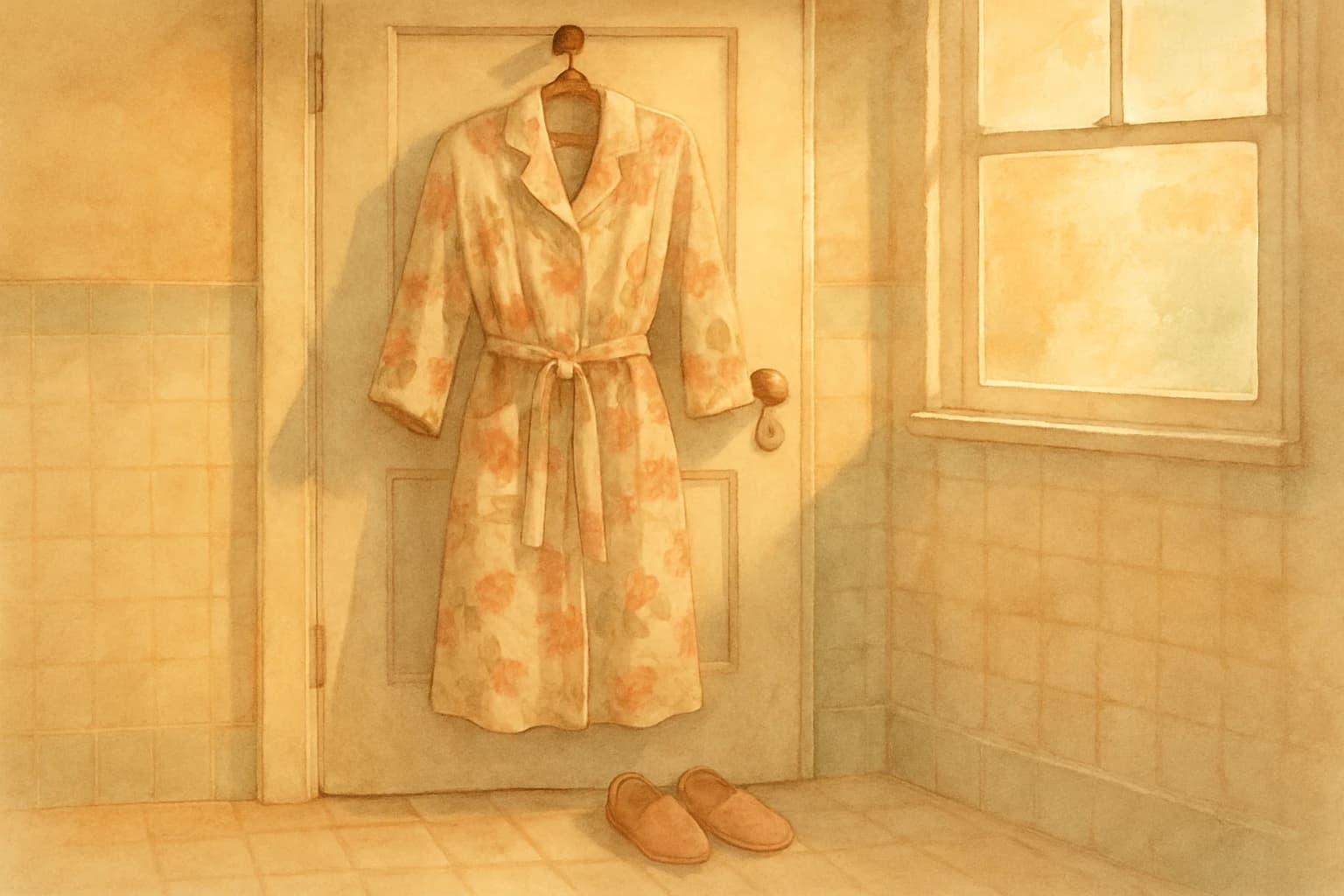
The housecoat hung on the back of the bathroom door.
It was the first thing she put on in the morning and the last thing she took off at night, and she wore it for almost every hour she spent in the house. It was not pajamas. It was not a regular outfit. It was a third category of clothing, specifically designed for the in-between hours of domestic life, and it has essentially vanished from the American wardrobe.
The housecoat is the entry point to a longer list. There was a whole vocabulary of women's clothing in the middle of the twentieth century that has now disappeared, and many of you reading this remember every item. Here are twelve.
1. The housecoat
Quilted, snap-front, knee-length, in a small floral pattern or a solid pastel. She put it on over her nightgown before coming downstairs to make breakfast. She wore it while she did the laundry, while she made the beds, while she ironed in the afternoon. She took it off only when she got dressed to leave the house, and put it back on the moment she got home.
It existed because the modesty expectations of the era required her to be "dressed" even when she was alone in the house, and a housecoat met that requirement without committing to a real outfit. The garment is now almost extinct. The closest modern equivalent -- yoga pants and a sweatshirt -- does not really do the same work, because it doesn't carry the same signal.
2. The apron over real clothes
The apron was not a costume. It was a basic piece of equipment that she put on over whatever she was wearing whenever she was working in the kitchen. The full apron with the bib, tied at the neck and the waist. The half-apron tied just at the waist for lighter work. The pinafore-style apron for serious cooking.
The apron protected the clothes underneath. It also signaled, to anyone who walked into the kitchen, that she was working -- that this was not idle time and not casual hospitality, but real domestic labor in progress. She took it off when she sat down to dinner, and the act of taking it off was a small ritual that marked the end of the cooking and the beginning of the meal.
3. The head scarf for going to the store
A patterned silk square, folded into a triangle, tied under the chin or behind the neck. She wore it on quick errands when she hadn't done her hair. It was an acceptable middle ground between "fully done up to leave the house" and "leaving the house with uncovered uncombed hair," which was not socially acceptable in her cohort.
Audrey Hepburn wore one in Roman Holiday. Queen Elizabeth wore one to the end of her life. Your mother wore one to the A&P when she needed milk and didn't have time to set her hair.
4. The curlers under the head scarf
Often, of course, the reason for the head scarf was that she had curlers in. Foam curlers or pink plastic curlers, set in her hair the night before or that morning, and covered with the scarf for the run to the store. Other women understood. The scarf and the curlers were a pair, and seeing a woman in the grocery aisle with the scarf-and-curler combination was not unusual; it was just Tuesday.
5. The rain bonnet folded in the purse
A small accordion-folded plastic bonnet, the kind that came out of a credit-card-sized pouch. She kept one in her purse and one in the car. When it started to rain unexpectedly, she pulled it out, unfolded it, tied it under her chin, and her hair was saved.
The whole point was hair preservation. A woman in 1968 had spent meaningful time on her hair, and rain was an enemy. The rain bonnet was the defense. Every woman of a certain age has had one in her purse. Many still do, in case.
6. Pantyhose
Worn every day, by every adult woman, with every outfit, except possibly the housecoat. Pantyhose were the foundational garment of the era. They came in shades meant to match the color of bare legs, or sometimes a slightly darker tone, and they ran constantly. A run in your pantyhose was a small daily crisis, and clear nail polish was the universal field repair for stopping a run from spreading.
She kept spare pairs in her purse, in her desk drawer at work, in the glove compartment of the car. The expectation that adult women would wear pantyhose to any professional or social setting was so total that there was no exception until casual Fridays began in the 1990s, and even then the change was contested for years.
7. The slip
Worn under any dress or skirt. Half-slip for the bottom, full slip for dresses with thinner fabric. The slip prevented the dress from clinging, from being see-through in strong light, from showing the outlines of underwear. It was a basic foundational garment that almost no woman of the era left the house without.
The slip has now essentially disappeared. Modern dresses are made of fabrics that don't require one, and the modesty conventions that demanded one have loosened. A whole drawer in your mother's dresser used to be slips, in white and beige and black, in various lengths. The drawer in her granddaughter's dresser uses the same space for something else.
8. Church gloves
Short white gloves, sometimes longer for more formal occasions, worn to church and to weddings and to funerals and to any other event that required a hat. Often paired with the hat itself.
The glove convention persisted longer in the South and in older urban communities than in the rest of the country. By 1975 it was already fading in most places. By 1990 it was effectively gone except in a few specific subcultures. The gloves themselves, however, are still in the dresser drawers of millions of older women, because nobody throws away their church gloves.
9. The girdle
The shaping undergarment. Worn under skirts, dresses, pants, basically anything that wasn't pajamas, by a generation of women who had been told that a smooth silhouette was a baseline requirement of public appearance. The girdle was uncomfortable. It was sometimes intolerable in summer heat. She wore it anyway.
The garment has not entirely disappeared -- modern shapewear is its descendant -- but the daily, universal wearing of it has. Women of her cohort still mention the girdle the way veterans mention boot camp, with a mix of horror and pride and dismissive humor.
10. The brooch
Pinned to the lapel of her dress, her coat, her sweater. The brooch was the cheap version of jewelry -- costume jewelry, mostly, with rhinestones or enamel or seed pearls -- and almost every adult woman owned a dozen of them, organized by occasion and season. The Christmas brooch in December. The flag brooch in July. The cameo brooch for funerals and serious occasions.
The brooch has been replaced, mostly, by no jewelry at all on the chest area, because outfits with structured shoulders to pin them to have themselves largely disappeared. The brooches sit in their cases in dressers and jewelry boxes across the country, and a great many granddaughters have inherited a small collection of them and don't know quite what to do with them.
11. The dressing gown for entertaining
Distinct from the housecoat. The dressing gown was a long, flowing, sometimes silk or satin garment that she put on when company came over in the evening for cocktails. It was not pajamas, not loungewear, not a dress. It was a fourth category of clothing, specifically for being a hostess in your own home in a slightly informal but elegant way.
You see them in old movies -- Doris Day, Lauren Bacall, your grandmother in a Polaroid from 1962. The garment has essentially disappeared because the social occasion it was made for has disappeared. People don't entertain at home in the same way, and certainly don't expect the hostess to wear something specifically designed for the event.
12. The good winter coat
Singular. Not coats. The coat. Wool, well-cut, in camel or navy or charcoal, with matching buttons and sometimes a fur collar. She bought it once, every fifteen or twenty years, and it lasted because it was made well and because she took care of it.
The good coat was a real financial decision. It cost a noticeable amount of money. She wore it for important occasions -- to church, to funerals, to travel -- and she kept it in a cedar bag in the summer to protect it from moths. When she died, it was probably still in the closet, and somebody had to figure out what to do with it, because it was still a perfectly fine coat that nobody else was going to wear.
Many of these items still exist somewhere, in dresser drawers and closets and cedar chests. The objects didn't go anywhere. What disappeared was the daily expectation that any of them would be worn -- the social and aesthetic framework that made each garment make sense.
The framework was demanding. We don't have to want it back to recognize that it was a real thing, and that an entire generation of women navigated it daily, with skill we mostly didn't appreciate. The housecoat in the morning, the apron at the stove, the slip under the dress, the girdle and the pantyhose, the gloves to church, the dressing gown when company came. Each garment did a specific job. The wardrobe was a tool kit, and she knew how to use it.
What did your mother wear that nobody wears anymore? Do you still have any of it in a closet somewhere? Tell us in the comments -- we'd love to hear.
Get a new story every Sunday morning.
One email a week. No spam. Unsubscribe anytime.
If this brought back a memory, you might also like
What the Phonebook Used to Mean
It hit the porch with a thump every October. Four pounds of everyone in town, listed alphabetically, with their home address and phone number. You could find anyone.