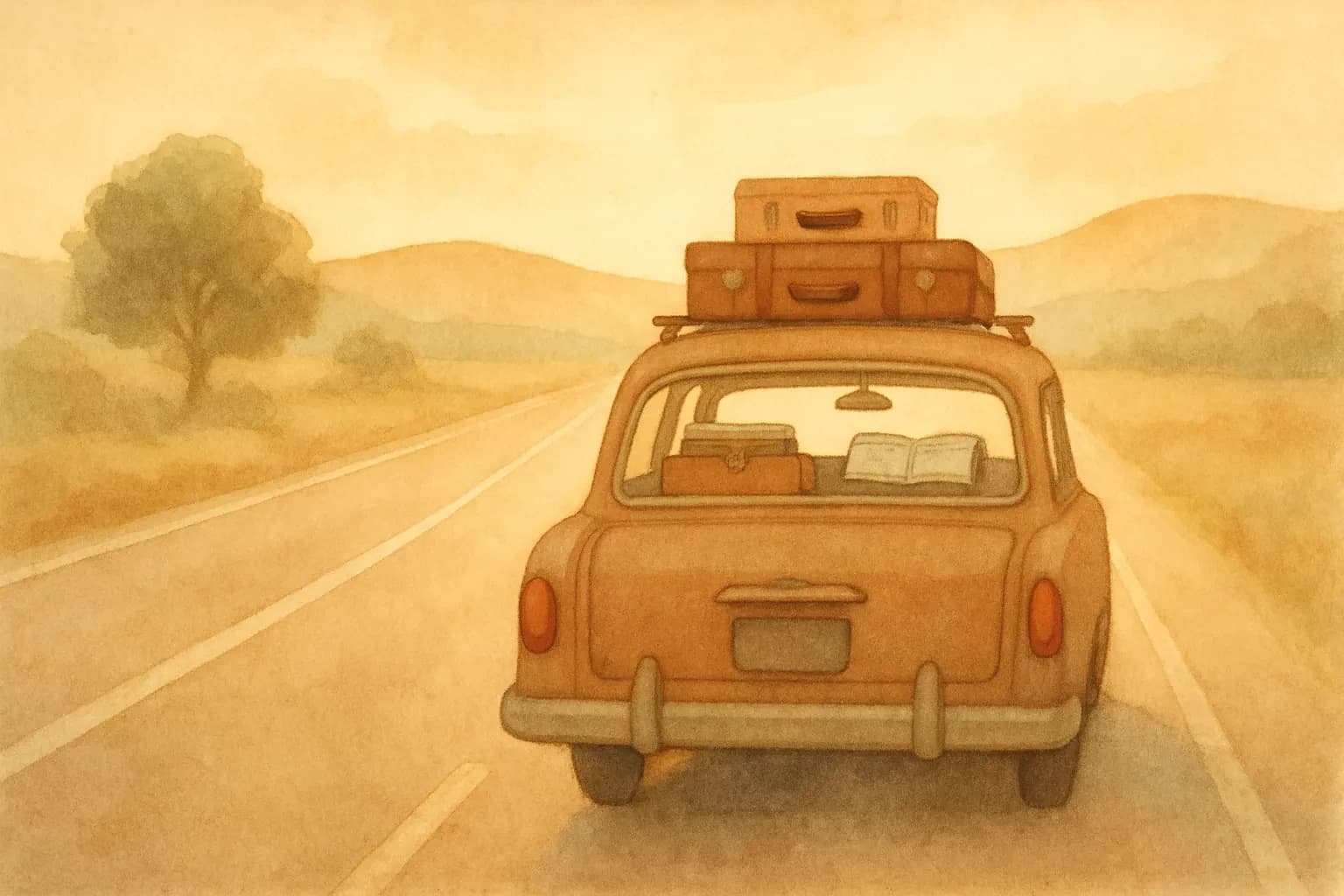
The American Family Road Trip
The car was packed the night before.
Your father had spent the previous Saturday changing the oil, checking the tires, looking under the hood at things you didn't understand. Your mother had been to the grocery store for the cooler items: bologna, white bread, mayonnaise, a head of iceberg lettuce, a six-pack of Tab. The Coleman cooler was on the kitchen counter. The thermos was on the counter next to it. The road atlas was on the kitchen table.
You woke up at four in the morning. Your father wanted to be on the road by five. He'd been talking about this for weeks. Your mother had made you go to bed at eight the night before, but you hadn't slept, because tomorrow was the road trip, and the road trip was the biggest event of the year.
This was the American family road trip. From roughly 1955 to 1995, this is how American families took a vacation, and an entire generation of children grew up partly inside it. It is mostly gone now, replaced by airplane vacations and theme park weekends, and what it gave the families who took it is worth saying.
The TripTik on the dashboard
Your father had stopped by the AAA office two weeks before the trip. The lady at the counter had asked him where he was going. He had said, for example, Cleveland to Orlando. She had then opened a long flat drawer and pulled out a series of small spiral-bound flip books that mapped the route, page by page, with the turns and the exits and the points of interest marked in red.
This was the TripTik. It sat on the dashboard for the entire trip, and at every stop your father flipped to the next page, traced the route with his finger, and made a small mark in pencil to show where you were.
The TripTik was free if you were a AAA member. It was, in its way, one of the better customer-loyalty programs in American business history. The lady at the counter was a kind of travel agent, retail navigator, and amateur tourism advisor, and she gave you a personalized route to your destination in about twenty minutes.
You can still get one. AAA still makes them. Almost no one asks.
The order of who sat where
Two parents in the front. Three kids in the back, with the youngest in the middle and the oldest by the window. The seating chart did not vary across thousands of miles of highway.
There were arguments. The window seats were better. The middle seat was hot, cramped, and forced you to lean into your sister, who did not want you leaning into her. Periodically your father, without looking, reached his arm over the seat and made a small swatting motion in the general direction of the back, which was the universal sign for stop it back there.
In the larger family vehicles — the station wagon, especially — there was the third row, which faced backward and seated two. The youngest two often ended up there. They were out of sight of the front, which meant they could be a little wilder, which meant they often were.
The cooler in the foot well
The cooler was on the floor of the back seat, between the middle kid's feet. It contained the lunch, which was eaten at a rest area picnic table somewhere in the middle of the day. Bologna sandwiches on white bread with mayonnaise, made by your mother in the morning before you left, wrapped in waxed paper and labeled with each kid's name. A bag of chips to share. Hard-boiled eggs in a Ziploc. A few apples. A six-pack of Tab.
The cooler also held the cold drinks, which were rationed. You did not get a Tab every time you wanted one. You got a Tab when your mother decided you got one, which was usually somewhere around eleven in the morning and again around three in the afternoon.
The cooler also held the ice, which melted over the course of the day into a soup of cold water and bologna juice that pooled at the bottom and was a problem the next morning.
The Howard Johnson's sign
The Howard Johnson's restaurant chain was at every major interstate exit from 1955 to about 1980. The sign was a tall pole with an orange roof on top, visible from a mile away. The orange roof meant: there is a Howard Johnson's here, with twenty-eight flavors of ice cream, a fried-clam plate, and clean bathrooms.
You ate dinner at a Howard Johnson's if you weren't camping. You ate the fried clams or the hot dogs or the ice cream. The waitress called your mother "honey." Your father studied the bill carefully and left a tip in coins.
The Howard Johnson's chain is essentially gone now. The last full-service restaurant closed years ago. The orange roof, which was once one of the most recognizable signs in America, is a thing you can find pictures of online but not in person. A specific era of American roadside dining vanished with it.
The rest area picnic table
Every interstate exit had one. A small grass area off the highway, with a few wooden picnic tables, a brick bathroom building, sometimes a vending machine, sometimes a state map under glass.
You stopped at one for lunch. Your mother spread a tablecloth on the picnic table. The sandwiches came out of the cooler. The kids ran around the small lawn for fifteen minutes while the parents drank coffee from the thermos. Then everyone got back in the car.
The whole process took thirty-five minutes. You were back on the road by one. The picnic was the only meal of the day that wasn't eaten in a restaurant or a vehicle, and it was the meal everyone remembered.
The rest areas still exist. They are now mostly used for bathroom stops. Almost nobody eats at the picnic tables, because almost nobody packs a cooler anymore. The picnic table is still there, weathered, waiting, mostly empty.
The motel pool at six p.m.
You checked into the motel around five. Holiday Inn, or Howard Johnson's, or a smaller chain like Travelodge, or sometimes a mom-and-pop motel with a neon sign and a real key on a plastic fob.
The pool was the point. You had been in the car for ten hours. You were hot, sticky, sun-stunned, and you wanted to swim. Your parents let you. They sat in lounge chairs by the pool with cold drinks and watched you splash around with a few other kids whose families were also stopping for the night.
The pool at the Holiday Inn in some forgotten town in Tennessee, at six p.m. on a July evening in 1976, is one of the most specific memories an American child of that era can have. The chlorine smell. The kids you'd never see again. The parents reading a paperback or a road atlas. The cars in the parking lot, every one of them packed full of luggage and bound for somewhere else.
The license plate game and the alphabet game
You played them for hundreds of miles.
The license plate game was a checklist on a notepad — fifty states, marked off as you spotted each one. By Indiana you had ten. By Tennessee you had eighteen. The hard ones were Alaska, Hawaii, and Vermont, which you sometimes never got, and which made the game last for the entire trip.
The alphabet game was more immediate. You had to find each letter of the alphabet, in order, on a road sign, a billboard, or a license plate. Q and X were brutal. You sat for thirty miles waiting for an X to appear on the back of a truck, and when it finally did you yelled it out and your sister, who was behind you in the alphabet, glared at you.
These games were how American children passed long stretches of highway before screens existed. They were free. They required no preparation. They were entirely sufficient.
What the trip actually did
The road trip, taken together, was a kind of education that no other experience quite replicated.
You learned the geography of your country at sixty miles an hour. You saw, in person, the change from cornfields to mountains to coast to swamp. You watched the accents change at gas stations across three states. You saw, with your own eyes, that the country was big, and that the people in it were not all the same as the people back home.
You learned how to be in close quarters with your family for ten hours a day, ten days in a row. The fights you had on a road trip were real, and they got resolved without anyone leaving the situation, because nobody could leave. You learned to share a back seat with a sibling, and to take turns with the cooler, and to take naps in inconvenient positions.
You learned that travel was something you did slowly, by ground, with all your possessions in the trunk. You earned the destination. The destination meant more because you had spent two days getting there.
What replaced it
The airplane mostly replaced it. By the late 1980s, flying had become cheap enough that for the same money you'd spend on gas, hotels, and meals for ten days, a family of five could fly to Florida in three hours and be in the swimming pool by dinner.
The math made sense. The trip was no longer the experience. The destination was the experience, and getting there was a logistical chore to be minimized.
What disappeared was the trip itself. The two days of station-wagon time. The Howard Johnson's. The motel pool at six p.m. The picnic at the rest area. The license plate game. The slow, hot, sticky, deeply specific feeling of being in a moving car with your family for a week, watching the country pass by through the back window.
This was a particular American childhood experience, and it is essentially over for most families. The kids being raised now will not have it. They will have other things, some of which are probably better. But they will not have this.
A small suggestion
If you have the time and the inclination, take a road trip this summer. Not a long one. A weekend, maybe. Three or four hundred miles round-trip. Pack a cooler. Bring sandwiches. Stop at a rest area. Stay in a motel with a pool.
Your kids or grandkids may not appreciate it the first day. By the second day they will be playing the license plate game without being told to. By the third day they will be asking when the next stop is and whether they can have a Tab from the cooler.
The road trip is still available. The roads are still there. The motels are still there, in smaller numbers but still standing. The country is the same size it always was, and it is still worth seeing from the ground.
The roads are still there. The motels are still there. The country is the same size it always was, and it is still worth seeing slowly, from the back seat, with the windows down.
Get a new story every Sunday morning.
One email a week. No spam. Unsubscribe anytime.
If this brought back a memory, you might also like
10 Things Your Father Did Without Being Asked
Your father did not announce his work. He just did it. By the time you noticed, it was done. You grew up assuming the things had taken care of themselves.