The Quiet American Memorial Day We Lost
The town gathered at the cemetery at ten in the morning.
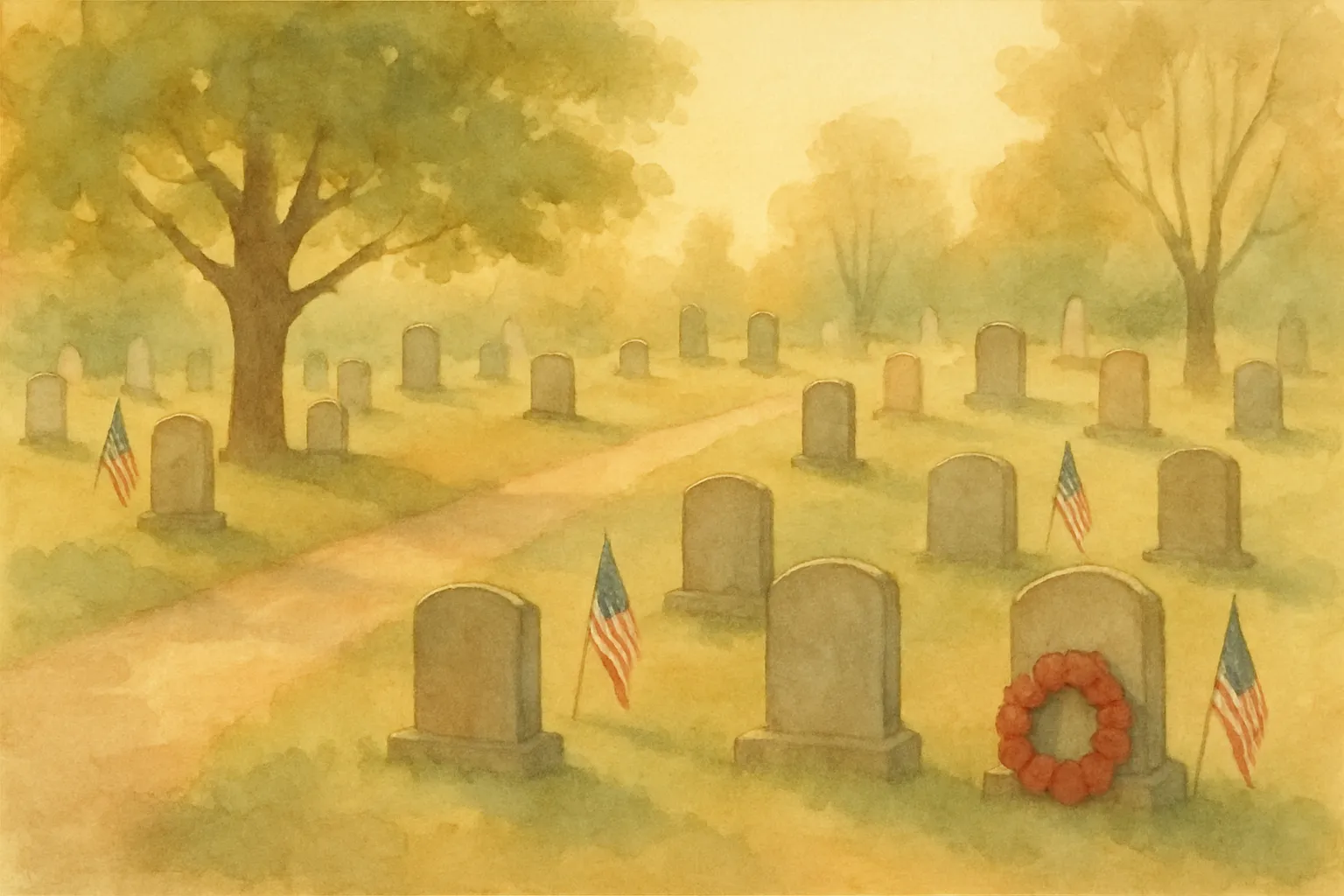
The veterans walked up first, in their old uniforms or their American Legion caps, slower every year. The Boy Scouts had already placed a small flag on every soldier's grave the night before, working from a list the post commander had typed out decades ago and updated by hand each spring. The high school band stood off to the side in their summer uniforms, holding their instruments at parade rest.
The minister read the names. He read every one of them — the boys from this town who had died in the wars, going back to the Civil War, sometimes ninety or a hundred names by the late 1960s — and the crowd stood with hats off in the heat. Then taps, played by a high school senior who had practiced the piece for two weeks. Then a brief speech from somebody from the Legion, almost always the same speech, almost always brief enough. Then the band played "America the Beautiful," and people walked back into the town for the parade.
This was Memorial Day.
A few hours later there might be a picnic. There might be a baseball game in the afternoon. The day didn't have to be solemn from morning until night. But it started at the cemetery, and what happened at the cemetery was what made it Memorial Day rather than just another Monday off work.
That start has mostly fallen away. The cookouts and the mattress sales remain.
What the day was actually for
Memorial Day was originally called Decoration Day, and it was created out of grief.
In the years immediately after the Civil War, women in towns across both the North and the South began going to the cemeteries in the spring to decorate the graves of soldiers who had died in the fighting. Sometimes they brought flowers from their own gardens. Sometimes wreaths made by hand. Sometimes just a flag. The practice spread in the late 1860s, an instinctive folk response to a war that had killed roughly 750,000 Americans and left almost no family untouched.
In 1868, General John A. Logan — the commander of the Grand Army of the Republic, the Union veterans' organization — issued a general order designating May 30 as a national Decoration Day, "for the purpose of strewing with flowers, or otherwise decorating the graves of comrades who died in defense of their country." The date was chosen because it was not the anniversary of any specific battle. It was a day to remember the dead in general, not to refight any particular war.
The holiday slowly took hold. By the end of the 1880s, most Northern states had recognized it. The South was slower for obvious reasons but eventually folded into the same observance, with the Confederate dead remembered on separate state-level holidays in some places. The name shifted gradually from "Decoration Day" to "Memorial Day" across the early twentieth century, with the federal government formally adopting "Memorial Day" in 1971.
By the late 1940s, Memorial Day had become what it remained for about two more decades: a day when American towns gathered to remember their war dead, with ceremonies, parades, speeches, and the quiet work of placing flags on graves.
It was never just for soldiers. The day became, for many families, a more general remembrance — visiting the graves of grandparents, parents, children. The Memorial Day cemetery visit was an established American ritual into the 1970s, and in many small towns, the cemetery was busier on that one morning than at any other point in the year.
The two changes that hollowed it out
Two specific things broke the modern Memorial Day, and they happened almost simultaneously.
The first was the Uniform Monday Holiday Act of 1968, which took effect in 1971. The law moved Memorial Day from its fixed date of May 30 to the last Monday in May, in order to create reliable three-day weekends. The intentions were practical. Workers wanted predictable long weekends. Retailers and the travel industry wanted them too. The legislation had broad bipartisan support and was, at the time, considered uncontroversial.
The cost was subtle but real. A holiday tied to a specific date carries weight. A holiday designed to produce a three-day weekend, by its very structure, signals to the country that the weekend is the point. Memorial Day became, within a decade, the unofficial start of summer — a long weekend at the lake, a barbecue, a sale at the appliance store. The cemetery visit became optional. The ceremony became something you attended if you were inclined.
The second change was the end of the draft in 1973 and the shift to an all-volunteer military. Before 1973, military service was a broadly distributed American experience. Most families had someone who had served. Most had someone they had lost or nearly lost. The Memorial Day ceremony was emotionally relevant to almost every household in town because almost every household had a stake in it.
After 1973, military service concentrated in fewer families. By the 2000s, the share of Americans with a close family member in the military had dropped substantially. Today, surveys consistently show a sharp generational gap: older Americans are far more likely to have family in the service, while younger Americans often have no close military connection at all. For households without that connection, Memorial Day's emotional center became abstract. The ceremony was for someone else's dead, somewhere else.
Together, these two changes — the three-day weekend and the volunteer force — slowly drained the day of its purpose for most American families. The cookouts stayed. The cemeteries quieted.
What's still there, if you look
The ceremonies have not vanished. They have simply gotten smaller and less central.
In most American towns, on Memorial Day morning, there is still a Legion post or a VFW hall that holds a ceremony. There is still a parade in many places, sometimes a small one. There are still Boy Scouts placing flags on graves, working from lists that have grown longer with the years. Veterans still walk. Names are still read.
What has changed is who shows up. The veterans are older. The crowds are thinner. The high school band is smaller and sometimes doesn't appear. The community function that used to organize the entire morning has shrunk to a service the dedicated still attend.
There is also the National Moment of Remembrance, established by an act of Congress in 2000. At 3:00 PM local time on Memorial Day, Americans are asked to pause for one minute and remember those who died in service. The legislation passed unanimously. Almost no one observes it. Most Americans have never heard of it.
The Tomb of the Unknown Soldier at Arlington National Cemetery has been guarded continuously, 24 hours a day, in every weather, since 1937. The wreath-laying ceremony there each Memorial Day is the most prominent remaining national observance. It is broadcast on C-SPAN and the major networks each year. It is watched, primarily, by older Americans and military families.
What the day still asks of us
Memorial Day has a specific job that no other American holiday performs. Veterans Day, in November, honors all who have served, living and dead. Armed Forces Day, in May, honors those currently serving. Memorial Day is reserved for those who died.
This is a small distinction that gets lost constantly. The well-meaning "Happy Memorial Day" or "Thank you for your service, today" misunderstands the holiday's intent. Memorial Day is not for the veteran at the cookout. Memorial Day is for the friend the veteran lost, the friend who is buried under one of the flags placed by the Scouts on Sunday night. The veteran knows this. He may not correct you.
You don't have to make the entire day solemn to honor the day. The picnic is fine. The lake is fine. The baseball game is fine. None of these things are violations of the holiday. What the holiday asks is something small: that some part of the day — maybe twenty minutes in the morning, maybe the moment of remembrance at 3:00 — be set aside for the actual purpose. A visit to a cemetery, even one without a personal connection. A pause at the parade. A conversation with a grandchild about what the day is for.
A whole American generation grew up knowing this without having to be told. The next generation will know it only if someone in their family decides to teach them.
A small thing to do this year
If your town has a Memorial Day ceremony, go. Take the kids. Stand in the heat. Listen to the names. The ceremony will be shorter than you remember, and the crowd will be smaller. It will still matter that you were there.
If your town no longer has one, visit the local cemetery. Walk the rows. Look at the small flags. Read a few of the dates. Some of the graves will be of people who died young, in places they never came home from. The cemetery is doing the work of remembrance even when no one is watching.
If you can't get to a cemetery, observe the National Moment of Remembrance at 3:00. Stop whatever you're doing. One minute. The holiday will hold together for one more year if enough households do this.
This is not about politics. This is not about war or its meaning or anyone's position on any current conflict. Memorial Day predates all of those debates and will outlast them. The day is simply for the dead — the boys from your town and every town, who left and didn't come back, and whose names were read at the cemetery on a hot morning in May for a hundred and fifty years.
The reading is still happening, somewhere near you, this Monday at ten.
The names are still being read, somewhere near you, on a hot morning in May. The dead do not require a large crowd. They only require that someone shows up.
Get a new story every Sunday morning.
One email a week. No spam. Unsubscribe anytime.
If this brought back a memory, you might also like
12 Skills Your Grandfather Mastered That No One Teaches Anymore
Your grandfather could fix almost anything with what was already in the garage. No YouTube, no service calls, just a workbench, good tools, and patience. Here are 12 skills worth reclaiming.