What Summer Sounded Like Before Air Conditioning
Sound traveled differently when the windows were open.
You could hear the neighbors talking three houses down. You could hear a dog barking on the next block, and a different dog answering from the block beyond that. You could hear a car door close at the corner. You could hear your father snoring in the bedroom upstairs, and you could hear your mother washing dishes in the kitchen with the back door propped open against the heat. The whole neighborhood was a single shared acoustic space, and you lived inside it whether you wanted to or not.
Air conditioning ended this. Most Americans don't quite realize how thoroughly it ended this, because the change happened slowly, room by room, house by house, across about three decades. By the time we noticed the silence, we had already gotten used to it.
Here is what summer sounded like in an American neighborhood before the windows got closed for good.
The cicadas at dusk
They started around seven in the evening. A low pulse at first, from the trees at the edge of the yard, then thickening into a wash of sound that filled the air completely. The cicada noise was so constant that you stopped hearing it after the first ten minutes, the way you stop hearing a refrigerator hum. But if you walked out into a yard at eight on a July night and listened, really listened, you would notice that the entire world was vibrating around you, and that it had been vibrating like this every summer evening of your life.
You can still hear them, in some places, if you go outside at the right hour. Most people don't go outside at the right hour anymore. They are inside, with the air running, and the cicadas are doing their work for an audience that has stopped paying attention.
The fan in the bedroom
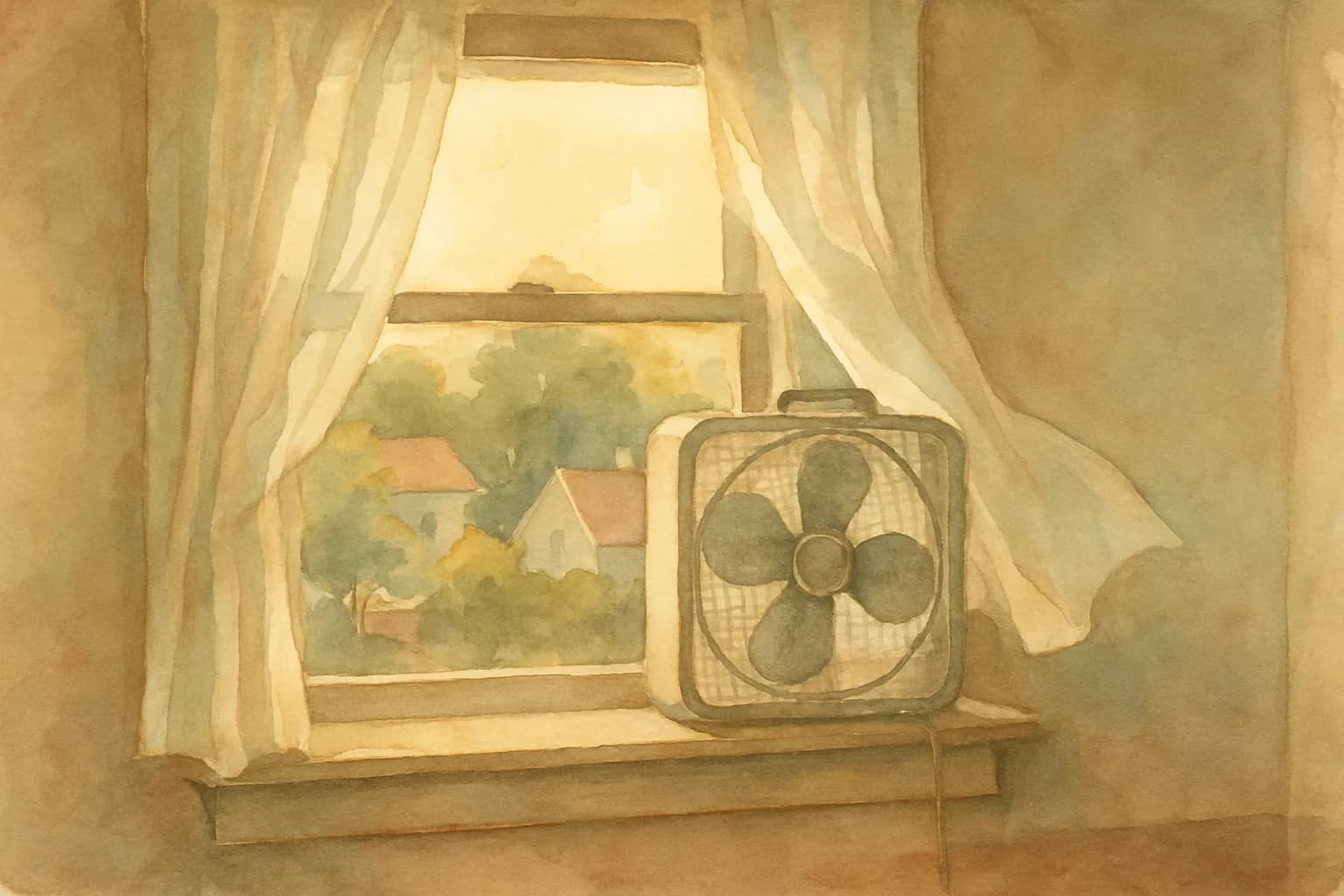
Every American bedroom in 1972 had a fan in the window, or a fan on the dresser, or a fan in the corner.
The window fan was the loudest. It had three settings, and on high it sounded like a small airplane taking off. You slept with it on high anyway, because the alternative was a still room with no moving air, and that was worse.
The box fan on the floor had a steadier hum, less aggressive but more constant, with a slight clicking sound on every rotation if it was older. The oscillating fan on the dresser made a sweeping noise as it turned, with a small pause at each end of its arc.
You did not really notice the fans while they were running. You noticed them when they stopped. The sudden quiet of a fan turned off was as much a sound as the fan itself, and a hot bedroom at three in the morning, with the fan suddenly off because the power had gone out, was one of the most uncomfortable silences in American summer.
The screen door slap
A wooden door, with a screen panel, on a spring hinge that pulled it shut after you let go.
It slapped. Every time. Sometimes hard, if you let it go from a distance. Sometimes soft, if you held it part of the way and eased it the rest. You could tell from the sound of the slap who was coming or going. Your father came in heavy. Your mother came in soft. The kids came in fast and didn't bother to ease it at all.
The screen door slap was so woven into the soundtrack of American summer that you can probably hear one in your head right now, and you'll be hearing the specific door of your grandmother's house, or your aunt's house, or the screened porch where you spent the summer of 1968.
Most houses now have solid storm doors with hydraulic closers that hiss instead of slap. The sound is not the same. The sound was, in fact, doing a small piece of work that the new doors don't do, which is announcing to the household that somebody had just come in or gone out.
The ice cream truck two blocks over
You heard him before you saw him. The tinny, slightly off-key recording of "Pop Goes the Weasel" or "The Entertainer," played through a speaker on the roof of a small white truck, repeating endlessly as he drove slowly through the neighborhood.
You had about three minutes from the moment you first heard the music to the moment you needed to be at the curb with your money. You ran inside, found your mother, asked her for a quarter, ran back outside, stood at the end of the driveway with your hand up, and hoped he saw you.
The ice cream man knew you. He knew what you usually got. He counted out your change with the deliberate slowness of a man who had been counting out change for forty thousand summer afternoons.
The trucks still exist, in some neighborhoods. The music still plays. Most American children no longer hear it, because most American children are inside, with the windows closed, and the music doesn't carry through air conditioning the way it carried through an open window.
The sprinkler hitting the side of the house
The lawn sprinkler had a sweep, and at one end of the sweep it hit the side of the house with a specific sound — a kind of metallic tac, tac, tac against the aluminum siding or the wooden clapboards, depending on the year and the house.
You learned, without being taught, the rhythm of your father's sprinkler. You knew when the tac was coming. You ran through the spray with your friends, timed to the rhythm, getting wet on the back swing and dry on the front. The grass under the sprinkler was the coldest place in the yard on a hot day, and you would lie down on it for a minute between runs.
The screen door slap again, in the evening
Worth saying twice because it happened twice. Morning slap, when your father went out to start the day. Evening slap, when he came in for dinner. The day was bookended by the same sound.
Your mother heard it from the kitchen and knew, without looking, who had just come in. The dog heard it from the back yard and ran around to the front porch. You heard it from the upstairs bedroom and knew it was time to come down. The whole house ran on the sound of a screen door, and nobody had to call out anybody's name.
The lawn mowers, all the lawn mowers
On a Saturday morning, you could stand in your yard and hear three or four different mowers running in three or four different yards. Your father's was the closest. Your neighbor's was a hundred feet away. The man across the street started his around ten. The whole street was a low concert of small engines, with the smell of cut grass riding along with the sound.
The mowers had different voices. The push mower was a steady drone. The riding mower was a deeper, slower throb. The reel mower, if anyone still had one, was a soft mechanical clicking, almost peaceful. You could close your eyes and tell who was mowing without looking.
Saturday morning still sounds a little like this in some neighborhoods, but quieter, because more lawns are mowed by services with one truck and one crew, all at once, and the staggered sound of individual fathers mowing their own grass has thinned out considerably.
The kids in the street
This is the sound that has thinned out the most.
In a summer evening in 1975, between dinner and dark, every block in an American suburb had a low background noise of children playing. Yelling at each other. Calling out the rules of the game. Arguing over a foul ball. Laughing. Screaming when someone got tagged. The sound carried through every open window of every house on the block.
Modern American neighborhoods are mostly quiet at six p.m. on a summer Tuesday. The kids are inside. The windows are closed. The air is on. The street is empty. You can stand in the middle of a suburban cul-de-sac at twilight in 2026 and hear, sometimes, no children at all.
What was lost when we closed the windows
Air conditioning was a real gain. Nobody wants to go back to a hundred-degree bedroom in August. The technology saved lives in heat waves and made the South habitable in summer for the first time in human history, and the case for it is overwhelming.
What we gave up, mostly without noticing, was the acoustic neighborhood. The sound of other people's lives drifting through your house. The fan running. The screen door slapping. The cicadas at dusk. The kids in the street until the streetlights came on. The sense that your house was inside a community, and that the community was making noise around you all the time.
A house with the windows closed is a quieter house. It is also a more isolated one. The sounds your neighbors make are no longer reaching you, and the sounds you make are not reaching them. You can live in a neighborhood for ten years now and never hear the people next door, and they can live there for ten years and never hear you, and the silence between you is a kind of distance that did not exist when summer sounded the way it used to.
If you are old enough to remember sleeping with the windows open, you remember a soundtrack that most American children today have never heard.
Try it once this summer, on a night when it's cool enough. Open every window. Turn off the AC. Lie in bed and listen. The neighborhood is still out there. It is just slightly quieter than it used to be, and slightly farther away.
The soundtrack is still playing, for those who step outside to hear it.
Get a new story every Sunday morning.
One email a week. No spam. Unsubscribe anytime.
If this brought back a memory, you might also like
10 Summer Sounds You Don't Hear Anymore
Summer used to have a soundtrack. Not a playlist, not a song. A real ambient track that ran from June to September. You only noticed it was gone after years.