The Lost Art of the Long-Distance Phone Call
The phone rang at six on Sunday evening.
Everyone in the house knew who it was. It was your grandmother, calling from Florida. She called every Sunday at six, because the long-distance rates dropped after six on weekends, and because the rates stayed up if you waited too long, and because Sunday at six worked for everyone -- dinner was over, the kids were home, nobody was at church.
Mom answered. She talked for ten minutes. Then she handed the phone to Dad, who talked for five. Then the phone went to each child in turn -- youngest first, oldest last -- and you each said the same things. We're good. School is good. I made the basketball team. Yes I'll write you a letter. I love you, Grandma. Two minutes per kid. Then back to Mom, who closed the call.
The entire exchange took 25 to 30 minutes. It cost about $4 in 1975 dollars, which was the entire family long-distance budget for the week. And it was the only voice contact you had with your grandmother for the next seven days.
This was the long-distance phone call. It was a specific American ritual for about sixty years, and it has been so completely replaced that most people under forty do not remember it ever existed.
What "long distance" actually meant
For most of the twentieth century, the American phone system was divided in two: local and long distance. Local calls -- to anyone within your area code, and often within your immediate exchange -- were free. They came with your monthly phone bill. You could talk to your next-door neighbor for three hours and pay nothing extra.
Long-distance calls -- anything outside your area code -- were charged by the minute, with rates that varied by time of day and distance. A call from New York to Los Angeles in 1965 cost about $3 for three minutes, the equivalent of roughly $30 today. A call across the state cost less, but still added up fast.
There were complex rate structures. Daytime rates were highest. Evening rates, after 5 PM, were lower. Night and weekend rates, after 11 PM weeknights and all day Sunday, were lowest. Every American household with relatives more than two area codes away knew these rate windows by heart, and called accordingly.
This meant the long-distance phone call was always deliberate. You did not casually pick up the phone to call your grandmother. You planned the call. You waited for the rate window. You called at the agreed time. You kept it short.
The economics shaped the conversation
Because the call cost real money -- meaningful money, in a family budget -- long-distance conversation developed a specific shape.
You did not waste the opening minute on small talk. Hi Mom, it's Bob. How are you. Good. Listen, we're all here, the kids want to talk too. The substantive news came fast, because every minute was a real number.
You took turns. The phone got passed around the household. Each person knew they had a minute or two, said what they had to say, and gave the phone back. There was a kind of orderly rhythm to a family long-distance call that does not exist in any modern equivalent.
You closed firmly. We've got to let you go, this is costing a fortune. The grandmother on the other end said the same thing. The call ended cleanly. Nobody lingered.
The whole exchange was efficient, warm, planned, and brief -- which sounds clinical, but actually was not. The constraints produced a specific kind of intimacy. You said the things that mattered because you couldn't afford to say anything else. The compression was the gift.
The receiver, the cord, the wall
The phone itself was a piece of furniture.
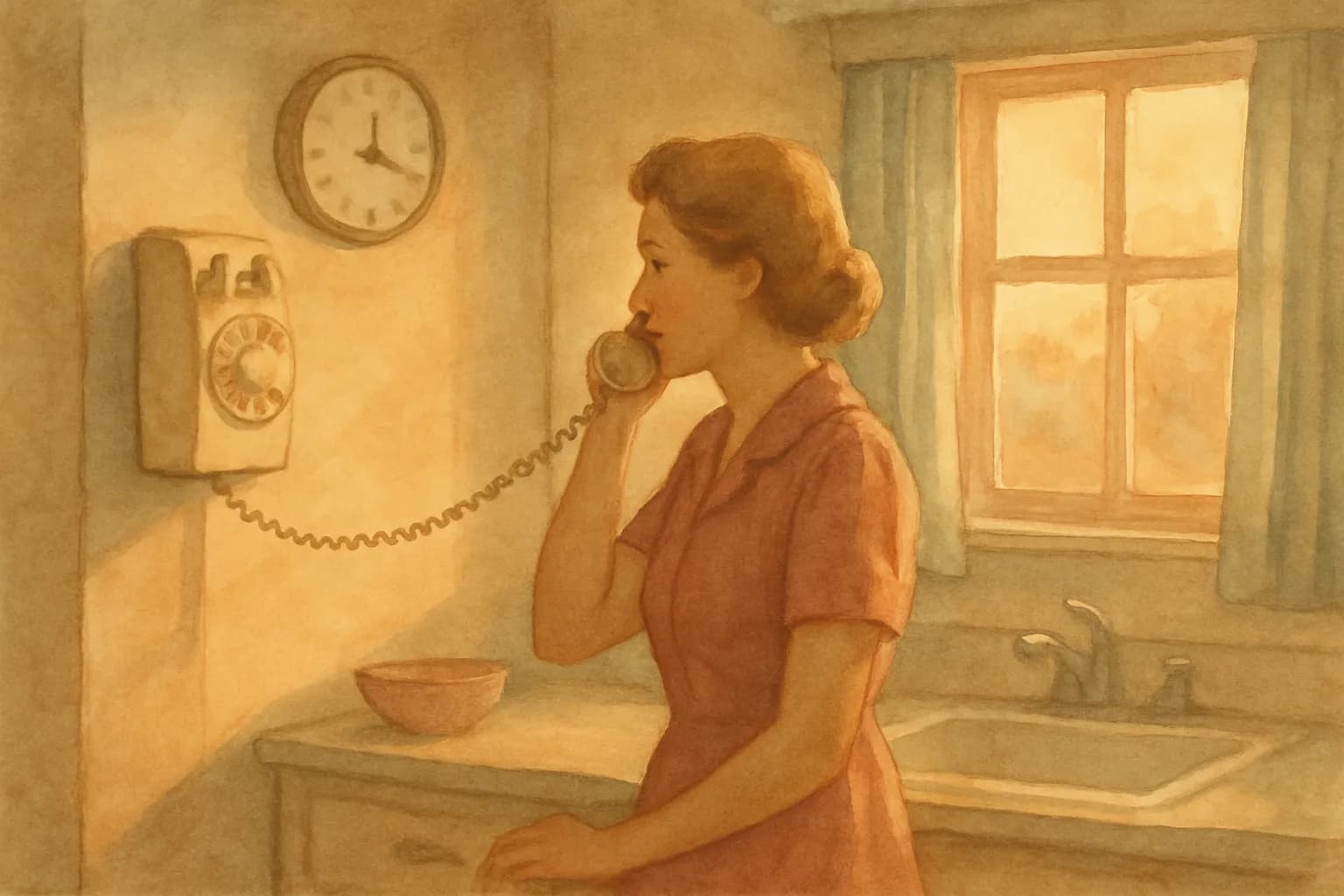
The wall-mounted kitchen phone, in beige or harvest gold or avocado green, with the long coiled cord that stretched to thirty feet. The desk phone in the den, with the rotary dial that took a slow second to turn back. The phone on the small table in the upstairs hallway, used by the teenagers.
When the long-distance call came, you went to the phone. The phone did not come to you. This meant that long-distance calls happened in a specific room -- usually the kitchen -- where the rest of the family could hear half the conversation. What did she say? She said the dog is sick again. Tell her hi from me. Mom says hi.
The call was a household event. The household was assembled, in some loose sense, around the phone. The grandmother on the other end was talking to the whole family in a way that a one-on-one cell phone call to a single child is not.
This was an architectural fact of how long-distance calls used to work. The wall phone with the long cord required physical co-presence. The conversation was therefore semi-public, semi-shared, and the relationship between the distant grandmother and the household stayed live partly because the household talked to her, not just one member.
The Christmas call, the birthday call, the Sunday call
There were three categories of long-distance call, recurring on a calendar that every American family with distant relatives knew by heart.
The Sunday call was the weekly check-in. Brief, regular, ritualized. The grandmother in Florida called every Sunday. The aunt in Seattle called the third Sunday of the month. The cousin in Texas called the second Saturday. Each household had a personal long-distance calendar that ran in the background of family life.
The birthday call was the obligation call. You called your father on his birthday. You called your son at college on his. You called your sister, your brother, your mother-in-law. The birthday call was not optional. Forgetting it was a small offense that would be remembered.
The Christmas call was the big one. Christmas Eve or Christmas Day, every distant relative got a call. The rate windows mattered less because everyone was making the same exception at the same time. The phone lines were strained -- sometimes you got a circuits busy signal and had to try again -- and the calls went on slightly longer than usual, because Christmas.
These three categories -- Sunday, birthday, Christmas -- were the entire annual long-distance ritual for most American households. Maybe a dozen other calls a year for emergencies. That was the structure. You knew, going into any given month, roughly what calls were coming.
What killed it
The pricing model changed first. The breakup of the Bell System in 1984 created long-distance competition -- MCI, Sprint, AT&T fighting for customers. Rates dropped through the 1990s. By the late 1990s, unlimited long-distance plans were standard. The minute-by-minute cost essentially disappeared. The deliberate, rate-window-timed call lost its underlying economics.
The cell phone finished the work. By the mid-2000s, long-distance pricing on cell phones was effectively gone. You could call your grandmother in Florida for two hours from your car and pay nothing extra. The call had become unremarkable.
Then video calls arrived -- first Skype, then FaceTime, then Zoom -- and the phone call itself, even the casual one, started to feel like a less rich form of contact compared to seeing someone's face.
Texting then absorbed most casual communication. The phone call became something you did for important news, not for routine check-ins. The Sunday call faded out, replaced by a steady drip of texts throughout the week. The grandmother who used to call at six on Sunday now texts a photo of her dog on Tuesday.
What was lost
A few specific things, none of them total, all of them real.
The event quality of the call. When the long-distance phone rang on Sunday at six, the whole household oriented around it. Now, with everyone holding a phone in their pocket, no individual call is a household event. The grandmother gets a text from one grandchild, on his phone, while everyone else in the family is in different rooms doing different things.
The passing-around of the phone. The ritual where every member of the household talked to the relative in turn, briefly, in front of the others. Now, calls are one-to-one. The grandmother's relationship to "the family" gets routed through individual grandchildren, and the collective relationship between her and the household -- which the wall phone with the long cord made possible -- has weakened.
The compression. When every minute cost money, you got to the point. The conversation was tighter, more focused, and arguably more loving for its brevity. Modern calls, free and unlimited, often produce the opposite -- drifting, distracted, with the other party multitasking. Constraint produced attention. Abundance produces distraction.
The predictability. The Sunday-at-six call was reliable. It meant the grandmother existed, every week, in the family's life. You did not have to wonder how she was. You knew you'd talk to her on Sunday. The current system, which is supposedly closer, is paradoxically less reliable. Days go by without contact. Then a flurry of texts. Then days again. The rhythm is gone.
What it might look like to bring back
You can't bring back the rate windows. The economics aren't there. But you can bring back the ritual -- the agreed time, the recurring call, the family event.
Pick a relative who's far away. Pick a recurring time -- Sunday at six, the second Saturday of the month, whatever fits both households' lives. Make the call. Put it on the calendar. Let the rest of the family know it's happening, and ask them to be home for it.
Pass the phone around. Take turns. Say the things that matter. Close firmly.
What you'll discover is that the structure carries the relationship in a way that ad-hoc texting doesn't. The grandmother feels remembered. The grandchildren feel connected. The household has a small recurring point of contact with someone they love.
It is not free. It costs you twenty minutes of your Sunday evening. The grandmother of 1975 would have called it the cheapest hour in her week, and she'd have been right.
The rates don't matter anymore. The voice on the other end still does.
Get a new story every Sunday morning.
One email a week. No spam. Unsubscribe anytime.
If this brought back a memory, you might also like
The Last Generation That Played Outside Until the Streetlights Came On
You came home when the streetlights came on, because that was the deal the whole neighborhood had agreed to. That deal is gone now. There may never be another generation like ours.