15 Standbys That Lived in the Medicine Cabinet and Never Asked Any Questions
The medicine cabinet in most American houses was modest, mirrored, and packed tight. It sat behind a mirror above the bathroom sink, and it held the same fifteen or so items for decades, regardless of who was president or what was on the news. Nobody organized it. Nobody threw anything out. The bottles just accumulated, and everyone in the house knew exactly where to reach without looking.
Here are fifteen of them.
1. Mercurochrome, the orange stuff
It stung less than iodine and stained your skin a deep reddish orange that took days to wear off. Mothers dabbed it on scraped knees with the little glass applicator built into the cap. The FDA pulled it from the market in the 1990s over mercury concerns, but for decades it was the first line of defense against a bloody knee, and kids walked around all summer with orange-tinted elbows as proof of a life properly lived outdoors.
2. A glass thermometer, rectal or oral depending on the household
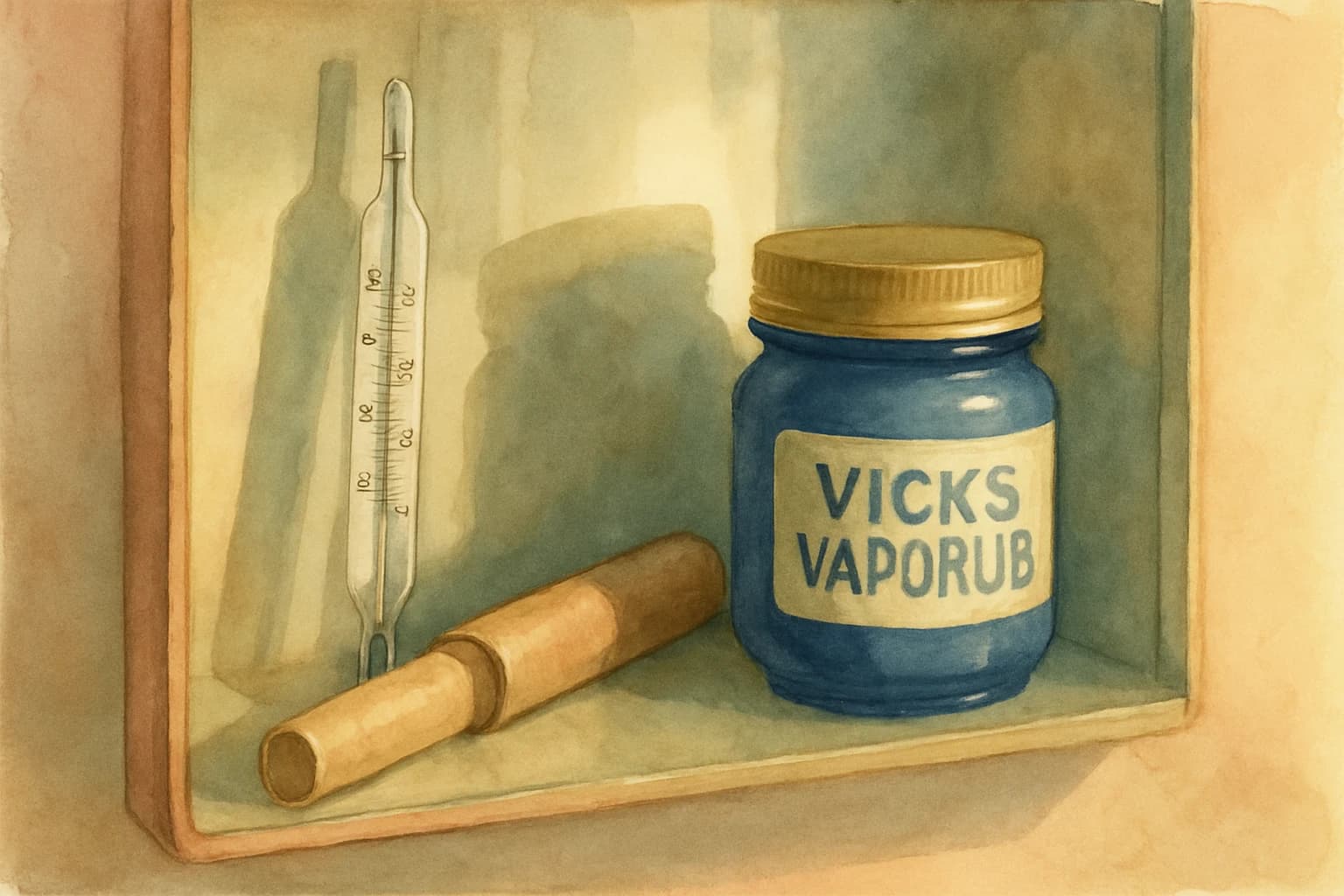
It lived in a slim cardboard tube or a hard plastic case, and it required a full three minutes under the tongue while you held very still and tried not to talk. Somebody in the house always knew how to read the little silver line of mercury against the numbers. Digital thermometers replaced it eventually, but the glass one had a ritual quality the beeping version never earned.
3. Vicks VapoRub
The blue jar with the gold lid sat in nearly every cabinet in America, and the smell of it alone could clear a stuffy head before you'd even opened the lid. Mothers rubbed it on chests, on the soles of feet under socks, sometimes on the upper lip as a decongestant of last resort. The smell announced illness in the house before anyone said a word about it.
4. Merthiolate or iodine, the stuff that actually hurt
Unlike Mercurochrome, this one stung on contact, and every kid in the house learned to brace before the swab touched skin. It came in a small brown bottle with a glass wand, and the application was often accompanied by a parent saying some version of "this will only hurt for a second." It usually did hurt longer than a second. Nobody complained too much, because complaining meant a second application.
5. A box of Band-Aids, mostly the tan kind
There was one size for fingers, one larger size for knees, and they were almost always tan, regardless of anyone's actual skin tone. The box lived on the same shelf for years, and it was never quite full and never quite empty. Somebody always had one stuck slightly crooked on an elbow by Tuesday afternoon.
6. Bayer aspirin, the orange bottle with the cotton stuffed on top
Aspirin was the answer to nearly everything before the 1980s. Headache, fever, hangover, the vague ache that came with getting older. The bottle had a childproof cap eventually, but for years it didn't, and kids grew up understanding that the orange bottle was for adults and the chewable orange St. Joseph's tablets, shaped like tiny discs, were for them.
7. Milk of Magnesia
The chalky white liquid in the tall bottle sat toward the back, reserved for occasions nobody discussed openly at the dinner table. A tablespoon of it, and you knew your evening plans for the next several hours. It tasted like a glass of drywall, and every kid who took it remembers exactly that taste, even fifty years later.
8. A box of cotton balls and a jar of rubbing alcohol
These two came as a pair, one dependent on the other. The rubbing alcohol smelled sharp enough to clear a sinus from across the room, and a cotton ball soaked in it was the standard treatment for cleaning a cut, disinfecting an earring hole, or wiping down a thermometer between uses. The jar's lid was usually a little sticky.
9. Vaseline, the squat blue jar
It fixed chapped lips, dry elbows, squeaky hinges, and stuck zippers, and it did all of this from the same jar for years without ever seeming to run low. Grandmothers used it on their hands before bed. Mothers used it on babies' bottoms. Nobody in the house could say for certain how old the jar actually was.
10. Ex-Lax, in the little chocolate-colored box
It looked like a candy bar, which caused more than one household emergency over the years when a child mistook it for a snack. It sat quietly in the back of the cabinet, doing its job without ever being discussed in polite company, and everyone in the house knew what it was for without anyone explaining it directly.
11. Q-tips, the original paper-stemmed kind
The box said not to put them in your ear canal, and everyone in the house did it anyway, every single day, without incident, as far as anyone could tell. The paper stems held up better than the plastic ones that came later. A jar or box of them sat next to the cotton balls, and both got used for a hundred purposes beyond their stated one.
12. A dented Band-Aid tin, the metal box before the cardboard box existed
Some households still had the metal Band-Aid tins from the 1950s and 60s tucked in a drawer, repurposed to hold safety pins, loose buttons, or spare aspirin. The tin outlived its original contents by decades. Nobody threw metal tins away in that generation. They just found new jobs.
13. Absorbine Jr. or Ben-Gay, for the fathers specifically
This one belonged to the men of the house, usually kept on a separate shelf from the children's supplies. The smell was sharp and medicinal, applied to sore backs and aching knees after a weekend of yard work or a long shift on your feet. A father reaching for the Ben-Gay jar on a Sunday night was a small, reliable signal that Monday was coming.
14. A box of gauze pads and a roll of white tape
These came out only for the more serious injuries, the ones that needed more than a Band-Aid. The tape never peeled off cleanly, and there was always a debate in the house about who was better at wrapping a wound, usually settled in favor of whichever parent had done it more recently. The roll of tape outlasted several house moves.
15. A bar of Phisohex or a bottle of witch hazel, for the teenagers
By the time a kid hit thirteen or fourteen, a new item appeared on the shelf specifically for them. Phisohex was the harsh, medicinal-smelling face wash prescribed by the family doctor for acne. Witch hazel, in the brown bottle, was the gentler alternative some mothers preferred. Either way, its appearance on the shelf was a quiet family acknowledgment that a kid was growing up, without anyone having to say so out loud.
What shouldn't come back
A fair amount of what lived in that cabinet was, by modern standards, not particularly good medicine. Mercurochrome contained mercury. Aspirin was handed out to children in doses nobody today would consider safe. Milk of Magnesia and Ex-Lax were reached for casually, without much thought about the actual mechanics of what they were doing to a body. The whole cabinet operated on trial, error, and inherited wisdom rather than anything resembling clinical guidance, and a good portion of that wisdom was simply wrong.
Modern medicine cabinets are better stocked, more precisely labeled, and considerably safer. Poison control exists now in a way it functionally didn't then. Nobody today would leave a box that looks exactly like chocolate candy in reach of a six-year-old. That part of the old cabinet deserved to go.
What's still there, in some form
Walk into most American bathrooms today and you'll still find a version of this cabinet, just with different brand names and better labeling. The instinct that built it, the desire to have something on hand for whatever the body does next, hasn't gone anywhere. What's mostly gone is the specific set of objects, the smell of Vicks through a closed door, the orange stain on a kid's knee that told the whole street he'd been out playing too hard.
What was in your family's medicine cabinet growing up? Did your house have the orange Mercurochrome or the chocolate-box Ex-Lax? Drop yours in the comments -- we'd love to hear it.
Get a new story every Sunday morning.
One email a week. No spam. Unsubscribe anytime.