The August Aisle Where Summer Turned in Your Chest
The smell hit you at the entrance to the store, and it told you something you'd been trying not to know.
August had arrived. Summer was real now only in the sense that it was ending. The Sears, the Kmart, the small downtown Ben Franklin -- whichever store your mother drove to in late July or early August -- had assembled its back-to-school display with a particular density of new rubber erasers and fresh spiral notebooks and still-stiff plastic binders, and when you walked through the door and took the first breath, the season turned in your chest like a key.
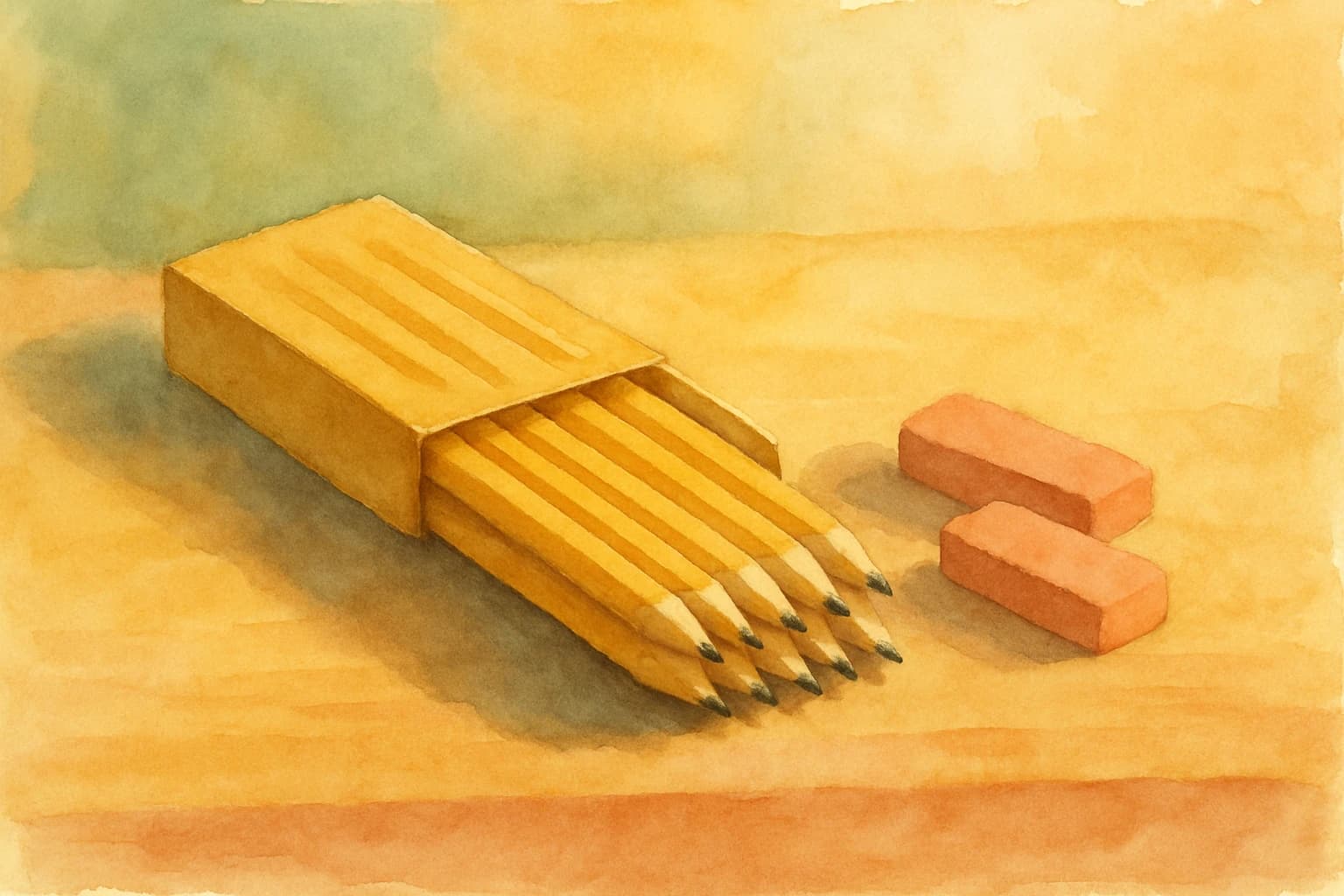
This smell had a name only in retrospect. While you were living it, it was just the smell of school shopping, the smell of the store in August, the smell that made you slightly sick. Looking back, you can pull apart its components: the sharp chemical note of freshly manufactured erasers, the flat wood smell of unsharpened pencils packed twelve to a box, the faint petroleum smell of ballpoint pens still in their shrink-wrap, the clean industrial smell of three-ring binders, the slightly sweet smell of new crayons. All of it together, in a well-stocked aisle, was unmistakable. It existed nowhere else and at no other time.
It told you summer was real because it told you summer was over.
What the store looked like in August
The seasonal display had its own logic. It took up a full aisle, sometimes two. Wide-ruled paper and college-ruled sat side by side, the college-ruled in harder-to-read smaller type that you aspired to but weren't sure about. Folders in every color, priced individually. Plastic pencil cases with two-way zippers. Composition notebooks with their black-and-white marble covers, which cost less than spirals and lasted longer. Boxes of crayons in the 8-count, the 16-count, the 64-count -- which was the one you wanted and would ask for and sometimes got.
The Trapper Keeper arrived in the early eighties and immediately claimed its position at the top of the supply hierarchy. It was more expensive than anything else in the aisle, and it came in colors that were new each year. Owning the current year's Trapper Keeper meant something at the social level of a middle-school hallway. Owning last year's meant something slightly different.
Pencil boxes were a separate negotiation. The cardboard ones were cheap and crushed by October. The metal ones with sliding lids lasted until graduation. The plastic ones were somewhere in between. Your mother had opinions about which was worth the money, and her opinions were generally correct.
You walked the aisle with a list. The list came from the school, mailed home in July on a half-sheet of paper that smelled faintly of mimeograph even in the later years when nothing was mimeographed anymore. The list was precise: 1 composition notebook (wide-ruled), 2 boxes 12-count No. 2 pencils, 1 pair blunt-nosed scissors for grades K-2 or 1 pair pointed scissors for grades 3 and up. You were one year older. You got the pointed scissors.
The ritual had a calendar
Back-to-school shopping didn't happen the week before school. It happened in early August, which was its own cruelty. Early August still looked like summer from the outside. The days were long. The neighborhood pool was still open. There was no visible evidence that summer was ending. And then your mother announced a shopping trip, and you drove to the store, and the smell told you otherwise.
The gap between the shopping and the first day was its own kind of suspended time. Two or three weeks during which you sat with the new supplies in a paper bag in your room, not yet allowed to use them, and felt summer contracting around you. The bag smelled like the store. You opened it periodically just to check that the things were still there, which they always were.
The new notebooks were not to be written in yet. The pencils were not to be sharpened. This wasn't a rule anyone stated. It was just understood. These things were for school, and school had not started, and opening them prematurely would have been something close to a violation of the order of things.
So you waited. And the summer that had once seemed endless now had a visible edge.
What made the smell mean something
Plenty of children got new supplies every fall not because their households had money to spare but because the supplies were not expensive, and the ritual of getting them mattered. A box of twelve No. 2 pencils cost about 29 cents for most of the 1970s. A package of wide-ruled notebook paper cost under a dollar. The investment for a full set of basic supplies was manageable even for families watching the budget carefully, and many mothers made sure of it.
What the new supplies represented, in any household, was a reset. You were not last year's student, with your smudged and dog-eared notebooks. You were this year's student, with everything clean and new and full of possibility. The school year stretched ahead of you unwritten. You had not yet failed a test. You had not yet forgotten a homework assignment. You had not yet had a bad week in October. The new supplies were the physical form of that unrealized potential, and they smelled like it.
This was the real content of the back-to-school smell, underneath the rubber and the pencil wood and the plastic. It was the smell of a beginning, arriving in the middle of what felt like an ending.
What wasn't so good
The annual school supply list was also, for some families, a month of low-grade anxiety. The lists got longer through the 1980s and 1990s, and the items got more expensive. Branded products appeared where generic had served before. The Trapper Keeper was only the most visible example. By the early 2000s, some lists required calculators for particular math courses, and a graphing calculator cost eighty or ninety dollars, and nobody pretended that was a pencil-box situation.
For children whose families couldn't afford the full list, or who arrived in the first week with last year's supplies held together with rubber bands, the ritual carried a different weight. The smell of new school supplies was, for some kids, also the smell of the distance between what the list required and what was in the bag. This was real, and it ran underneath the nostalgia the way a lot of real things run underneath nostalgia when you look carefully enough.
The supply aisle also did not always carry everything required. The binder color the teacher wanted was gone. The right scissors were out of stock. You got what was left, and you hoped it was close enough.
What's different now
Schools now often provide many of the basic supplies. Lists have been simplified in some districts and eliminated in others, partly because research made visible what had been mostly invisible before. Teachers buy supplies with their own money at a rate that would have seemed remarkable in 1975, which is its own problem, but the gap between the list and the bag has narrowed in places.
Online ordering has changed the experience entirely for most families. The smell is mostly gone. You select the items from a website, the box arrives on the porch, and you put the supplies in the backpack without ceremony. It is more efficient. It is less expensive in some cases. It doesn't work the same way on the calendar, because you can order in June and be done with it, and the August-particular quality of the ritual has dissolved.
What is genuinely better: the child whose household couldn't easily afford the list has more options now. Bulk purchasing programs through schools, community supply drives, donated materials -- none of this existed at scale in 1975. The efficiency has produced some equity that the old ritual, charming as it was, did not.
What is gone: the walk through the aisle with a list on a half-sheet of paper, and the particular weight of the 64-count box of crayons in your hands, and the smell that told you summer was real precisely because it was ending.
The smell is mostly still there in the store, if you walk through the right aisle in early August. It is worth doing, once, if you haven't in a while. Take a breath near the erasers. It will tell you something you already knew.
What did your back-to-school shopping look like? Was there one supply on the list you always hoped for? Tell us yours -- we'd love to hear it.
Get a new story every Sunday morning.
One email a week. No spam. Unsubscribe anytime.
If this brought back a memory, you might also like
The Heavy Hardcover That Sat on the Desk for Decades
The spine was cracked from use, and pencil marks in the thin, onion-skin pages left a trace of every word looked up by hand.