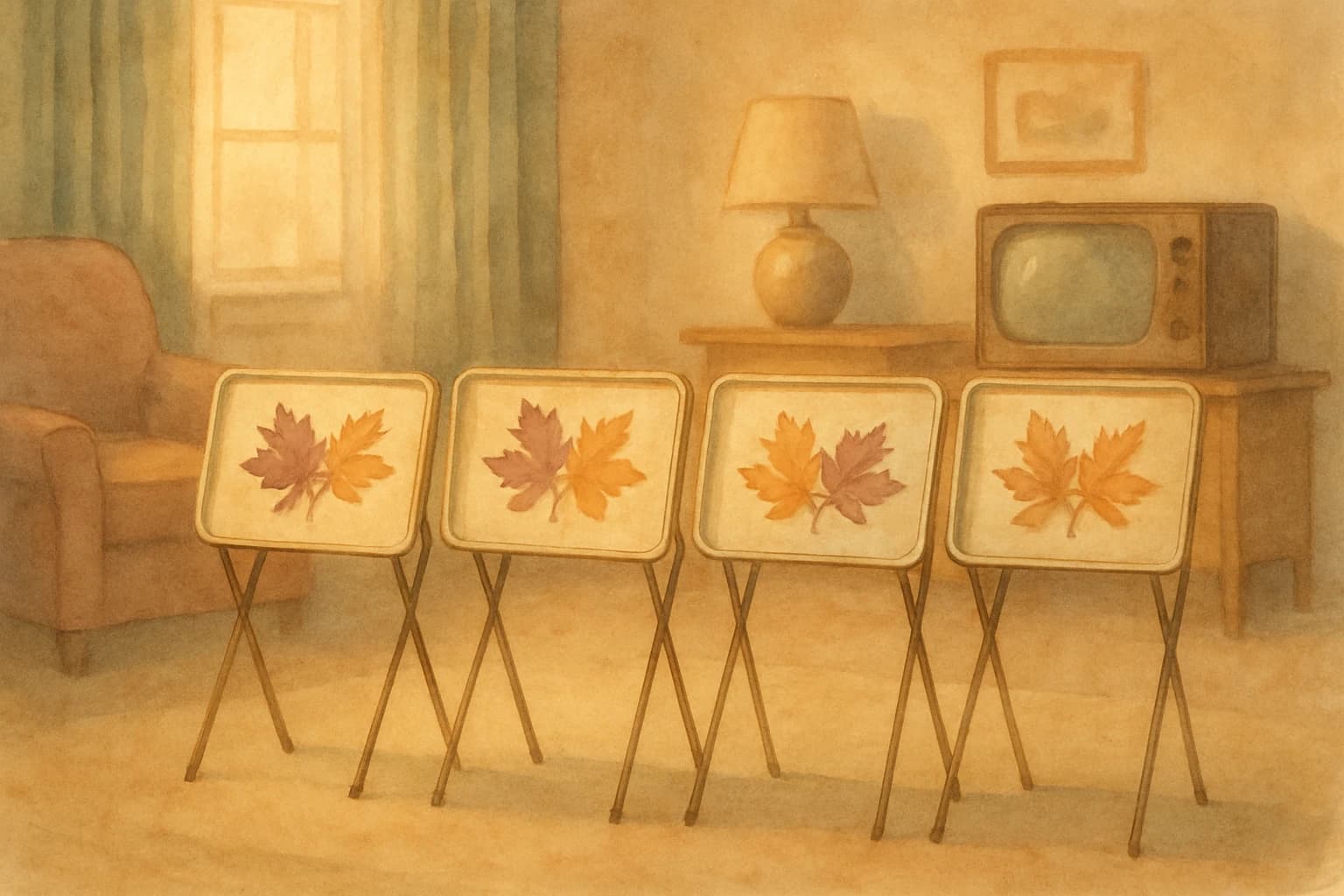
The Four Clicks of the Aluminum TV Tray Ritual
The tray had a picture on it. A pheasant in flight, or a Colonial couple in a horse-drawn sleigh, or a spray of autumn leaves in colors no actual leaf has ever been. It was printed on stamped aluminum, folded into a set of four with a stand that clicked open with a particular sound, and it lived in a narrow gap between the refrigerator and the wall, or in a slot behind a closet door, waiting for Wednesday.
Wednesday because that was the night the good shows were on, or Friday because that was the start of the weekend, or whatever night your family had settled on without ever discussing it out loud. On that night, dinner did not happen at the table. It happened in the living room, on these trays, in front of the television, and for one evening the room where the family normally just sat became something closer to a restaurant. A bad one, structurally. A beloved one, in memory.
The setup had its own choreography
The trays came out before the food did. Someone, usually a kid, was sent to fetch them from wherever they lived, and the unfolding of four stands in a row was itself a modest ritual, four clicks in quick succession, the legs locking at the same height every time because they were built that way. They went in front of the couch, in front of the recliner, wherever the seats were. Nobody measured the spacing. Everybody knew where their own tray went, the way everybody knew their own seat at the actual table.
The food arrived on real plates, which is a detail people forget. The tray itself was not a plate. It was a table, in miniature, sized for exactly one plate, one glass, one napkin, and if you were lucky a little dish for something extra. The meal was usually simple on tray nights. Fried chicken. A casserole that reheated well. Something you could eat with a fork without needing two hands and a knife working at the same time, because balance was a real concern. The tray was steady, but it was not a table bolted to the floor.
The television was already on when the food came out. This is the part that made the whole thing feel like an event rather than a compromise. Dinner at the table was daily. Dinner on trays was scheduled around something, a show that had a start time, that the whole family wanted to see, and the trays existed to solve the specific problem of eating during it without a plate on a lap and a glass sweating onto the carpet.
It solved a real problem
Before the tray, eating in front of the television meant eating on your lap, which worked for a sandwich and failed for almost everything else. A bowl of soup on your lap is an act of faith. A plate with gravy on it, balanced on two thighs while you lean forward to reach a fork, is asking for an accident, and accidents on the good carpet were not tolerated lightly in most households.
The tray fixed this with almost no engineering required. Four aluminum legs, a stamped top, a stand that folded flat for storage. It was cheap to make and cheap to buy, which is why it spread so fast through American homes in the years after television itself spread. By the mid-1950s the tray table was in millions of houses, sold in sets, sold with matching stands, sold sometimes with the television dinner already built around the idea of eating this way.
Swanson's frozen dinner arrived on an aluminum tray of its own, divided into sections, meant to go straight from oven to a lap-height stand in front of the set. The two products, the folding tray and the frozen dinner, were not the same invention, but they were clearly courting each other. Together they described an entire evening. Heat the tray. Carry it to the living room. Set it on the aluminum stand. Watch the show. The word "TV dinner" survived the actual dinners by decades, which tells you something about how completely the idea took hold.
What the ritual actually delivered
The living room on tray night was not the dining room. Nobody was pretending it was. The dining room, if the house had one, was for company and for Sundays, and it operated under a different set of expectations, tablecloths and passed dishes and a certain formality that everybody understood without anyone stating it. The living room on tray night was informal in a way that felt earned rather than lazy, because it happened on a schedule, for a reason, with its own equipment.
There was a kind of equality to it that the dining table didn't always have. At the table, seats had assignments, and the assignments often mapped onto the family's actual hierarchy, father at the head, mother closest to the kitchen, kids in the middle. On tray night, everyone sat wherever there was a clear line of sight to the television, and the seating had nothing to do with rank. A kid could end up closer to the screen than either parent, simply because that was where the good chair happened to be.
The conversation changed shape too. At the table, talk was often directed, parents asking about school, about homework, about the day. In front of the television, the show did some of the talking, and the family's commentary ran alongside it instead of carrying the whole load. This was, for some families, a relief. Not every household ran on easy conversation, and the tray nights gave everyone something to look at together that didn't require anyone to perform.
What shouldn't come back
It's worth saying plainly that eating in front of a screen instead of at a table, as a nightly habit rather than an occasional one, is not something to romanticize without qualification. Plenty of families in this era used the tray table not once a week but every night, and the shared meal, the actual conversation, the practice of sitting across from each other with nothing between you but food, thinned out because of it. Family researchers who study dinner-table habits point to this exact period as the beginning of a long decline in the frequency of families eating together at an actual table, a decline that has continued for seventy years and shows up in outcomes researchers still argue about today.
The tray table also encouraged a kind of eating that wasn't especially good for anyone. Fast, distracted, timed to a commercial break rather than to appetite. Kids who grew up eating every meal in front of a television did not necessarily learn the unspoken social skills that a shared table teaches, the passing of dishes, the waiting for everyone to be served, the practice of talking to the people actually in the room with you instead of watching a screen together in silence.
None of this means the occasional tray night was a mistake. A once-a-week departure from the table, tied to something the family genuinely looked forward to together, is different in kind from a habit that replaces the table altogether. The families who kept it occasional got the good parts, the informality, the shared anticipation of a favorite show, without losing the daily practice of sitting down together. The families who let it become every night lost something they didn't fully notice losing until later.
What's actually gone
The trays themselves mostly went to yard sales sometime in the 1990s, or into attics, or into the trash when someone finally decided four aluminum stands with a bent leg between them weren't worth keeping. Coffee tables in front of couches serve the function now, or laps do, or nobody bothers with a surface at all and just eats standing at the kitchen island with the television audible from the next room.
What's gone isn't the eating in front of the television. People still do that constantly, more than ever, probably. What's gone is the specific evening built around it, the scheduled night, the four clicks of the stands unfolding in a row, the sense that this was an occasion rather than a default. The tray table required a bit of setup, and the setup was the thing that turned an ordinary habit into a remembered one.
Did your family have tray night, and what night was it? What was on the plate, and what was on the television? We'd love to hear about yours in the comments.
Get a new story every Sunday morning.
One email a week. No spam. Unsubscribe anytime.