10 Heavy Objects That Lived in the American Laundry Room
The laundry room was not supposed to be comfortable.
That was understood. It was a working room, usually off the kitchen or in the basement, with a concrete floor or linoleum that had been mopped so many times the pattern had rubbed thin at the spots where you stood. It was not where you went to relax. It was where you went to work, and then you left. The equipment in it was built on the same principle: functional, heavy, designed to last, and made without any consideration for how it looked in a magazine.
Most of what filled those rooms is gone now. Not the washers and dryers -- the function continues -- but the particular objects that surrounded them, the tools and containers and fixtures that made the work possible. Here are ten of them.
1. The Wringer Washer
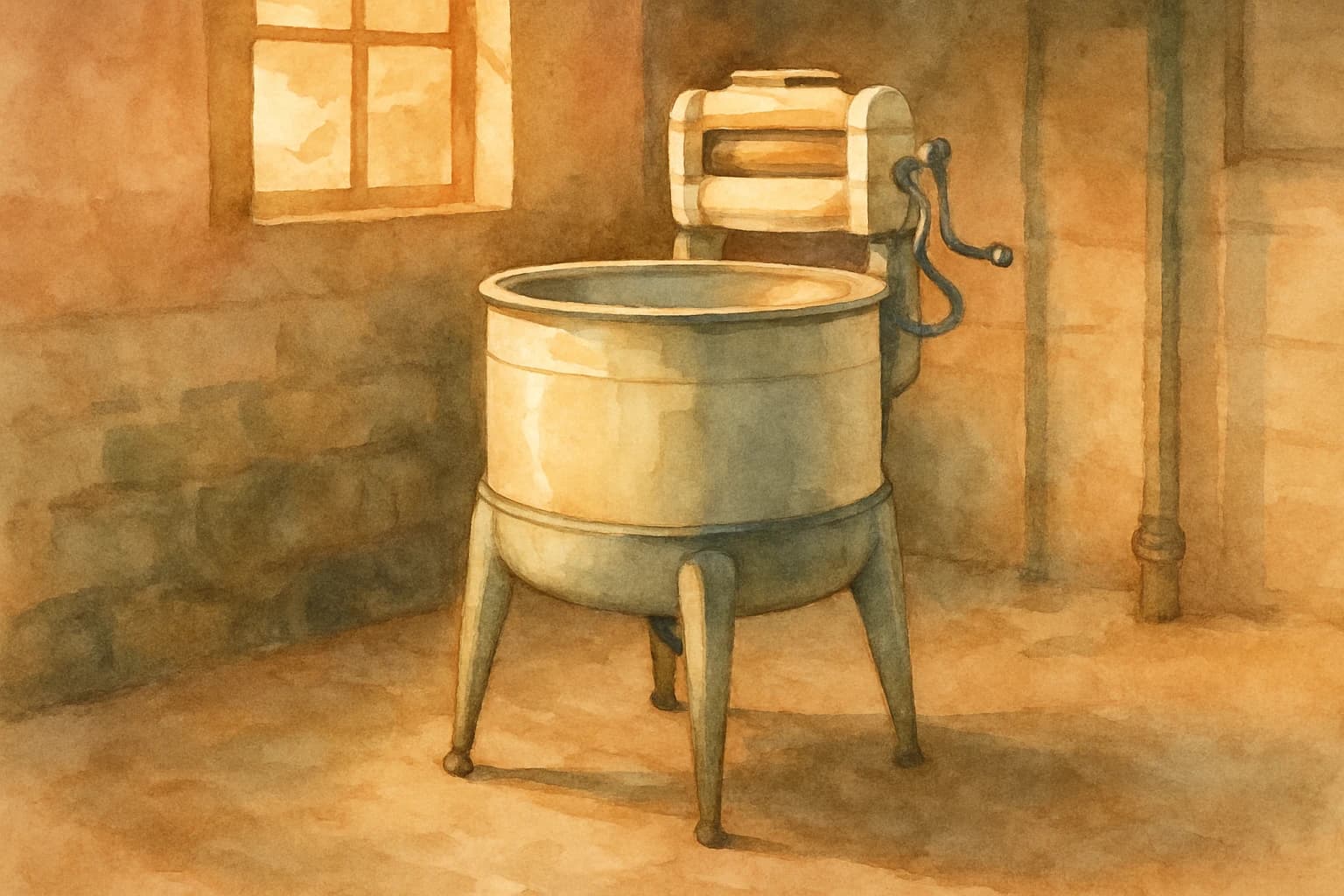
Not the automatic washer that followed it, but the original: a top-loading tub with a hand-cranked or motor-driven wringer mounted on top. You washed in the tub, then fed the wet clothes through two rubber rollers that pressed the water out, and the clothes came out the other side flattened and damp rather than soaking. The wringer could take a finger off if you were careless, and plenty of women were, briefly, careless. It was a real machine with real consequences for inattention.
By the 1960s, automatic spin-cycle washers had pushed the wringer washer out of most American homes, but not all of them. Rural households held on. Families who bought their equipment used held on. There are women alive today who ran wringers into the 1970s and will tell you without nostalgia that the automatic washer was one of the genuine improvements of the century. They're right. The wringer washer worked, and it worked better than washing by hand, but the automatic washer was the upgrade.
2. The Wringer Mounted Over the Utility Sink
The utility sink itself still exists -- a deep, cast-iron or porcelain basin with a high faucet, built to hold water for soaking and hand-washing and filling buckets. What doesn't exist anymore is the hand wringer that used to mount to its rim. A clamp-on mechanism, two rollers, a handle. You fed the item through, turned the handle, and the water wrung out into the sink below. Tablecloths. Wool sweaters. Anything that couldn't go through the wringer washer or was too delicate for the spin cycle.
Hardware stores used to carry them. They cost a few dollars. They lasted forever because the only moving parts were the rollers and a simple gear.
3. Bluing
Before optical brighteners were introduced into laundry detergents in the 1950s, white fabric turned yellow with age and washing. The solution was bluing: a liquid or powder containing a blue dye that, added in small amounts to the rinse water, counteracted the yellow and made whites appear whiter. It worked because blue and yellow cancel each other optically, and a faint blue cast reads as "clean" to the human eye.
Mrs. Stewart's Liquid Bluing still exists, technically, and you can order it online. But it left the mainstream laundry room when detergents with optical brighteners took over, because the brighteners did the same thing automatically. Women who used bluing for fifty years and then switched to modern detergent in the 1960s did not miss it. The measuring and the careful addition to the rinse water was one more step in a process that already had too many steps.
4. The Clothes Sprinkler Bottle
Before steam irons became standard, you ironed dry clothes by dampening them first. The sprinkler bottle was the tool: a glass Coke bottle or a dedicated bottle with a perforated metal sprinkler cap screwed on top. You shook water across the shirt, rolled it up to let the moisture distribute evenly, and then ironed the damp fabric flat.
The dedicated sprinkler bottles came in all shapes. Some were ceramic figures -- chickens, elephants, other animals -- with the sprinkler cap fitted where the beak or trunk would be. These were marketed as "novelty" items and sat on ironing boards across America through the 1950s. They were functional art, and they were everywhere, and now they are at antique malls for twenty dollars apiece.
5. Fels-Naptha Bar Soap
A hard, yellow bar with a sharp chemical smell and a paper wrapper. Used for pre-treating stains: you wet the stain, rubbed the bar against it, and let it sit before washing. It worked on grass stains, grease, and most of what children managed to apply to themselves on a daily basis.
Fels-Naptha still exists. It is still made and still sold, mostly at hardware stores and through online retailers, and it still works the way it always worked. It didn't disappear -- it just stopped being a household word. The laundry room that once had a bar of it within arm's reach of the washer now mostly relies on spray pre-treaters in plastic bottles. Different product, same basic function.
6. The Wall-Mounted Ironing Board
Not the freestanding kind that folded out and leaned against the wall when not in use. The wall-mounted kind: a full ironing board on hinges, built into the wall of the laundry room or kitchen, that folded down for use and folded flat and latched shut when you were done. The board was right there. You didn't drag anything out. You unlatched it, ironed, and folded it back up.
They were standard in homes built between 1930 and 1960, particularly in smaller houses where a freestanding ironing board took up more floor space than could be spared.
7. The Mangle
A household mangle was a large, electrically powered ironing press: a padded roller and a curved heated plate, designed for flat work -- sheets, pillowcases, tablecloths, shirt collars. You fed the item in, the roller pressed it against the heat, and it came out ironed on the other side. A sheet that would take ten minutes with a hand iron took two minutes through a mangle.
Mangles were not rare. They were sold in department stores and used in middle-class homes through the 1950s. Some weighed a hundred and fifty pounds. They required dedicated space. When synthetic fabrics arrived in force in the 1960s and 70s -- fabrics that didn't wrinkle, that came out of the dryer already presentable -- the mangle lost its case. Ironing an entire household's worth of sheets every week stopped being necessary when the sheets stopped wrinkling.
8. Argo Starch in the Box
Powdered starch, dissolved in water and added to the rinse, stiffened fabric: shirt collars, cuffs, work shirts, housedresses. A starched collar held its shape all day. A starched work shirt held its crease through a full shift. Men who wore dress shirts to work expected them starched and ironed, and starching was part of the laundry sequence, not an optional extra.
The spray starch in a can made the process faster and the box disappeared from most laundry rooms by the late 1960s. Spray starch still exists. The box of powdered starch mostly doesn't, outside of a few grocery stores in regions where people still make their own sizing for quilting and fabric crafts.
9. The Wicker Laundry Basket with the Two-Handed Lid
Not the plastic hamper that replaced it, and not the canvas bag that replaced the plastic hamper. A stiff, woven wicker basket, oval, with a lid that arched up and latched or simply rested flat. It was heavy before you put anything in it. It was difficult to carry once you did. It scratched your arms if you weren't careful about how you gripped it.
It lasted for thirty years because wicker, left alone and not abused, simply lasts. These baskets sat in laundry rooms, at the bottom of staircases, in bathroom corners, holding laundry through multiple decades and sometimes multiple generations. They ended up in attics and garages when plastic baskets arrived and were cheaper and lighter and didn't splinter.
10. The Felt Tip Laundry Marker
For marking children's clothes before they went to summer camp, or before they went into a household where two or three kids wore the same size and you needed to know whose was whose. The laundry marker was a permanent felt-tip pen with ink that survived washing without fading. You wrote initials inside the collar, on the waistband tag, along the hem edge.
The practice itself is mostly gone. Camps still require labeled clothing, but iron-on labels and label makers have replaced the pen. The action itself -- a mother with a permanent marker going through a pile of clothes before school started, writing the same two initials on forty items -- is the kind of thing that happened quietly every August for decades and then simply stopped.
What Shouldn't Come Back
Most of this list doesn't deserve revival, and that's worth saying plainly. The wringer washer was a real improvement on washing by hand, but it was not a pleasant machine to operate. The mangle was dangerous. The starch sequence added work to an already labor-intensive process that fell almost entirely on women, who had not been consulted about whether they wanted to do it.
Modern laundry takes thirty minutes of actual attention for a household that used to spend two full days a week on the same work. The machines are better. The detergents are better. The fabrics are better. Anyone who tells you laundry was more satisfying in 1955 either didn't do it then or doesn't do it now.
What's worth noticing is how purposeful the equipment was. Every item in the laundry room of 1955 had a plain job, and it did that job without any extra features. Nothing in the room sent notifications or needed a firmware update. The mangle ironed. The sprinkler bottle dampened. The bluing whitened. The job was completed and the room was left.
That's not nostalgia for the work. It's a small observation about what it means for a tool to be exactly what it's supposed to be, nothing more.
Did your family have a wringer washer or a mangle? What do you remember about laundry day growing up? Let us know in the comments -- we read them all.
Get a new story every Sunday morning.
One email a week. No spam. Unsubscribe anytime.