The Green Stamp Book and the Patient Arithmetic of Saving Toward Something
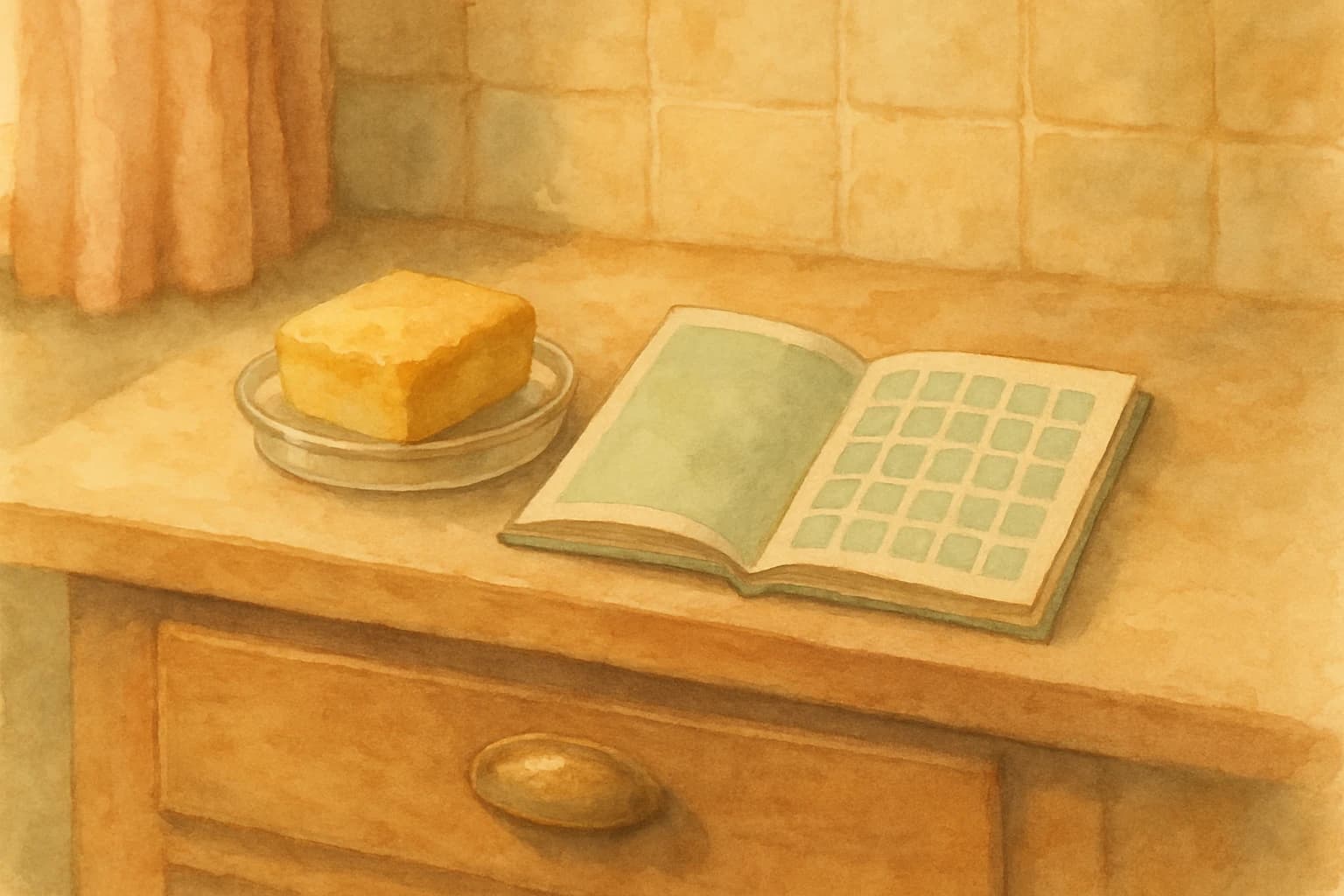
The book sat in a kitchen drawer, usually the second one down, with a damp sponge in a margarine lid next to it.
You licked the stamps and pressed them into the squares. One stamp per square, ten stamps per row, fifty stamps per page. The book held twelve hundred stamps when full. You needed anywhere from three books to forty books depending on what you wanted, and the arithmetic of getting there was the whole project.
S&H Green Stamps were the dominant version, but there were others -- Gold Bond, Top Value, Plaid, King Korn, depending on where you lived and where you shopped. The gas station gave them. The grocery store gave them. Some dry cleaners gave them. A careful shopper who paid attention to the double-stamp promotions on Tuesdays could fill a book faster than a shopper who didn't, and careful shoppers paid attention.
What the program actually was
The mechanics were simple. Sperry & Hutchinson, the S&H company, sold stamps to retailers, who gave them to customers as a purchasing incentive. Customers collected the stamps, filled the books, and redeemed the books at S&H redemption centers for merchandise from a catalog. The retailer paid for the stamps as a marketing cost. The customer got something for free, more or less, since the price of the stamps was built into the retail prices across the board.
By 1964, S&H was the largest purchaser of consumer products in the United States. The company printed three times more stamps than the US Postal Service. There were roughly eight hundred redemption centers nationwide, and the S&H Green Stamp catalog was the most widely distributed publication in America, outselling the Sears catalog and TV Guide combined.
This was not a minor promotion. This was a parallel economy running quietly alongside the cash economy, and it ran through the kitchen drawer.
The drawer and the discipline
The accumulation was steady and mostly automatic. You shopped. You got stamps. You came home and put the stamps in the drawer. Eventually you sat down at the kitchen table and filled the books.
The filling was its own kind of work. The sponge in the margarine lid was because licking twelve hundred stamps yourself produced a taste and a texture that nobody wanted. You dampened the sponge, pressed the stamp lightly, peeled it up, applied it to the page. Methodical. Meditative, even. There was no rushing the filling of a stamp book.
Most of the women who did this work -- and it was mostly women, since it was connected to the grocery shopping and the running of the household -- developed their own systems. Partial stamps stuck to the back of the front cover until there were enough to make a row. Books in progress stayed in the drawer. Full books went somewhere more permanent, often a shoebox in the closet, stacked and rubber-banded, accumulating toward the goal.
The goal was the thing. You looked at the catalog and you found the item and you counted how many books it required. A toaster was three books and a partial. A set of mixing bowls was two books. A portable television was twenty-two books. You knew where you stood. You knew how far you had to go. The arithmetic was patient and it worked slowly, but it worked.
What it taught
There is a generation of Americans who learned to save not from formal instruction but from watching their mother fill stamp books. The lesson was not articulated. It was embodied in the drawer, the sponge, the shoebox, the catalog.
The lesson was this: if you accumulate steadily toward a fixed goal, and you don't spend the accumulation on something else, and you are patient, you will eventually have the thing.
This is not a complicated lesson. It is not a novel one. But it is plain, and it is different from the way acquiring things tends to work now, which is mostly immediate and credit-driven and doesn't require a shoebox in the closet.
The woman who filled stamp books over fourteen months to get a particular stand mixer understood something about the stand mixer that a woman who orders the same stand mixer on a credit card and has it by Thursday does not quite understand. The waiting was part of it. The accumulation gave the object a history that it didn't have before it arrived. It had been the goal for over a year. You had earned it one row of stamps at a time.
The counterpoint
Let's say what's true: the Green Stamp program was not a neutral gift to consumers. The cost was already built into the retail price, which meant everyone paid for the program whether they collected stamps or not. The person who paid cash and didn't bother with stamps subsidized the person who did. If retailers had simply lowered prices by the equivalent margin, the whole arrangement would have vanished and everyone would have been roughly even, with more money in their pockets and no shoebox in the closet.
The redemption process was also not particularly efficient. Redemption centers kept limited hours. The catalog had a way of featuring items on its cover that required a staggering number of books to obtain, and the items at the lower end of the book count were often things nobody especially needed. Some families accumulated stamps for years toward something substantial, and then the nearest redemption center closed, and the S&H system contracted in the 1970s, and the books in the shoebox became a paperweight problem.
And the savings lesson, while real, was incidental. It wasn't designed into the program. It was a side effect of the arithmetic. The program was designed to increase retailer foot traffic and generate customer loyalty. The savings discipline that some families took from it was genuine, but it was not the point. It was accidental character formation.
Credit, for all its genuine downsides, actually improved access to major purchases for households that would have spent years filling stamp books toward something they could have used much sooner. The person who needed the refrigerator needed it in April, not in November of next year when the books were finally full. The immediate acquisition is sometimes the right acquisition.
What the stamps were really about
But here is the honest part, separate from the economics. For many households, the stamp book was the only system in place for accumulating toward a goal. There was no automatic savings transfer. There was no investment account. There was no employer match. There was the drawer, and the sponge, and the stamps that came in from the grocery store and the gas station every week, and slowly, with genuine patience, you filled the books and you got the thing.
For a particular kind of American household in the postwar decades -- not wealthy, not especially financially sophisticated, paying close attention to every dollar that came in -- the Green Stamp program provided a structure for wanting something and working toward it that wasn't otherwise provided by any institution. The bank was for emergencies and mortgages. The stamps were for the mixer.
The program peaked in the mid-1960s and declined through the 1970s as inflation made the stamps' purchasing power drop and as other forms of consumer promotion -- rebates, frequent flyer miles, credit card points -- began to fill the same niche in a more efficient format. S&H Green Stamps effectively ended consumer operations in 1981, though the company survived in other forms.
What ended with them was not the idea of a loyalty program. That idea is more alive than ever. What ended was the particular texture of the drawer and the sponge and the margarine lid, the physical accumulation of small paper rectangles into a book you filled with your own hands, the shoeboxes stacking toward something particular.
The whole system fit inside a kitchen drawer. You could see where you stood. You knew what you were saving toward. And then one Tuesday, finally, you had enough books in the shoebox, and you drove to the redemption center, and you came home with the thing you had been working toward for most of a year.
That sensation -- the patient accumulation finally cashing out -- is harder to replicate now. It doesn't happen at checkout. It doesn't happen with a credit card. It happens, maybe, if you set up a savings account with a name on it and watch the balance climb, but that requires deliberate effort that the stamps did not. The stamps came automatically, with the groceries, and they accumulated whether you were paying attention or not.
Did you fill Green Stamp books as a kid, or watch your mother fill them? What were you saving toward? Tell us about yours in the comments below.
Get a new story every Sunday morning.
One email a week. No spam. Unsubscribe anytime.