10 Midway Traditions Vanished Along With the Ferris Wheel Skeleton
The county fair arrived on a Thursday and left before you were ready for Monday.
You knew it was coming by the lights you could see from the highway a week before it opened, the skeleton of the Ferris wheel going up in sections, the carnival trucks parked in rows along the back fence. By the time you got there, the midway was fully assembled and humming, a temporary city of canvas and neon and diesel generators that had been built in forty-eight hours and would be gone in six days. What ran down the center of it -- the games, the rides, the food, the noise -- was particular enough that you could describe it thirty years later without hesitation.
Some of it is still there. Some of it has been regulated out. Some of it simply stopped making money when the economics of running a traveling midway got harder. Here are ten things that used to be standard equipment.
1. The High Striker
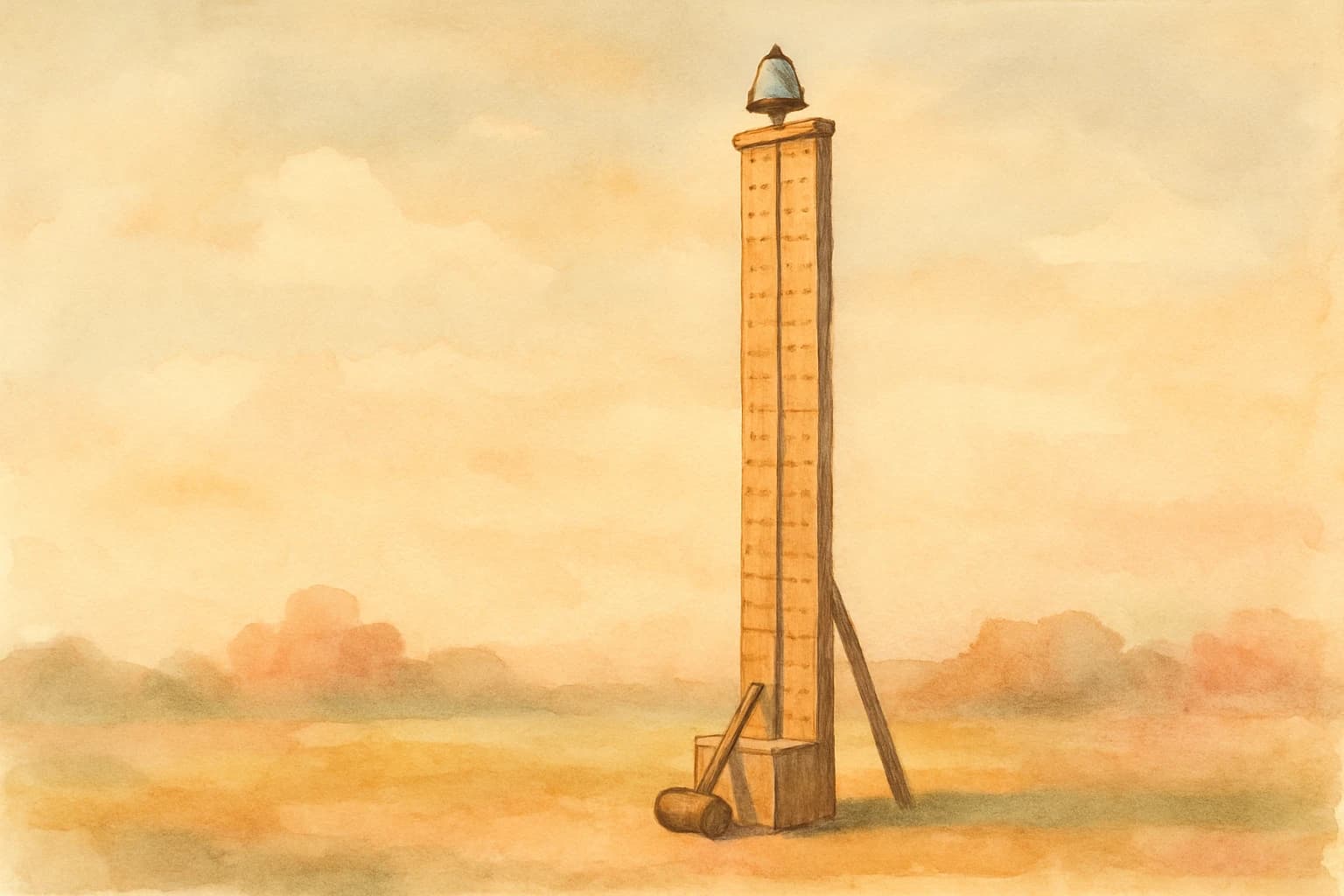
A steel pedestal, a rubber mallet, a cable, a bell at the top that only rang if you hit it perfectly. The carnie would hand you the mallet with an expression that suggested you probably wouldn't make it. You had a decent chance of being right. The thing required a downward stroke with precise contact, not just raw strength, and if you swung wide or off-center the cable barely moved. The bell rang maybe once every forty attempts from the crowd.
The High Striker still exists at some fairs, but it has thinned considerably. Liability concerns about the mallets, the mechanism, and the general physics of adults swinging heavy things near children have pushed it out of many venues. The ones that remain are often lighter, easier. The genuine article -- the one that rang maybe once in an afternoon -- has become a rarity.
2. The Pitch-Till-U-Win Game with the Plates
You threw a ring, or a coin, or a ball at a surface covered in plates or bottles. If the projectile landed where it was supposed to land and stayed there, you won whatever was behind the counter. This sounds simpler than it was. The plates were tilted. The rings were slightly too large, the bottles slightly too wide, the balls slightly too light. The geometry was adjusted in ways that weren't illegal, exactly, but that were also not entirely honest.
You still occasionally see ring toss. What you don't see anymore is the physics calibration that made these games nearly unwinnable while still remaining technically winnable. Federal and state regulations on carnival game odds, which tightened through the 1980s and 1990s, changed what could be on the midway. The FTC and various state attorneys general went after the most egregious setups, and many of the classic mechanisms disappeared. What replaced them are games with better odds and worse prizes, which is probably fairer but is also less dramatically frustrating.
3. The Prize Goldfish
Win a game -- sometimes any game, sometimes a particular one -- and you walked away with a plastic bag with a goldfish in it, tied shut with a rubber band, the fish swimming in a circle and looking resigned to the situation.
The goldfish lasted, in most cases, under a week. You set it up in a bowl with tap water, fed it pinches of flakes, and it died quietly on a Tuesday. Some families got more serious about it, bought a real tank, made the commitment, and ended up with a fish that lived for four years. Those families remember the fish. The rest of us remember the bag and the rubber band.
Regulations have removed the prize goldfish from most American fairs. California banned the practice in 2008. A number of other states and municipalities followed. The argument, which is not wrong, is that the fish are treated carelessly during transport and storage, and that handing them to children who have no equipment to care for them ensures a bad outcome for the fish.
4. The Traveling Freak Show Banner
Along the outer edge of some midways, before the rides started, there was a row of painted canvas banners twelve feet tall depicting what was supposedly inside. The illustrated figures were extraordinary -- half-man half-woman, the world's smallest horse, the alligator boy, the two-headed calf. The banners were painted in a style that was particular to the craft: flat, bright, hyperbolic, with expressions of theatrical astonishment on the painted faces.
What was inside was usually less spectacular than the banner promised. The two-headed calf was real but preserved. The "world's smallest horse" was a Shetland pony. The banner art was doing most of the work.
The traditional sideshow effectively ended by the 1990s, pushed out by a combination of changing public attitudes toward disability and difference, the advocacy work of disability rights organizations, and falling attendance as the act became harder to market. The banner art, which was genuinely its own American folk form, mostly ended with it. Original banner painters are almost all gone now. What survives is in folk art collections and a handful of museum shows.
5. The Dunk Tank with a Live Target
A person sat on a platform over a tank of water, usually saying something provocative to the crowd, and you threw a ball at a target that would collapse the platform. Hit it, they went in. The target could be reached from a reasonable distance with a reasonable throw.
This one still exists at some fairs, but the person in the seat is now usually a volunteer from a local organization raising money, not a professional carnie whose job was to needle strangers into spending money on bad throws. The professional version had a practiced quality to it -- the person in the seat knew exactly how to make you angry enough to throw five more dollars' worth of balls. That skill is mostly gone.
6. The Glass Cutter Demonstration
A man at a folding table would cut glass into shapes with a handheld tool and sell you the set. He had a patter. He cut the glass cleanly, held the pieces up to the light, showed you how straightforward it was. The kit cost $4.95. The kit sat in a drawer in your kitchen until you moved.
The midway demonstration booth -- glass cutters, Ginsu knives, vegetable spiralizers, chamois cloths -- was a real category of carnival commerce that has been absorbed entirely by television. The demonstrations moved to late-night cable and then to the internet. The booth is gone because the medium moved on.
7. The Duck Pond (the Way It Used to Be Priced)
The duck pond was the children's game: plastic ducks floating in a circular pool, each with a number on the bottom, and every number won a prize. It was designed to be unloseable. Every child went home with something.
This version still exists. What's gone is the price. A duck pond turn in 1978 cost 25 cents. You could play twice for two quarters. The prize was a plastic trinket or a piece of wrapped candy, and the economics of the transaction were clear: you paid a modest amount, your child was happy for thirty seconds, you moved on. The modern version often costs two dollars a turn, which changes the emotional math of the whole thing considerably.
8. The Penny Pitch
A flat surface covered in overlapping plates and glassware. You threw pennies from a distance and tried to land one cleanly on a plate. If it stayed without touching the rim or another coin, you won the piece.
The game required pennies, which most people carried. It required patience and a throwing technique you developed over a few turns. The penny pitch faded as inflation made the penny essentially worthless and the glassware became a liability concern. You don't see it anymore.
9. The Saltwater Taffy Puller
A machine in a window, pulling a rope of taffy back and forth, stretching it until it was the right texture. You watched it through the glass while you waited for the bag. The machine was mesmerizing in a particular mechanical way -- the hooks rotating, the taffy going pale as air worked into it, the whole thing moving with a steady patient rhythm.
The taffy itself is still sold at fairs. The visible machine in the window is mostly gone, replaced by pre-packaged product assembled elsewhere. The demonstration was its own reason to stop. Without it, the taffy stand is just another candy booth.
10. The Shooting Gallery Where You Shot the Star Out
You had a BB gun, cork-tipped or pellet, and a paper target with a red star printed in the center. The object was to shoot every part of the star out of the paper -- put holes around it until the whole star fell away -- within the number of shots provided. The target was no bigger than your palm. Kids shot them. Adults shot them. The midway smelled like gunpowder near this booth.
BB and pellet shooting galleries have been removed from almost all American county fairs, partly due to insurance requirements, partly due to policy changes at the fairgrounds level, and partly because the cultural appetite for children handling firearms in public has changed. The gallery still exists at a handful of rural fairs where the context makes it unremarkable. Everywhere else, it's gone.
A few of these things went away for reasons that are not very complicated: they were deceptive, or they were cruel to animals, or they relied on physics that regulators decided was dishonest. The prize goldfish was bad for the fish. The rigged pitch games were designed to extract money through manufactured frustration. The freak show, in its traditional form, asked people to pay to stare at someone with a disability or a medical condition. These are fair criticisms.
The harder question is whether the midway is better now for having removed them. Safer, probably. More regulated, certainly. But a midway that is fully safe, fully fair, fully honest about its odds is a different place than the old one was. Part of what the midway sold was the electric feeling of a temporary world operating outside the ordinary rules. When you've patched all the holes in that, something in the atmosphere changes, and you end up with a very large playground that doesn't feel quite the same after dark.
What do you remember from the county fair midway that you haven't seen in years? Did you ever win the dunk tank game, or shoot the star out, or go home with a fish that actually survived? We'd love to hear your story in the comments.
Get a new story every Sunday morning.
One email a week. No spam. Unsubscribe anytime.