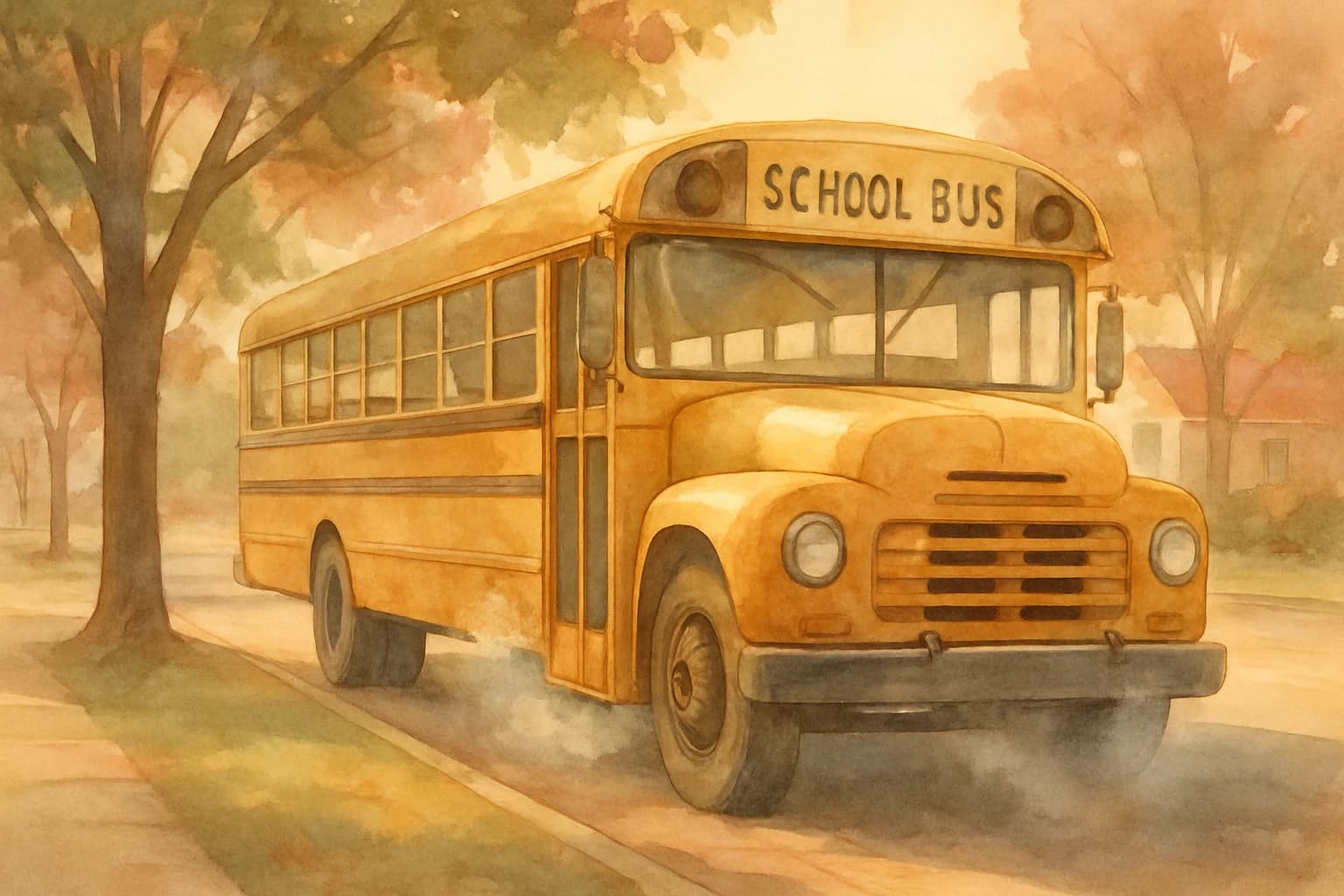
10 Noises That Announced the School Bus Before It Turned the Corner
The bus had a sound before it had a shape. You heard it two or three streets over, low and mechanical, and you knew how much time you had left before you needed to be standing at the end of the driveway.
Every bus ran the same route of noises, more or less, from the moment the driver turned the key to the moment the doors folded open at your stop. Kids who rode the same bus for years could probably reconstruct the whole sequence from memory. Here are ten of them.
1. The diesel cough at the far end of the route
The engine didn't start clean. It turned over with a rattle, caught, and then settled into an idle that shook the whole chassis a little. If your house was near the start of the route, you heard this every morning from somewhere down the block, before the bus was even visible. It sounded like effort. Diesel engines in the 1970s and 80s were not hushed machines, and nobody expected them to be.
2. The air brakes
This one had a hiss to it, sharp and short, every time the bus slowed at a stop sign or pulled up to the curb. Kids learned to recognize it as a warning that the doors were about to open, the same way you'd learn a doorbell. Some drivers rode the brake harder than others. You could tell which bus was coming by how aggressive the hiss sounded before it even turned the corner.
3. The stop sign arm swinging out
A metal clunk, then a pause, then the motorized whir of the arm extending from the side of the bus. It wasn't loud, but it was distinct, and it meant the driver had put the bus in park and traffic behind you was required by law to stop. Younger kids sometimes watched for the arm the way they'd watch for a magic trick. It appeared, and cars obeyed it.
4. The folding door
The door didn't slide. It folded in the middle, two panels meeting at a hinge, and it made a particular squeak-and-clap sound every time the driver pulled the lever. New buses had a tighter, quicker sound. Older buses, especially toward the end of a route when the engine had been running for an hour, had a looser, slappier one. You could often guess a bus's age by its door alone.
5. The vinyl seat protest
Sitting down on a hot vinyl seat in September, before the bus had cooled off from sitting in the lot all morning, produced a sound and a sensation at the same time. A short squeak, sometimes a longer skid if you slid across the seat to make room for someone. In winter the same seats were stiff and cold and made almost no sound at all. The seasons changed the acoustics of your own seat twice a year without anyone announcing it.
6. The driver's radio, low and constant
Some drivers kept a modest radio going up front, tuned to an AM station or a country channel, just loud enough to hear if you were sitting in the first few rows. It wasn't for the kids. It was company for the driver, who was alone with forty children for two hours a day and needed something. By the back of the bus you couldn't hear it at all, only the engine and everyone talking over it.
7. Forty kids talking over an engine that was already loud
This wasn't one sound so much as the sound, the baseline noise of the whole ride. The engine ran under everything, and on top of it was a layer of shouting, laughing, arguing over seats, somebody singing a commercial jingle badly, somebody else telling the same story they told yesterday. The volume built as the bus filled with more stops. By the time you reached the school, the noise had a texture to it that a nearly empty bus never had. A driver's occasional shout to sit down and be quiet barely dented it.
The noise was loudest in the middle of the route and most subdued right at the start and right at the end, which meant the bus had its own daily rhythm independent of anyone's intention. Kids near the front usually rode in relative calm. Kids in the back rode in something closer to a marketplace.
8. The window crank
Manual windows, cranked by hand, made a ratcheting sound that every kid on the bus recognized instantly, because it usually meant somebody wanted air, or wanted to yell something out at a kid walking on the sidewalk, or wanted to spit, which was against the rules and happened anyway. The crank stuck sometimes. You had to force it, and the metal-on-metal grind that followed was its own brief announcement to the row around you.
9. Gravel and potholes on the back roads
Paved roads produced one sound under the tires. Gravel driveways and rural back roads, especially on routes that served farm properties, produced another. A low rumble, sometimes a sharp crack if a stone kicked up against the wheel well. Kids on rural routes could tell exactly which stretch of the drive they were on by the sound of the road alone, without looking up from whatever they were doing.
10. The final hiss and clunk at your stop
The whole sequence resolved itself the same way every day. Brakes hissed, the bus rocked forward slightly as it came to a full stop, the stop arm swung out with its own motorized whir, and the door folded open with its particular squeak. Then your name, sometimes, if the driver knew you, or just a look that meant this was you. You stood up before any of it finished, because by then you'd heard the sequence enough times to know exactly when to move.
What Wasn't Worth Keeping
Not every part of this was good, and it's worth saying so plainly. The exhaust that leaked into the cabin on older buses was a real problem, one that some kids remember as a headache-inducing part of every ride, and diesel emissions standards have genuinely improved since. The seatbelt situation was nonexistent on most buses well into the 1990s, and nobody thought twice about it at the time, which in hindsight is not something to be nostalgic for. The noise itself, the constant baseline roar of forty unsupervised kids over an engine, was exhausting for drivers, some of whom did the job for decades with very little support and very little pay. Modern buses are quieter, cleaner, and safer, and none of that is a loss.
What's gone is something more modest and harder to defend on paper. The predictability of the sequence, the way a kid could tell you the exact order of sounds that got them from their driveway to their seat, was its own kind of comfort. New buses hum along more smoothly and arrive with less drama. Fewer kids these days seem to know their bus by ear the way an older generation did, because there's less to distinguish one bus's sound from another's.
What sound do you remember most clearly from your own bus route? Did your driver have a radio going, or a rule about noise that nobody followed? We want to hear your version in the comments.
Get a new story every Sunday morning.
One email a week. No spam. Unsubscribe anytime.
If this brought back a memory, you might also like
The Four Clicks of the Aluminum TV Tray Ritual
The trays lived in a narrow gap behind the closet door, waiting for the four distinct clicks that turned the living room into a restaurant for one night.