10 Objects That Lived in the American Mudroom in 1972
The mudroom was not a room in the way the living room was a room. It was a transition space, usually unheated or barely heated, wedged between the back door and the kitchen, and its job was to stop the outside from coming any further into the house than it had to. Every family used it differently, but the objects that lived there were remarkably consistent from Ohio to Oregon. Here are ten of them.
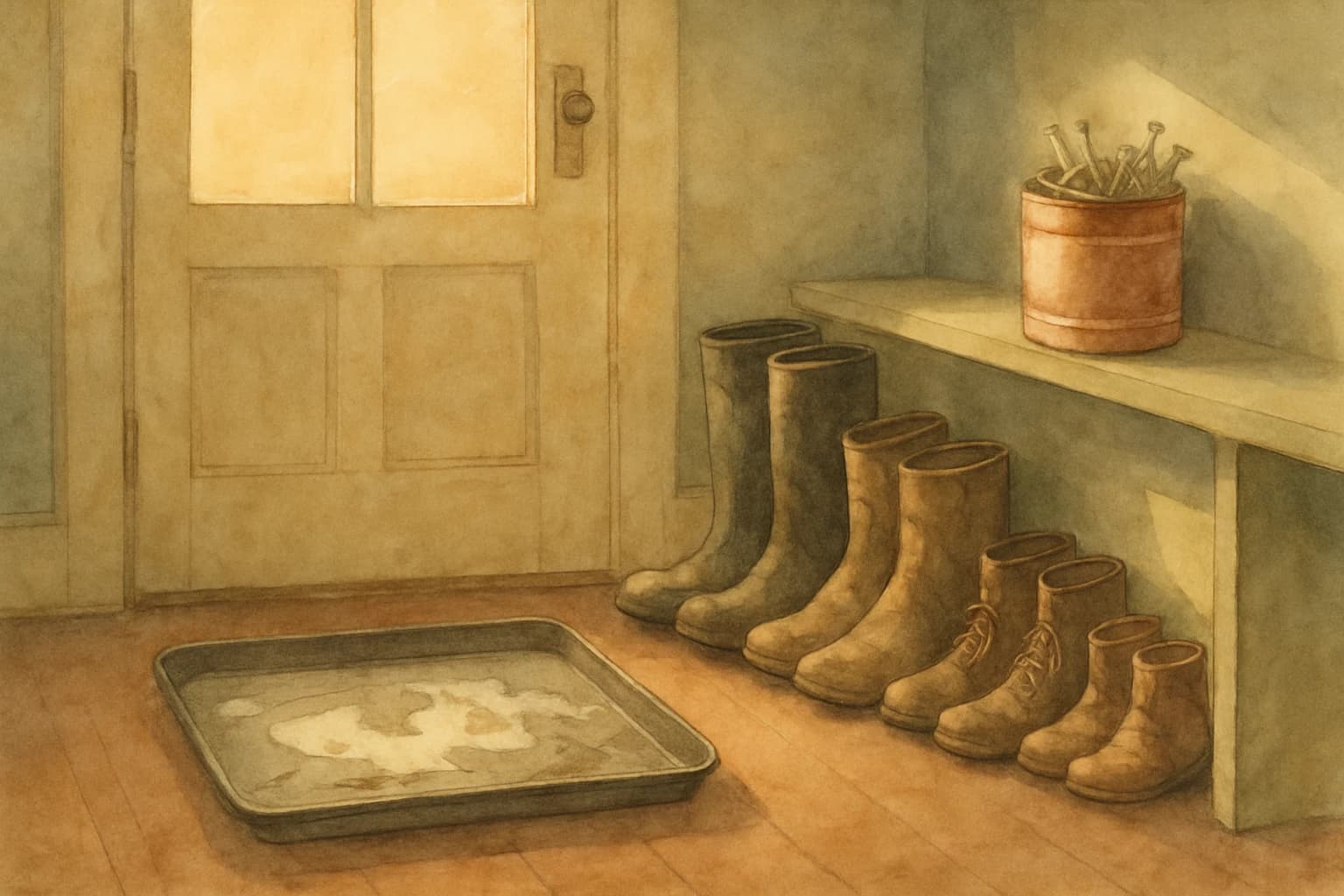
1. The boot tray
A rubber or metal tray sat just inside the door, and it existed for one reason: to catch the mud, snow melt, and general filth that would otherwise track across the kitchen linoleum. Some families used an actual manufactured tray. Many more used a cut-down cardboard box or a cookie sheet pressed into permanent service. Either way, the tray filled up fast in March and stayed wet until May.
2. A row of boots that didn't match anyone in particular
There were always more boots in the mudroom than there were feet in the family. Old work boots that belonged to a father who'd since bought new ones. A single rubber boot with no partner. Boots two sizes too big for anyone currently living in the house, kept because someone might grow into them, or because throwing away a perfectly good boot felt like a minor betrayal. Nobody remembered whose they were. Nobody threw them out either.
3. The coffee can of nails and loose hardware
This one usually sat on a shelf or windowsill, a repurposed Folgers can holding a mix of nails, screws, a stray hinge, and maybe a spark plug that had wandered in from the garage. It wasn't organized. It didn't need to be. When something needed fixing, the can got dumped onto a workbench or the mudroom floor, and the right piece turned up eventually.
4. Hooks, and more coats than hooks
The wall had hooks screwed in at slightly uneven heights, usually installed by whoever lived there rather than a contractor, and the coats hung on them stacked two and three deep. Winter coats stayed up all year in a lot of houses, because the mudroom was the one place cold enough that moths didn't bother and warm enough that things didn't freeze solid. A barn coat. A choir robe on its hanger, still in the dry cleaner's plastic. Somebody's letterman jacket from 1968, kept for reasons nobody explained.
5. The dog's towel
Every family with a dog had a specific towel, usually an old bath towel demoted from bathroom duty, kept near the door for the sole purpose of drying off a wet or muddy animal before it was allowed further into the house. This towel was never washed as often as it should have been. It had its own smell, and everyone in the house recognized it immediately, and nobody thought to question why the dog towel lived in the mudroom instead of the laundry room. It just did.
6. A calendar from the feed store or the funeral home
Local businesses gave these away every December, and they ended up nailed to the mudroom wall more often than the kitchen wall, maybe because the mudroom was where you actually stopped and checked a date on your way out the door. The photography was regional. A grain elevator. A covered bridge. Twelve months of a town's own scenery, given away for free by a business hoping you'd remember them come planting season or when someone passed.
7. The wall phone that didn't quite work right
Some mudrooms had an extension phone mounted on the wall, usually because the kitchen phone's cord didn't reach far enough and somebody got tired of missing calls while out back. This phone was often the oldest one in the house, handed down from an earlier upgrade, with a dial that stuck on the six and a receiver that crackled if you held it wrong. It worked well enough. Nobody replaced it until it stopped working entirely.
8. The step stool nobody remembered buying
A wooden or metal folding step stool sat somewhere in the corner, used for reaching the high shelf where the Christmas ornaments were stored, or for standing on to change a porch light bulb. It had usually come from a hardware store decades earlier, cost around three dollars at the time, and outlived several subsequent purchases of nicer stools that ended up in the garage instead.
9. A galvanized bucket, sometimes two
The bucket had rotated through several jobs over its lifetime. Carrying water to a garden. Holding ice for a party. Catching drips from a roof leak that never got properly fixed. It sat empty most of the time, tucked in a corner, ready for whichever job came up next. Some households had a matched pair, one slightly more dented than the other, and everyone knew which one was for what without being told.
10. The mail nobody had opened yet
The mudroom often doubled as a catch point for mail that came in through the back door instead of the front, particularly in houses where the family used the back entrance as the real entrance and reserved the front door for company. A stack accumulated on a shelf or a table by the door: bills, seed catalogs, a letter from an aunt in another state. It sat there for a few days before someone got around to it, which was fine, because none of it was usually urgent enough to open the same day it arrived.
What the mudroom actually did
The function was simple and largely lost now. It created a buffer between the working, muddy, sweaty, outdoor version of a family and the clean indoor version. You didn't walk into the kitchen in your barn boots. You stopped, dealt with the boots and the coat and the dog, and only then crossed the threshold into the part of the house that mattered to keep clean. The mudroom absorbed the mess so the rest of the house didn't have to.
What shouldn't come back
The mudroom of 1972 was also often unheated, poorly lit, and home to whatever the family didn't want to deal with. It smelled like wet dog and gasoline more often than anyone would admit out loud. The lack of organization that gives the room its charm in memory also meant that finding a specific glove in January could take ten minutes of digging through a pile that had grown unsupervised since October. Modern mudrooms with labeled cubbies and heated floors are, by any practical measure, an improvement. Nobody needs to relive the actual experience of a bare concrete floor at six in the morning to appreciate what the room represented.
What's left
Most houses built after 1990 don't have a mudroom in the old sense. They have a "drop zone" near the garage door, designed by an architect, with a bench and individual cubbies labeled with each family member's name. It's tidier. It's also missing the accumulation, the coffee can nobody sorted, the boots that didn't belong to anyone in particular. The old mudroom wasn't designed. It just happened, the way a drawer fills up with things that don't have anywhere else to go, and that's part of why it felt like it belonged to the family instead of to a catalog.
Did your family's mudroom have a name, or was it just "the back room"? What's the one object from yours you can still picture exactly where it sat? Share your memory in the comments below.
Get a new story every Sunday morning.
One email a week. No spam. Unsubscribe anytime.