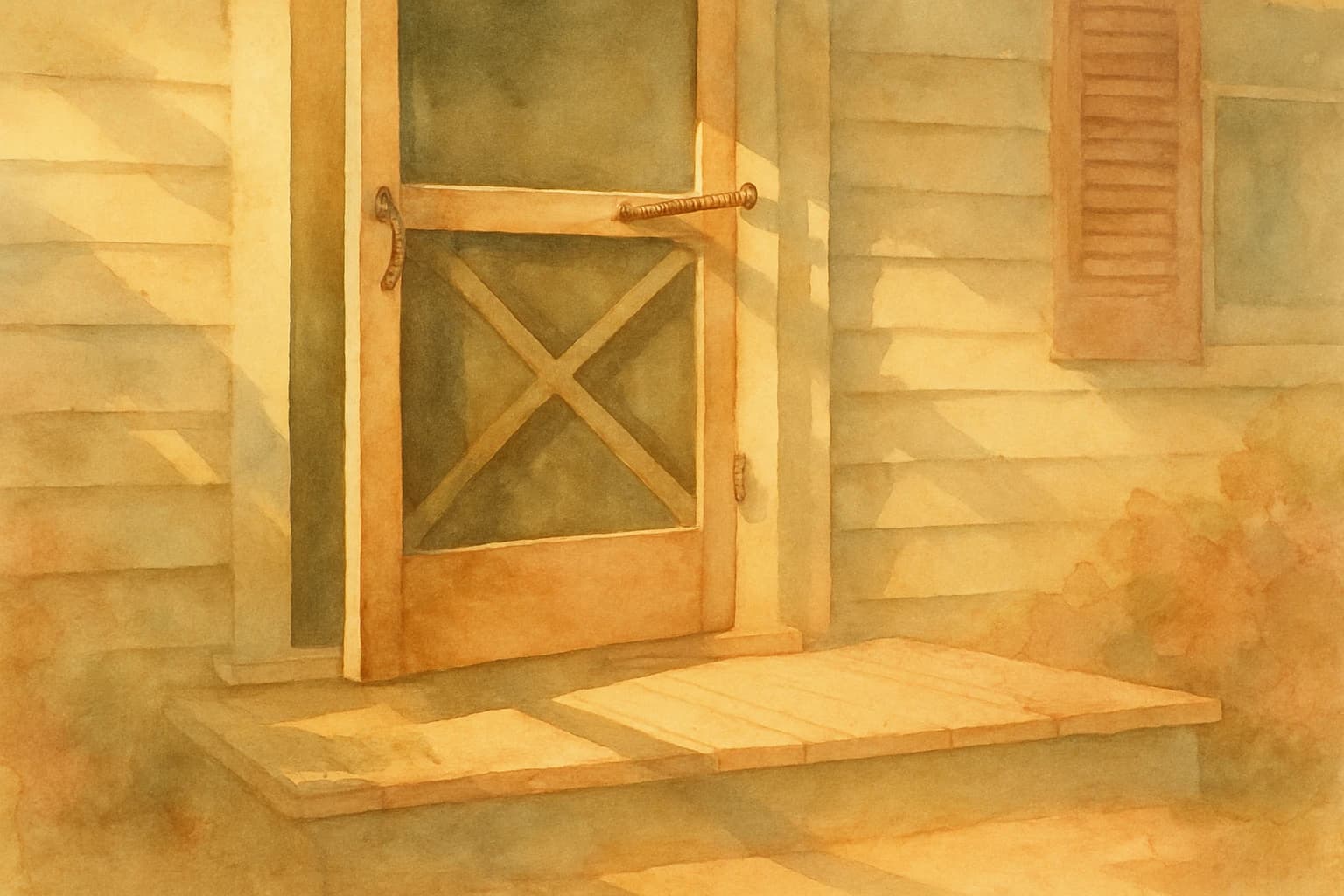
10 Ways a Screen Door Spoke Without a Single Word
The screen door had a vocabulary, and everyone who grew up with one spoke it fluently.
You didn't need to look up from your book to know who had just come in. You didn't need to call out to ask who was leaving. The door told you. It told you the mood, the speed, the intent, and sometimes the age of the person passing through it. Forty years of spring-loaded aluminum and wood-framed wire mesh, and the whole thing functioned as a household communication system that nobody ever formally installed.
Here are ten things it said, and what each one meant.
1. The full slam, no hesitation
A child in a hurry. The spring didn't even have time to slow it down -- the door hit the frame and bounced once, maybe twice, before settling. It happened at the start of summer afternoons, and it happened at the end of them, and it happened every time a kid got a sudden idea about something that needed to happen outside immediately.
Your mother heard this sound and did not look up from what she was doing. She had heard it two hundred times before.
2. The slow creak followed by a careful click
Someone trying not to make noise. This was the sound of coming home past the hour you were supposed to be home, or of sneaking a second Popsicle from the garage freezer, or of a teenager leaving in the early evening without wanting to explain where they were going. The care taken to prevent the slam was, itself, a sound. It traveled through the house as clearly as the slam would have. The person doing the sneaking never seemed to understand this.
3. The slam plus the voice of whoever was inside
"Don't let the screen door --" And then the slam. Every time. You heard it in sequence so often that the first word of the warning became inseparable from the sound it was trying to prevent. Mothers, grandmothers, aunts. The phrase came reflexively, even when they knew it wouldn't work, because it had been said reflexively at them, and at their mothers before that. The door never got less satisfying to slam. The warning never got less automatic.
4. The quick double-tap
Someone who knocked before coming in. A neighbor, usually. A close neighbor, someone who knew the house well enough to open the door as she knocked on its frame, the tap and the entry simultaneous. She called your mother's name as she stepped inside. The sound meant coffee was about to be made and two women were going to sit at the kitchen table for forty-five minutes and your afternoon was going to get very quiet in the good way.
This was ordinary in a way that is now almost ceremonial. People don't walk into each other's houses anymore. The screen door that received a knock-as-entry was a door in a neighborhood that ran on a different kind of trust. You can decide whether you miss that, or just the idea of it.
5. The long slow whine of the spring at full extension
Somebody standing in the doorway, holding it open, not quite in and not quite out. One foot inside, one outside. A child mid-sentence, mid-decision. Someone watching a car go down the street. Your father stepping out onto the porch to see what the sky was doing. The spring held its tension and whined quietly against it while whoever was holding the door figured out what they were going to do. This was the sound of domestic ambivalence, a person caught between two places for a few seconds in the late afternoon.
6. The sharp single crack, early morning
This was the screen door at 5:45 AM, which meant your father was leaving for work. One clean motion, no hesitation, no attempt to muffle it. He was going and the house knew it. The rest of the house went back to sleep immediately. The sound of the car leaving the driveway came a few minutes after. By the time you were fully awake, he was gone, and the house had already closed around the space he'd left.
7. The series of fast open-close-open-closes
Children, plural, in and out on some errand that required multiple trips. Water guns being filled. Supplies being ferried from the garage for a project that had materialized twenty minutes ago. The door swung and banged in rapid sequence, and the sound of it was the sound of summer existing in the way it was supposed to. No screen door ever survived this treatment without eventually needing the spring replaced or the frame realigned. It didn't matter.
8. The deliberate knock with no entry
A stranger. Someone selling something, or a kid from down the block who was polite enough -- or uncertain enough -- not to open a door that wasn't his. He knocked and waited at the door rather than opening it and calling inside. You knew from the sound and the pause after it that you didn't know who it was. Your mother wiped her hands on a dish towel and went to see.
The phrasing matters here: he knocked at the screen door, not on the solid door behind it. The screen door was the first boundary, and knocking at it rather than opening it was a social signal about how well you knew the household. Neighbors opened it and knocked on the frame. Strangers waited outside it.
9. The soft catch at the end of a slow close
This is the one that took practice. Not a slam, not a squeak, but a clean and quiet engagement of latch into frame. It was the sound of an adult who had been doing it long enough not to think about it. Your grandmother could do this. The door would swing out, she'd step through, and it would close behind her the way a good door is supposed to close -- not carelessly, not dramatically, but with the low and certain sound of something built to do a job, doing it.
10. No sound at all
In the winter, the screen door came down and the storm door went up. The storm door didn't make the same sounds. It was heavier and it had a pneumatic closer and it shut with a kind of interior sigh that didn't carry through the house the same way. The winter house was quieter in a specific respect. What you noticed, when the screen door went down every October, was the silence it left behind -- the absence of the vocabulary you'd been speaking all summer. The house still told you things, but it told them differently, and not as well.
What doesn't need to come back
Some screen doors were terrible. The frame warped over time and the door hung crooked and let in flies. The wooden frames on older houses rotted at the bottom, especially where they made contact with the threshold, and no amount of painting slowed it down much. The springs failed in one direction or another -- either losing their tension so the door hung open and the moths came in all night, or stiffening to the point where a child couldn't get them open without help.
The latch was always the first thing to break, and the broken-latch era of a screen door's life meant either rigging something with a hook and eye or just accepting that the wind would bang it all night when a thunderstorm came through. The sound of an unlatched screen door at 2 AM in a summer storm is also a sound people remember. Nobody is nostalgic for that one.
The houses that have replaced the screen door with a storm door with a retractable screen have made a sensible choice on the merits. The pneumatic closer doesn't slam. The insulation is better. The seal is real. The practical advantages are not small.
What's gone is the specific acoustic relationship between a household and the people moving through it. The retractable screen in a storm door closes quietly and the same way every time. It doesn't slam when you're excited. It doesn't whine when you stand in the doorway deciding something. It doesn't let anyone in the kitchen know, from sound alone, whether the person coming in is in a hurry or trying to hide.
The house got quieter and better insulated. It got a little harder to read.
What did the screen door in your house sound like? Was there a sound it made that you'd recognize anywhere, fifty years later? Share your memory in the comments below.
Get a new story every Sunday morning.
One email a week. No spam. Unsubscribe anytime.