The Grease Spot and the Pencil Ghost: What a Recipe Card Actually Records
The recipe card was not a recipe. Not exactly.
The recipe was the instructions. The card was everything else.
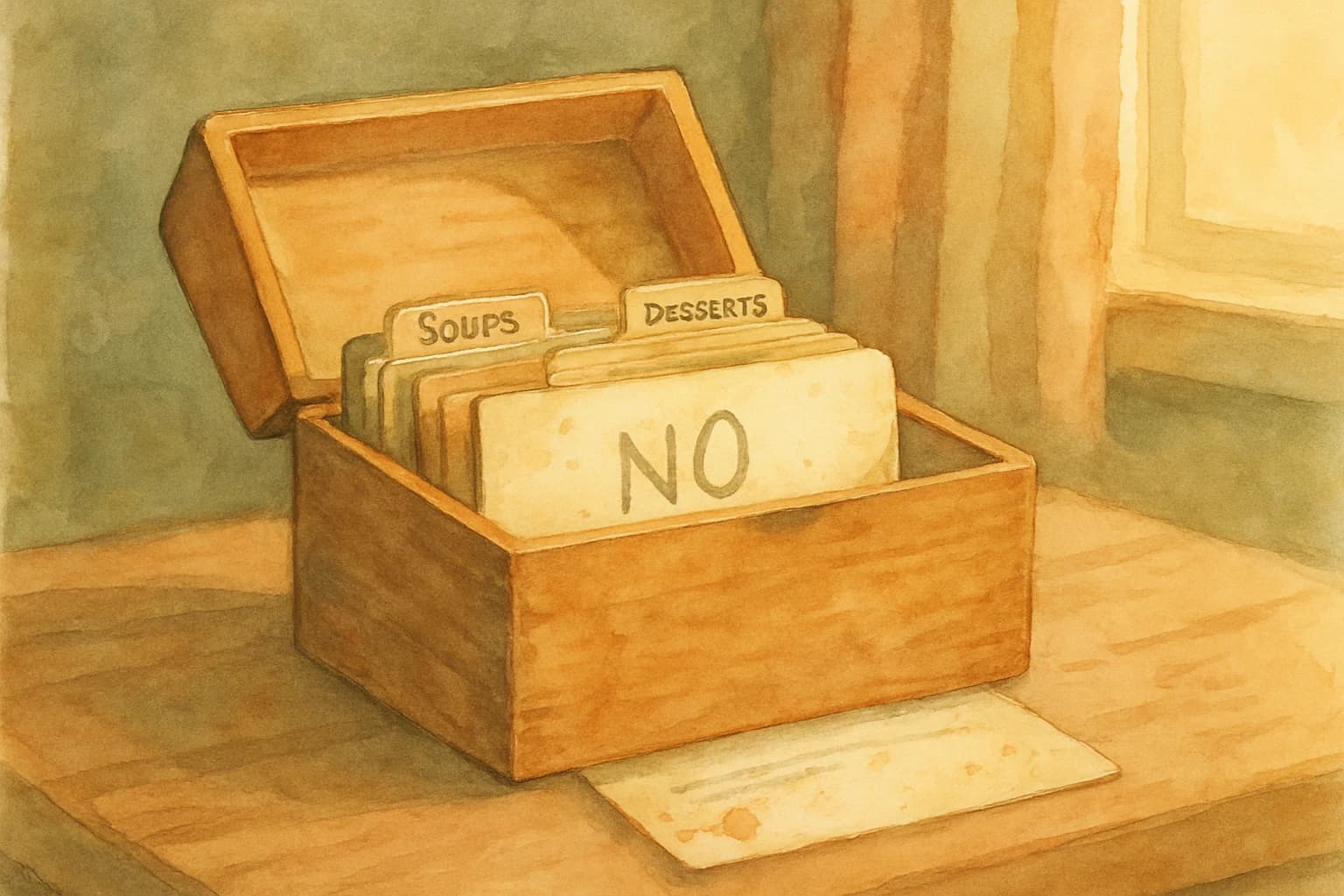
Consider what actually accumulated on a recipe card over forty years of use. The grease spot near the butter measurement, from the day somebody read the card with slick hands and didn't notice. The pencil notation in the margin: reduce sugar 1/4 cup or Judy hates the nutmeg or simply NO beside one of the steps, in handwriting firm enough that you can still read the conviction behind it. The flour dust sealed under the coating of age. The stain at the bottom that might be vanilla or might be coffee and is now neither, just a brown ring with no origin you can trace. The card bent slightly at the corner because it lived in a certain spot in the box and the lid pressed down on it for decades.
A printed recipe from a food blog is instructions. A recipe card is a record.
The box itself
Most households had a recipe box. The wooden kind with the sliding lid, or the metal kind with the hinged top. Some were organized by divider tabs: Soups, Salads, Meats, Desserts, Breads. Others were organized by nothing except what had been added in roughly chronological order, which meant that the oldest recipes were at the back and the most used were at the front, worn and splattered, because they never made it back to their correct section once they'd been pulled.
The cards inside were not uniform. Some were the standard index-card-sized recipe cards with the printed red or blue border from the card shop, the words Recipe For printed at the top with a blank line for the title. Others were torn from magazines and scotch-taped to a card because someone didn't want to lose the page. Others were written on whatever was available -- the back of an envelope, a sheet of notebook paper folded down to card size, an actual index card with the lines showing through the handwriting.
A great many were in multiple handwritings, because the recipe had passed through more than one set of hands. The base recipe in one grandmother's script, the modification in another hand below it, and a third notation from someone who had updated the card after the recipe traveled from one household to another. Three generations of cooks on a four-by-six card.
What the handwriting told you
The handwriting on a recipe card was not incidental. It was the most important information on the card, because it located the recipe in a particular person.
You could identify your grandmother's handwriting at a glance, the same way you could identify her voice on the phone. The loops she made on her lowercase g's. The way she wrote the number 4, open at the top or closed depending on which decade you were looking at. The abbreviations she used: T. for tablespoon, t. for teaspoon, oven @ instead of bake at. The recipes in her hand were hers in a way that the recipes in print were not anybody's.
When a person dies, the recipe cards they wrote become documents of presence. The card is still there. The handwriting is still there. The instructions are in their voice, in their own shorthand, with their own assumptions about what you already know. Season to taste written in your mother's hand carries different information than the same phrase in a cookbook, because you know what she tasted for. You know what her standard for seasoned was.
This is not sentiment. It is evidence. The card is a record of a particular person's method for a particular dish, modified over time by that person's evolving judgment, and the physical object is the only place that record exists.
The missing steps
Recipe cards from the mid-twentieth century are often incomplete by the standards of a contemporary printed recipe. They assume knowledge.
Make a roux. That's the step. Not how long, not what ratio, not what color you're looking for. You were expected to know what a roux was and how to make one, because the person who wrote the card knew you'd grown up in a kitchen and had seen a roux made before you ever read the instructions for it.
Bake until done. This appears on cards with a frequency that seems reckless until you understand that the cook who wrote it had made this dish enough times to know what done looked like. She was not writing for a stranger. She was writing a note to herself or to her daughter, who had also watched this dish come out of the oven many times.
The gaps in the instructions are gaps in what needed to be said. They are the negative space of a life spent cooking, which is to say a life spent teaching someone else to cook by standing next to them while you worked.
The honest counterpoint
The recipe card as a system had real problems, and it's worth being straight about them.
A great many recipes in a great many boxes were bad. Not occasionally -- consistently bad, reproduced faithfully from one generation to the next because nobody questioned whether the thing was actually good, only whether you had made it correctly. Overcooked vegetables written in ink. Underseasoned everything, because the palate that produced the recipe had been shaped by scarcity and a general conviction that food should not make too much of itself. Some of what's in those boxes should stay in those boxes.
The box system also meant things got lost, or went home with the wrong person at the estate sale, or were simply thrown out because nobody recognized what they were looking at. Oral traditions that had survived centuries did not survive a single inattentive afternoon.
And the assumption of shared knowledge that made recipe cards efficient also made them exclusive. If you didn't already know how to cook, the card gave you nothing. You couldn't learn from them the way you can learn from a well-written cookbook or a video of someone actually making the dish. The cards spoke only to people who already knew the language.
Contemporary recipe resources are, in a strictly technical sense, better. They're precise. They're written for strangers. The steps are complete. The timing is tested. You can make a dish you've never seen made before and have it come out right. This is a real improvement.
What the card had that the recipe doesn't
The problem with a technically complete recipe is that it has no past. It was written for no one in particular, which means it belongs to no one.
The grease spot on the card belongs to a certain afternoon. The pencil ghost -- the impression of writing that was erased but left its mark on the card underneath -- is a decision someone made and then reconsidered. The Judy hates the nutmeg is a piece of information about Judy, whoever Judy was, and about the relationship between Judy and the person who wrote the card, and about the dinner table where the nutmeg was discussed enough times that it warranted a permanent note.
None of this is instruction. All of it is evidence.
A recipe printed from a website on copy paper and slid into a sheet protector is clean. It will be clean in forty years. It will be clean in eighty years. It will have none of the information that a recipe card carries about who used it and when and how often and what they thought of the nutmeg.
If you are still cooking from handwritten cards, the instruction is to keep cooking from them. Get them a little more splattered. Write the margin notes. If you improve on the recipe, say so on the card, in pencil, in your own handwriting, because that record is the part that doesn't exist anywhere else.
If you have someone's box and don't know what to do with it, go through the cards. The ones with the most stains and the most margin notes are the ones that mattered most. Cook from those first.
Do you still have a recipe box with handwritten cards? Is there a card you'd never give up? We'd love to hear your story in the comments.
Get a new story every Sunday morning.
One email a week. No spam. Unsubscribe anytime.
If this brought back a memory, you might also like
The Afternoon Permission That Rains Leave Behind
You could walk down the middle of the still-wet sidewalk without explaining yourself, or sit on a porch step that was almost dry for fifteen minutes.