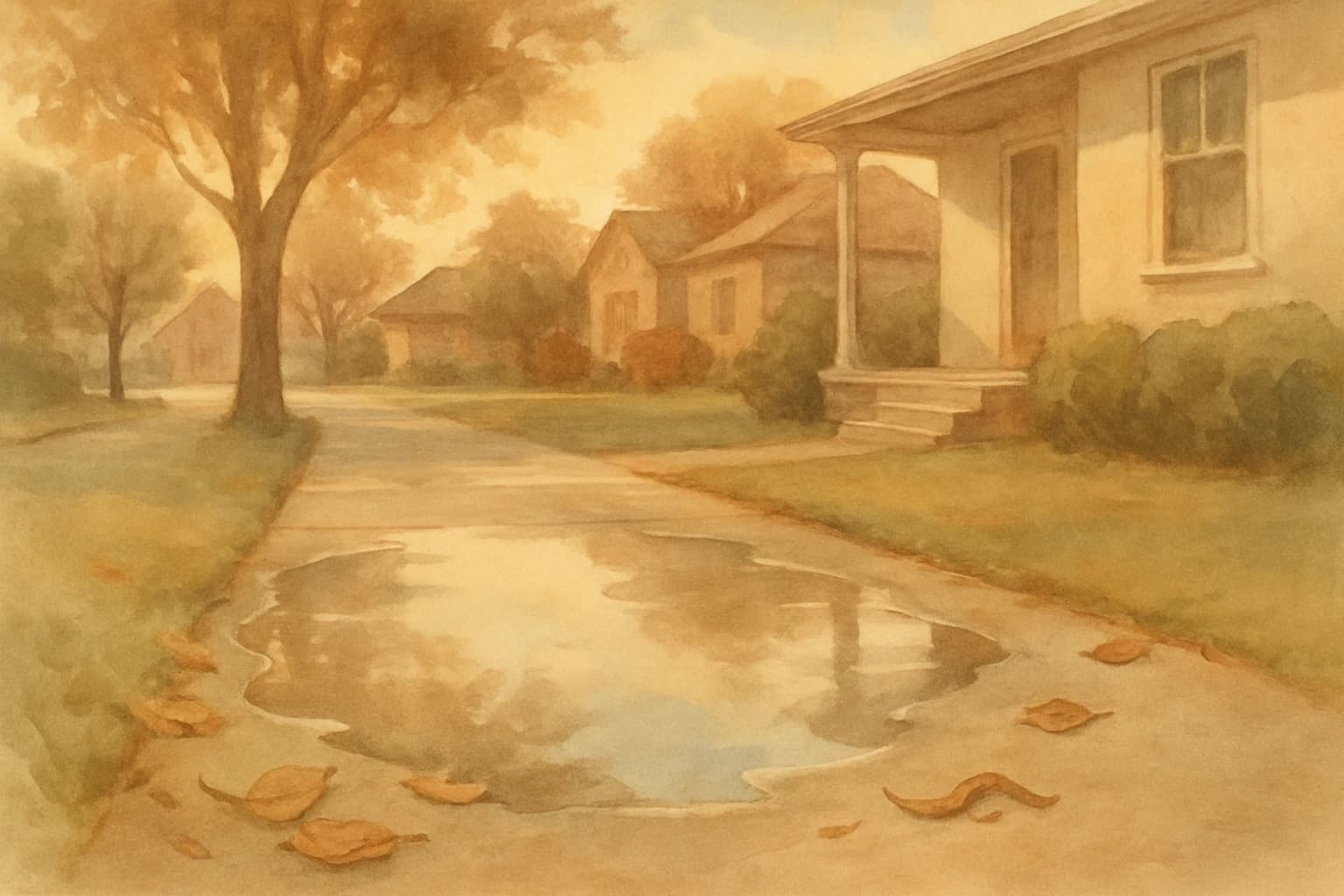
The Afternoon Permission That Rains Leave Behind
There was a particular kind of afternoon that existed only in the twenty-four hours after a hard rain.
The sky was done with it. The sun was either back or at least neutral, not threatening anything further. The streets were wet but not flooded. The gutters still ran, carrying leaves and wrapper scraps and the occasional earthworm down toward the storm drain. The grass was the greenest it had been in a month. The air smelled like pavement and cut grass and something harder to name, something cold underneath the warmth that was returning. The puddles would be gone by evening, or by tomorrow morning at the latest. You knew that. The whole thing was on a clock you didn't need to check.
And for those hours, things were different in a way that's difficult to account for rationally.
It wasn't a holiday
Nothing was cancelled. The day went on normally -- school, or work, or the errands that needed doing. But the post-rain afternoon had a looseness to it that the ordinary Tuesday did not. Something in the air after rain suggests permission. You could walk down the middle of the still-wet sidewalk without explaining yourself. You could take the long way home. You could sit on a porch step that was almost dry and just be there for fifteen minutes without anyone thinking it was strange.
Kids understood this better than adults because kids spent more time outside and because children are better attuned to the rhythms of outdoor permission than grown-ups tend to remain. You went out right after the last thunder, when your mother was still at the window uncertain. You found your friends already in the street. Nobody called the meeting. The meeting just happened, because rain had been released and now the world was clean and cool and available again, and you had a finite amount of time before it dried up and became an ordinary afternoon.
The puddles were the clock. A deep one at the low point of the driveway might last until the next morning. A shallow one on the sidewalk would be gone by four. You watched them without thinking about watching them.
What you did in that window
Bicycles. The pleasure of riding through a puddle at speed and feeling the spray come up off the back tire and hit your calves. Repeated until the puddle became too shallow to spray properly, which usually took four or five passes.
Sticks at the gutter. The race format was simple: you dropped a stick at the top of the flowing gutter water and followed it on foot, cheering or coaching it past obstacles, watching it either make it to the drain or get hung up on a pile of leaves. You could play this for forty-five minutes without noticing.
The dirt patch that had turned to mud at the corner of the yard. Something about wet dirt was irresistible and we don't need to pretend otherwise. Adults who played in mud as children still have a clear memory of what that felt like between the fingers, the way it gave, the particular smell of it. Nobody is nostalgic for having muddy shoes to deal with. They are nostalgic for the mud.
Walking in general. The post-rain neighborhood was the same neighborhood you walked through every day, but the light was different and the surfaces were different and the sound your shoes made was different, and all of it together produced the sensation of being somewhere slightly new without having gone anywhere. This is cheap travel, and children discovered it every time, and most of them didn't know to value it until they were old enough to want it back.
The adult version of the same afternoon
Most adults lost direct contact with it. They were inside when it rained and they drove through what remained of it afterward and they arrived somewhere dry. The post-rain mood happened around them rather than to them.
But some of it leaked through anyway. The drive home with the window down when the rain had just stopped and the air coming through the window was that combination of cool and green. The walk from the parking lot to the office in the morning after an overnight rain, when the pavement was still dark and the trees still dripping. The coffee on the back step after a hard afternoon storm in August, when the temperature had dropped ten degrees in an hour and you could sit outside again.
The adults who held onto it most consistently were the ones who remained in some contact with yard or garden. You noticed the rain differently if you'd been watching the tomatoes struggle through a dry spell. You noticed the puddles differently if you'd been hand-watering. The mood had something to do with relief, and relief required having wanted the rain.
What was actually bad about it
The mud came inside. Every house with children had an entry point -- back door, side door, garage -- that caught the evidence, and the evidence was tracked across whatever floor was nearest. Certain mothers handled this with equanimity and certain mothers did not, and both responses were understandable. The outside world had no interest in your floors. The work of separating the two fell on whoever was responsible for them.
Certain outfits were destroyed. School shoes in particular. The heartbreak of a good pair of leather shoes exposed to repeated puddle contact was a real one, and it recurred. The child who wore good shoes into a puddle at the end of the school day was not a bad child. The puddle was simply there, and physics operated in the usual way.
And the mood itself had a melancholy underneath that was real even for children, more real for adults. The puddles were on a clock. You knew they were going. The afternoon had a quality of temporary that the ordinary Tuesday lacked, and that made it beautiful the way things on a clock are beautiful. But it also meant the afternoon was leaving even while you were still in it. There was a feeling, around five o'clock, when the shallow puddles were already gone and the deep ones were going, when you could feel the ordinary day reassembling itself. Tomorrow would be dry. Tomorrow would be just Tuesday again.
Some children found this sad in a way they couldn't name. Most of them grew up into adults who still find it sad in a way they still can't quite name.
The mood it belonged to
There is a category of experience that depends entirely on being temporary. The mood of a post-rain afternoon is in this category, with the last day of summer and the hour before a long trip and the quality of light in October when you know what's coming. These experiences are not better than ordinary experience. They are different from it, and the difference is that you can feel them while they're happening in a way that ordinary experience doesn't permit.
A dry Tuesday is not going anywhere. You don't feel it arriving or leaving. The post-rain afternoon is different because you know the puddles are drying. You can literally watch them go.
This is, if you think about it, how all of childhood felt from the inside. Everything was temporary and the adults knew it and the children didn't, and then the children grew up and found out. The post-rain afternoon was a concentrated version of that larger fact, available every few weeks through the spring and summer and early fall. The puddles dried. The smell faded. The world went back to normal. And you had been there for it.
That's the whole thing, and it doesn't need a better explanation than that.
Did you have a favorite puddle spot or a particular thing you did in the gutter after rain? Is there a post-rain smell from your childhood that still stops you in your tracks? We'd love to hear your memory of this.
Get a new story every Sunday morning.
One email a week. No spam. Unsubscribe anytime.
If this brought back a memory, you might also like
The Catalog That Lived on the Kitchen Drawer Shelf
Inside twenty-four hours of the new arrival, the old book moved to the toilet rack to be cut into paper furniture and standing toys for the children.